To save content items to your account,
please confirm that you agree to abide by our usage policies.
If this is the first time you use this feature, you will be asked to authorise Cambridge Core to connect with your account.
Find out more about saving content to .
To save content items to your Kindle, first ensure no-reply@cambridge.org
is added to your Approved Personal Document E-mail List under your Personal Document Settings
on the Manage Your Content and Devices page of your Amazon account. Then enter the ‘name’ part
of your Kindle email address below.
Find out more about saving to your Kindle.
Note you can select to save to either the @free.kindle.com or @kindle.com variations.
‘@free.kindle.com’ emails are free but can only be saved to your device when it is connected to wi-fi.
‘@kindle.com’ emails can be delivered even when you are not connected to wi-fi, but note that service fees apply.
“We aren't passengers on Spaceship Earth; we're the crew. We aren't residents of this planet; we're citizens. The difference in both cases is responsibility.”
Astronaut Rusty Schweikart
Some pollution problems are daunting; others less so. This chapter begins with a brief overview as to how we can separate the “trivial” from the serious, whether the risk of a chemical or of a broader environmental problem. The chapter emphasis is on preventing or controlling pollution. Also introduced are the tools that assist us in moving toward sustainable societies. Section I introduces risk assessment concepts, how to evaluate the magnitude of a given risk, chemical risk assessment, and comparative risk assessment. Section II asks, how do we reduce, even eliminate, pollution's risks? Legislation is important. Many laws stress trapping pollutants already produced. The pollution prevention (P2) paradigm, also called source reduction, is more effective. P2 involves changing a process so that it produces less pollution or, sometimes, none at all. Section III introduces industrial ecology (IE), which goes beyond P2. IE examines pollution holistically, searching for means to mesh the human enterprise into the natural environment. Some tools of IE are briefly examined including life-cycle assessment and design for the environment.
SECTION I
Risk assessment
For many years, society has struggled with the problem of how to evaluate environmental risks. Risk assessment tools have been developed over decades, and continue to be refined. ▪ Chemical risk assessment examines the risk of individual chemicals.
“The key to reducing dead zones will be to keep fertilizers on the land and out of the sea. For agricultural systems in general, methods need to be developed that close the nutrient cycle from soil to crop and back to agricultural soil.”
Robert J. Diaz and Rutger Rosenberg
Whether animal, plant, or microbe, water is essential to life. Fish and other water-dwelling creatures are vulnerable to polluted water and there are waters in the world so polluted that life has disappeared. In other locales fish and shellfish survive, but are not safe to eat because their flesh is contaminated. Humans enjoy being around water, but contamination with infectious organisms often makes swimming unsafe, and being near water with noxious odors or scum is not pleasant. Clean water – and enough of it – is vital. ▪ Laws governing water quality existed in the United States before 1972, but no uniform national law existed. Water pollution was not well controlled and some states, eager to keep or attract industry, were negligent. The Clean Water Act (CWA) of 1972 and the Safe Drinking Water Act (SDWA) of 1974 were laws mandating that water pollution be treated uniformly nationwide; they have been updated over the years. ▪ In developed countries, water bodies are generally cleaner. In the United States, some are much cleaner than in 1972, the year that Congress passed the CWA: in 1972, only 30% of US waters were judged fishable and swimmable. By 1994, it was greater than 60%.
Geochemical modeling is a powerful tool for characterizing environmental site contaminations and predicting environmental impacts. This book discusses the application of geochemical models to environmental practice and studies, through the use of numerous case studies of real-world environmental problems, such as acid mine drainage, pit lake chemistry, nuclear waste disposal, and landfill leachates. In each example the authors clearly define the environmental threat in question; explain how geochemical modeling may help solve the problem posed; and advise the reader how to prepare input files for geochemical modeling codes and interpret the results in terms of meeting regulatory requirements. Support material for the book, including input files, is available on the Internet. Environmental Applications of Geochemical Modeling will serve as an advanced textbook for courses in environmental geochemistry, and as an indispensable reference for professional hydrogeologists, geochemists, engineers, and regulators, working within the environmental spheres.
The critical role of trace gases in global atmospheric change makes an improved understanding of these gases imperative. Measurements of the distributions of these gases in space and time provide important information, but the interpretation of this information often involves ill-conditioned model inversions. A variety of techniques have therefore been developed to analyze these problems. Inverse Problems in Atmospheric Constituent Transport is the first book to give comprehensive coverage of work on this topic. The trace gas inversion problem is presented in general terms and the various different approaches are unified by treating the inversion problem as one of statistical estimation. Later chapters demonstrate the application of these methods to studies of carbon dioxide, methane, halocarbons and other gases implicated in global climate change. This book is aimed at graduate students and researchers embarking upon studies of global atmospheric change, biogeochemical cycles and Earth systems science.
Involving a wide range of scientists working on intertidal sediments, this 1997 book is of importance to all environmental scientists. Individual chapters explore the underlying biogeochemical processes controlling the behaviour of carbon, the nutrients nitrogen and phosphorus, and contaminants such as toxic organics, trace metals and artificial radionuclides in intertidal environments. The biogeochemistry of these environments is critical to understanding their ecology and management. All of the chapters include both a comprehensive review and the results of recent research. The authors are active researchers in this diverse and ecologically important environment. This book is mainly for researchers and managers working on these environments, but it will also serve as a valuable advanced undergraduate and graduate reference text in environmental chemistry, environmental science, earth science and oceanography.
This book is about radioactive gases and particles which are dispersed in the environment, either from natural causes, or following nuclear test and accidental emissions. In the first five chapters of this book, the formation and properties of radioactive aerosols are described. Radon, which is of natural origin, is treated at some length, because its contribution to background radiation dose is important. Chapters describe the release of fission products, tritium and plutonium, in bomb tests and nuclear accidents. Particular reference is made to the pathways leading via agricultural products to man. The emphasis then changes to cover experimental aspects of radioactive aerosols. For example, problems in micrometeorology, the study of mass transfer, the mechanics of the human lung and uptake of lead from motor exhausts. Arthur Chamberlain has worked at the Atomic Energy Research Establishment at Harwell for thirty years as the leader of the Aerosol Group. It is a unique exposition and will be used by chemists, geographers, environmentalists as well as governments and other agencies involved in the nuclear debate.
Safeguarding economic prosperity, whilst protecting human health and the environment, is at the forefront of scientific and public interest. This book provides a practical and balanced view on toxicology, control, risk assessment and risk management, addressing the interplay between science and public health policy. This revised edition provides a detailed analysis on chemical and by-product exposure, how they enter the body and the suitability of imposed safety limits. Chapters on dose, with particular emphasis on children and vulnerable subpopulations, reproductive and developmental toxicants and toxicity testing are included. With updated and comprehensive coverage of international developments of risk management and safety, this will have broad appeal to researchers and professionals involved in chemical safety and regulation as well as the general reader interested in environmental pollution and public health.
This book, first published in 2000, provides a comprehensive review of UV radiation effects in the marine environment. A multidisciplinary approach is adopted to discuss all aspects from a physical, chemical and biological perspective. The book begins by describing the attenuation of UV radiation in the atmosphere and sea water, outlining the photochemical reactions involved and highlighting the role that such chemistry can play in influencing the biogeochemical cycling of various elements. The deleterious consequences of such radiation on organisms and strategies adopted to mitigate these harmful repercussions are discussed. The organisms considered range from virus and bacteria through phytoplankton and zooplankton to fish and mammals. The book is aimed at researchers and graduate students in photobiology, photochemistry and environmental science. It will also be useful as a supplementary text for courses in oceanography, climatology and ecology.
Humic substances are highly-abundant organic compounds formed in soils and sediments by the decay of dead plants, microbes and animals. This book focuses on the important binding properties of these compounds which regulate the chemical reactivity and bioavailability of hydrogen and metal ions in the natural environment. Topics covered include the physico-chemical properties of humic matter and interactions of protons and metal cations with weak acids and macromolecules. Experimental laboratory methods are also discussed, together with mathematical modelling. Finally the author looks at how the results of this research can be used to interpret environmental phenomena in soils, waters and sediments. This comprehensive account of cation binding by humic matter is a valuable resource for advanced undergraduate and graduate students, environmental scientists, ecologists and geochemists.
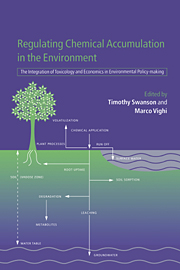
The environment has become exposed to a range of damaging contaminants from a wide variety of sources. Regulation of and legislation against offending parties has frequently been hampered because of the difficulty of co-operation between disparate disciplines in the natural, social and political sciences. This volume forms the conclusion of five years' collaboration between toxicologists, economists and lawyers in the understanding and solution of the problem of accumulative chemicals. As well as a case study of the accumulation of pesticides in groundwater in one particular region (the European Union), the book forms a general study of the value of interdisciplinary approaches in environmental policy making. The volume will be a valuable resource for a broad group of academics and researchers in the area of environmental science and environmental policy. It will also form a useful supplementary reference text for courses in environmental policy, science, economics and toxicology.
Before discussing the formation of the major geological units of the solid Earth, we should review the internal structure of our planet as described by seismic wave studies (Fig. 11.1).
The most important discontinuities observed by seismologists are:
The base of the crust (called the Mohorovičić discontinuity or Moho), 40 km below the continents, but only 5–7 km beneath the oceans.
The base of the lithosphere, on average 80 km below the oceans, and deeper still beneath the continents. Rather than a discontinuity, this is a rather diffuse transition. This is the lower boundary of the rigid tectonic plates. The softer part of the upper mantle underneath the lithosphere is called the asthenosphere. The 410 km discontinuity corresponding to a change in olivine structure (spinel or ringwoodite phase). The 660 km discontinuity corresponding to the transformation of all minerals into perovskite and minor Fe–Mg oxide (magnesio-wüstite). This is the base of the upper mantle.
The mantle–core boundary at about 2900 km. Above this boundary is a seismically abnormal layer some 200 km thick, known as the D”layer.
The outer core–inner core boundary at about 5150 km. The core is composed mostly of metallic iron and nickel. The motion of the fluid outer core generates the Earth's magnetic field.
Plate tectonics is a powerful theory that unifies the geological expression of crustal and upper-mantle geodynamics (Fig. 11.2). The Earth's surface is covered with rigid lithospheric plates that may or may not carry continents.
Before discussing the composition of the different systems of geological interest and the exchanges of matter that make those systems evolve relative to each other, it is worth recalling the principles governing the geochemical differentiation of our planet. These seemingly simple principles conceal what are often daunting complexities. They are: the principle of conservation of mass, elementary and isotopic fractionation induced by phase changes, kinetic fractionation, and radioactivity. In the Introduction, we alluded to the contrast between mixing processes and differentiation processes. We will now look at a number of examples.
Partial melting of the mantle beneath mid-ocean ridges produces basaltic liquids whose chemical composition is different from the ultramafic chemical composition of the source peridotite. This chemical fractionation of elements between the molten fluid and its parent medium can be described by thermodynamic rules. The former makes up the oceanic crust while the latter forms the refractory base of the lithosphere (located in the oceanic plates beneath the crust). It must be kept in mind that there is no chemical or isotopic fractionation in the system unless at least two phases co-exist (solid/liquid, vapor/liquid, mineral A/mineral B, …) each to host a different share of the initial inventory. Conversely, when the oceanic crust and oceanic lithospheric mantle plunge at subduction zones, they begin a long journey within the mantle, where convection folds and stretches them, in much the same way as a baker kneads dough, progressively eliminating the differences that initially existed between the two constituent parts. Convective mixing, or better, stirring, therefore undoes the effect of magmatic differentiation.
Geochemistry utilizes the principles of chemistry to explain the mechanisms regulating the workings – past and present – of the major geological systems such as the Earth's mantle, its crust, its oceans, and its atmosphere. Geochemistry only really came of age as a science in the 1950s, when it was able to provide geologists with the means to analyze chemical elements or to determine the abundances of isotopes, and more significantly still when geologists, chemists, and physicists managed to bridge the chasms of mutual ignorance that had separated their various fields of inquiry. Geochemistry has been at the forefront of advances in a number of widely differing domains. It has made important contributions to our understanding of many terrestrial and planetary processes, such as mantle convection, the formation of planets, the origin of granite and basalt, sedimentation, changes in the Earth's oceans and climates, and the origin of mineral deposits, to mention only a few important issues. And the way geochemists are perceived has also changed substantially over recent decades, from laboratory workers in their white coats providing age measurements for geologists or assays for mining engineers to today's perception of them as scientists in their own right developing their own areas of investigation, testing their own models, and making daily use of the most demanding concepts of chemistry and physics. Moreover, because geochemists generate much of their raw data in the form of chemical or isotopic analyses of rocks and fluids, the development of analytical techniques has become particularly significant within this discipline.
I am specially happy to preface this book. First, because it is always a pleasure to be able to speak well of a friend's work; and Francis Albarède is a friend of long standing! We both embarked on our academic careers at about the same time. After some solid grounding in geology at the University of Montpellier, we were fortunate enough to begin our doctoral research in geochemistry in the 1970s in Professor Claude Allègre's laboratory at the Paris Institut de Physique du Globe, at a time when the discipline was really taking off in France. We also helped set up degree courses in geochemistry at the recently founded University of Paris 7, where we were appointed Assistant Lecturers. Our work together resulted in the publication of a short book in 1976, primarily for students, which quickly sold out and curiously enough was never reprinted! Few universities in those days offered specialist courses in geochemistry.
Times have clearly changed since then! Geochemistry is now taught in most universities and it is needless to recall here the fundamental contribution that this discipline has made to all areas of Earth sciences and cosmochemistry. It is always helpful, though, for students and for non-specialist faculty to have a textbook that provides a review of the basic concepts and the most recent contributions to the discipline. And this is the second reason why I am happy to present this book; because Francis Albarède's work fulfills both these requirements.