To save content items to your account,
please confirm that you agree to abide by our usage policies.
If this is the first time you use this feature, you will be asked to authorise Cambridge Core to connect with your account.
Find out more about saving content to .
To save content items to your Kindle, first ensure no-reply@cambridge.org
is added to your Approved Personal Document E-mail List under your Personal Document Settings
on the Manage Your Content and Devices page of your Amazon account. Then enter the ‘name’ part
of your Kindle email address below.
Find out more about saving to your Kindle.
Note you can select to save to either the @free.kindle.com or @kindle.com variations.
‘@free.kindle.com’ emails are free but can only be saved to your device when it is connected to wi-fi.
‘@kindle.com’ emails can be delivered even when you are not connected to wi-fi, but note that service fees apply.
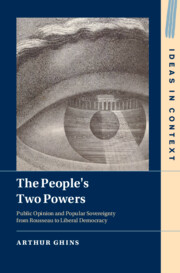
The People's Two Powers revisits the emergence of democracy during the French Revolution and examines how French liberalism evolved in response. By focusing on two concepts often studied separately – public opinion and popular sovereignty – Arthur Ghins uncovers a significant historical shift in the understanding of democracy. Initially tied to the direct exercise of popular sovereignty by Rousseau, Condorcet, the Montagnards, and Bonapartist theorists, democracy was first rejected, then redefined by liberals as rule by public opinion throughout the nineteenth century. This redefinition culminated in the invention of the term 'liberal democracy' in France in the 1860s. Originally conceived in opposition to 'Caesarism' during the Second Empire, the term has an ongoing and important legacy, and was later redeployed by French liberals against shifting adversaries – 'totalitarianism' from the 1930s onward, and 'populism' since the 1980s.
This chapter situates classical education in late antique Gaul in its historical context, positioning the work within the current scholarly debates, and building on recent scholarship on late antique Gaul. Arranged thematically, Chapter 2 considers key developments in the political and military relationships between the western Roman empire, Gallo-Romans and barbarian groups, the prospects and prosperity of Gallo-Roman aristocrats, the increasing dominance of the Church and bishops in daily life, and the vitality and continuity of Gallo-Roman cities. It considers the conditions necessary for classical education to thrive and function and discusses how the structures that fostered education were affected by the political, military, religious, and cultural transformations of fifth-century Gaul.
Chapter 1 opens with a discussion of the foundational importance of classical education in Roman society and politics, and how it served as a basis for both office-holding and elite Roman identity and self-fashioning. The chapter also provides a prosopographical sketch of the teachers and students that are visible in the historical record from the fourth to early sixth centuries in Gaul, showing that identifiable teachers and students begin to fade from the sources from the later-fifth and early-sixth centuries. It discusses the marked shift in the visibility of these individuals, the changing nature of our sources for education throughout the period, the limitations of our sources, and what we can learn from those limitations. The chapter argues that, while classical education largely disappears from the historical record by the early sixth century, this by no means indicates that classical education ceased to exist entirely. Rather, it shows that classical education was no longer a ‘public’ institution as it had been under the Roman empire, and that it did not occupy that specific place within politics, society, and culture that allowed it to be visible and take a prominent place in the technical and literary texts of the period.
In September 1522, Martin Luther published his German translation of the New Testament. Each of the four Gospels opened with a woodcut initial depicting its apostle seated with a codex. Each apostle was identified by his symbol; otherwise, Matthew, Mark (lion), and Luke (ox) might have been taken for humanists in their studies, small cramped spaces with narrow windows. Lucas Cranach depicted Matthew (Figure 28), Mark, and Luke each holding a stylus, seated at a desk writing in the codex; Matthew and Mark are writing at the bottom of the right-hand page of a codex. John (Figure 29) was significantly different: seated not at a desk, not in a study, but outdoors in a landscape framed by a medieval town and mountains. He, too, held a stylus, but on a page already lined past his hand, a specific place in what was so visibly a complete text. Alone among the four, John was depicted in apostolic robes.
This chapter explores gender and sexuality in the earliest Italian lyrics, via the themes of love and religion, positioned through modern creative critics such as Anne Carson and the medieval Italian theologian Thomas Aquinas. Howie shows how reading these poems can become a mutually constitutive interpretative exercise, thereby liberating new meanings. The chapter reads a number of thirteenth- and fourteenth-century poems by authors including Lapo Gianni, Dante Alighieri, Guido Guinizzelli, the so-called Compiuta Donzella, Antonio Pucci, Iacopone da Todi, and the anonymous authors of a Jewish-Italian elegy and Christian nativity poem, exploring how religious and poetic erotic discourse interact with each other. Through examples of the nursing baby Jesus and St Francis’s stigmata, Howie invites us as readers to participate in these accounts of embodied desire. Howie thus explores the materiality of secular, sacred and supernatural bodies, both within the medieval and within contemporary frames of reference.
This chapter uses the first Italian bibliography – Anton Francesco Doni’s La libraria (1550) – to reflect on the process of compiling literary history, and analyse approaches and attitudes to poets and poetry in the Cinquecento. It considers the degree to which current critical interest in the concept of social communities in poetry, especially in relation to Petrarchism, correspond to Cinquecento concerns. Petrarchism is ubiquitous in Doni’s work, and especially visible in praise for Tuscan and eminent models like Pietro Bembo, Iacopo Sannazaro and Vittoria Colonna, but it co-exists alongside poets who overtly reject the Tuscan model and/or satirise the obsessive fascination with a narrow set of rules for writing lyrics. Listing authors by name rather than genre emphasises the extent to which most Cinquecento writers composed in a variety of modes and reveals a more expansive conceptualisation of authorship not yet constrained by Romantic notions of individual genius.
The chapter introduces the intellectual programme for the volume as a whole. The opening analysis explores the category of ‘poetry’ as a form of cultural production pertinent to each of the single topics addressed in the individual chapters, emphasising a consistent concern with questions not only of literary form but also of materiality, performance and transmission, conceptions of authorship, cultural context and more. A second section turns to locating how poetry was discussed during the centuries 1200-1600, beginning with how poets and commentators conceptualised the craft of making poetry itself. This is followed by a review of places where poetry could be found, in its written form and also in performance and discussion around the peninsula. Finally, the chapter discusses how Italian intellectuals and theorists investigated definitions of poetry and its cultural importance, and constructed their own histories of poetry from the viewpoint of their own times.
During the Quattrocento and Cinquecento, the Italian peninsula saw a boom in the production of poetry written in Latin, under the impetus of the humanists’ reframing of the relationship between the contemporary and ancient worlds as new texts, authors, artworks and other evidence about the Roman and Greek worlds came to be known in Western Europe. The chapter evaluates how cultivation of ancient models by Neo-Latin (and Neo-Greek) authors reconfigured relationships to the past, while also taking account of how classical studies and the use of Latin had persisted throughout the Middle Ages. It also discusses how Italian poets writing in Latin used the ancient language to express themselves on key cultural themes and debates of their own day. The chapter stresses the abundance and variety of poetic production in Latin produced in every region of Italy, and in genres covering lyric, pastoral, epic, satire, epigrams and didactic verse.
The performance of poetry across the sixteenth century was often curated and received as a multimedia experience. Verse might be written down by hand or published in print, but this did not exclude its oral performance, as poets and performers read aloud from the text, spoke from memory or combined memory and invention in varying degrees to create improvised or semi-improvised performances. This chapter takes a deliberately long view of the sounds and spectacle of poetry in order to explore the ways in which elements of performance could be shared and contrasted across and between ‘high’ and ‘low’ contexts and settings, from professional street singers aiming to earn a living from their performances of canonical authors in the piazza to elite gatherings of humanists performing erotic verse in private interiors and to women poets singing on stage in a recreation of the classical pastoral tradition.
In the nave of Sant’Apollinare in Classe stands what, by the time it was constructed, had come to be called an altar (Figures 13 and 14). By the sixteenth century, not only the name but also the matter, the form, and the composition had come to provoke thousands of Christians, some to call for their replacement with wooden tables, some to singular physical violence, bringing sledgehammers to smash into rubble what had, for generations, stood in choirs, apses, and chapels and against columns. Even those who left them in place no longer accorded them the same role in the Mass. For Lutherans, they were the surface for the celebration of the Eucharist. For Catholics, they were more, but no longer what they had been. Even the great Jesuit scholar Joseph Braun, whose study of altars remains foundational, defined the altar as “that liturgical instrument [Gerät] on and at which the Eucharist was celebrated.” It was for him a thing. He accorded some six pages in a 756-page volume to the “symbolism” of the altar. For him, meaning was given to the altar by texts: commentators, liturgists including Durand, canon lawyers, popes, and theologians. The altar itself was mute.
The seventh chapter of Invisible Fatherland examines the transformation of August 11 into “Constitution Day.” Introduced in 1921 in the form of a modest celebration, this annual commemoration of President Ebert’s signing of the Weimar Constitution became a key moment of republican self-representation. The chapter traces the expansion of the festivities during the years of relative stability in the mid-1920s and their culmination on the occasion of the constitution’s tenth anniversary in 1929. Despite its growing prominence, the holiday faced strong opposition from representatives of the far-left and far-right, who rejected the republic’s legitimacy. The chapter explores how this obstruction shaped the government’s efforts to establish an inclusive and forward-looking democratic tradition. In tying together different strands of this book, this chapter demonstrates that the republic pioneered an early form of constitutional patriotism, even before the concept was formally articulated.
This chapter emphasises the social dimension of lyric verse, exploring how communities are created between poems, and between the producers and audiences of poetry within anthologies of secular and spiritual verse printed in the second half of the Cinquecento. The chapter charts some of the key stimuli for lyric anthologies, including the commemoration of events, individuals, cities and collective social bodies or institutions such as women poets or academies. It illuminates the ways in which structural arrangements and systems of ordering in the anthologies contribute to the meaning of the poems, the canonisation of poets and publishers, and can provide a space for the discussion of poetics. Changing fashions affect the organisation of lyrics – by author, meter and topic – and the ways in which they cross-pollinate with genres such as dialogues or madrigals. Nonetheless, designing and consuming verse anthologies remains deeply rooted in notions of dialogue and exchange.
The conclusion of Invisible Fatherland reviews the book’s findings with a view to the rise of Nazism and the concept of militant democracy. Juxtaposing the republic’s constitutional patriotism with Nazi ideology, the author highlights the clash between two diametrically opposed “ways of life.” While Nazism was a violent political order that dehumanized marginalized groups, Weimar democracy embraced plural and hybrid identifications. Although the republic ultimately fell to the Nazi threat, the study argues that its constitutional patriotism remains a positive legacy of Western-style democracy. By reframing the narrative, Invisible Fatherland provides a forward-looking, “glass-half-full” perspective on one of history’s most misunderstood democratic experiments