To save content items to your account,
please confirm that you agree to abide by our usage policies.
If this is the first time you use this feature, you will be asked to authorise Cambridge Core to connect with your account.
Find out more about saving content to .
To save content items to your Kindle, first ensure no-reply@cambridge.org
is added to your Approved Personal Document E-mail List under your Personal Document Settings
on the Manage Your Content and Devices page of your Amazon account. Then enter the ‘name’ part
of your Kindle email address below.
Find out more about saving to your Kindle.
Note you can select to save to either the @free.kindle.com or @kindle.com variations.
‘@free.kindle.com’ emails are free but can only be saved to your device when it is connected to wi-fi.
‘@kindle.com’ emails can be delivered even when you are not connected to wi-fi, but note that service fees apply.
Chapter 28 considers Persian influences on Goethe and the reception of his work in modern Iran, the first Persian translations of Goethe having appeared in the 1920s. The chapter emphasises the importance of Middle Eastern sources – especially the Persian poet Hafez – for Goethe’s writing. It then divides the Persian reception of Goethe into three phases. In the first, his status as a world great was the focus; in the second, his writings were portrayed as a reflection of either Persian poetry or Islam, while the recent third phase takes Goethe on his own terms.
This chapter is a meditation on Goethe’s 1826 poem ‘Im ernsten Beinhaus’ (‘On Contemplating Schiller’s Skull’). The chapter moves from poetic form (Dante’s terza rima), to weaving, to wisdom, to mystery. It emphasises the resonance between Goethe’s reflections here and the use of oracle bones for divination in ancient China, and closes with the famous non-closure of Goethe’s poem.
The penultimate chapter is about the reliquary shrine of Saint Charlemagne known as the Karlsschrein. It explores both the political and the religious significance of the monument and how the local convent, the city and the imperial court all participated in its making. By delving deep into the history of Aachen and its surrounding region, the ex-Kingdom of Lotharingia, Sulovsky shows how every single inconsistency was deliberately chosen to make a political or religious point. Thus, where previous scholars only focused on the major figures on the shrine, this book presents dozens of overlooked depictions both of symbolic animals and of humans, including representations of the local community. Moreover, where scholars struggled to find an exact purpose for the shrine’s appearance, the author makes it clear that the papal–imperial negotiations for the introduction of hereditary monarchy served as the foundation for the new vision of the Holy Roman Empire. Indeed, the Karlsschrein is shown to refer not only to Charlemagne’s foundation of the city and church of Aachen, and also of the Empire, but to the centuries-long papal–imperial alliance.
Chapter 13 examines the development of Weimar Classicism, from the impact of Goethe’s own experiences in Italy to his collaboration with Friedrich Schiller. A crucial factor in any classicism, including that of Goethe and Schiller, is the absence of the ancients, and the chapter argues that Weimar Classicism was far from the settled, canonical project for which it is often taken. Rather, it emerged from historical crisis, above all the French Revolution, and it is characterised by internal tensions, between antiquity and modernity, desire and restraint.
Chapter 8 offers an overview of Goethe’s development as a lyric poet, from his earliest innovations to his mature work, and highlights the diversity of his poetic oeuvre. It demonstrates the variety of forms which he adopted, often shaping them decisively in turn. The chapter also positions him in relation to his contemporaries and immediate predecessors, emphasising the influence of Klopstock, and examining Goethe’s participation in certain literary trends, including classical metres and the sonnet form. Finally, it considers Goethe’s relationship to the German Romantics.
Chapter 10 examines Goethe’s development as a writer of prose across the spectrum of forms, beginning with his radicalisation of the epistolary novel through his Werther. It highlights significant influences – from Giovanni Boccaccio to Sophie von La Roche – and, at the same time, emphasises the singularity of his writing. It also reflects on Goethe’s use of deliberate aestheticisation as a means of contending with the instability of human life. The chapter shows that Goethe’s prose writing is both thoroughly embedded in and transcends the many contexts from which it emerged.
Chapter 25 examines Goethe’s Italian journey of 1786–8, the turning point in his life. It was crucial not only in furthering his knowledge of antiquity, which had been the original purpose of his journey, but also for his development as a poet and as a human being. The chapter focuses in particular on his time in Sicily, which Goethe had wanted to visit as a proxy for ancient Greece, but which exerted a lasting influence both on his aesthetics and on his science. For Goethe, Italy represented an organic fusion of nature and culture.
This article reflects on whether and how European communities’ cultural frameworks of seasons are coming to poorly correspond to the climatic conditions they experience, and the implications for how Europe adapts to climatic (and social and environmental) change. It starts from a colder- and drier-than-normal autumn and winter (2023/2024) in Bergen, Norway, and a local researcher’s investigation into why these climatically anomalous seasons were being culturally celebrated as ‘seasonal weather’. He compares studies into the Bergen population’s cultural expectations for weather conditions in each of the four seasons, with the statistical climatic record, and reveals a mismatch. He argues that the four-season framework prominent in Europe poorly describes or anticipates meteorology in Bergen, and that other frameworks could fit better. The article argues that seasonal frameworks continuously evolve with interlinked environmental and social change – from drivers such as climate change, landscape modification, social evolution, and globalization – so that seasonal mismatches are as much about how societies culturally re-conceive of seasons as about physical climate change for instance. This is important because the way European societies divide the year by seasonal expectations affects how they relate to the meteorological conditions they come to face each season.
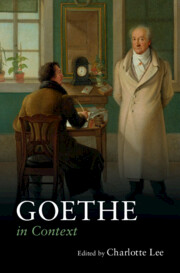
One of the most prolific and versatile writers of all time, Johann Wolfgang Goethe (1749–1832) made an impact that continues to extend far beyond his native Germany. The variety of human questions and experiences treated in his works is arguably without parallel. He also had (for his era) an unusually long life, which spanned the French Revolution, the end of the Holy Roman Empire and subsequent reshaping of the German-speaking world, and the rapid onset of industrial modernity. In thirty-seven short essays, leading international scholars explore Goethe's life and times, his literary works, his activity in the realms of art, philosophy and natural science, his reception of – and indeed by – other cultures, and, finally, the resonance of his work in our time. The aim of this collection is to open as many windows as possible onto Goethe's wide-ranging intellectual and practical activity, and to give a sense of his ongoing importance.
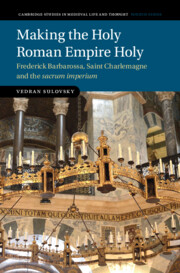
How did the Holy Roman Empire (sacrum imperium) become Holy? In this innovative book, Vedran Sulovsky explores the reign of Frederick Barbarossa (1152–1190), offering a new analysis of the key documents, artworks, and contemporary scholarship used to celebrate and commemorate the imperial regime, especially in the imperial coronation site and Charlemagne's mausoleum, the Marienkirche in Aachen. By dismantling the Kulturkampf-inspired view of the history of the Holy Roman Empire – which was supposedly desacralised in the Investiture Controversy, and then resacralised by Barbarossa and the Reichskanzler Rainald of Dassel – Sulovsky, using new evidence, reveals the personal relations between various courtiers which led to the rise of the new, holy name of the Empire. Annals, chronicles, charters, forgeries, letters, liturgical texts and objects, relics, insignia, seals, architecture and rituals have all been exploited by Sulovsky to piece together a mosaic that shows the true roots of sacrum imperium.
States’ attempts to translate the messy realities of revolutionary-era coerced mobilities into orderly categories of law were met with efforts to define legal statuses by those forcibly removed. Focusing on revolutionary-era political refugees, the chapter shows how governments’ responses led to a proliferation of so-called alien laws across the Americas and Europe and how, despite their seemingly universal and neutral character, these laws reflected the ambiguous status and multiple mobilities during this period. As can be seen in a major legal battle involving a family of refugees of Haitian origin in Jamaica, the regulation of alien status had long-standing ramifications during a period in which the terms of political membership and state belonging were in full transformation across the Atlantic world. Both in mundane administrative interactions and legal battles, refugees engaged with the law and sought to shape and negotiate their status. In doing so, they could also rely on “vernacular” uses in other relevant branches of the law, such as legal distinctions governing freedom and slavery. As with freedom, belonging was not just granted or asserted by state authorities but could also be claimed and recrafted by those who sought it.
Agustín de Iturbide was a renowned Spanish American military man who switched sides and led his Army of the Three Guarantees to declare Mexico’s independence in 1821. Within a year, Iturbide was forced off the throne and sent into exile on the condition that he never return. The ex-Emperor quickly broke his promise and traveled to London, where he spent four months conspiring with politicians, merchants, and bankers. He departed for Mexico in May 1824 and was executed soon after landing. Iturbide’s interregnum in London was significant – for the future direction of the young Mexican state, for political debates about recognition, for relations with Spain and the Holy Alliance, and for those merchants who were interested in Mexican markets and silver. This chapter describes the lived experience of a prominent exile whose fate was closely followed on three continents and offers a case study of the exile experience during the Age of Revolutions.