To save content items to your account,
please confirm that you agree to abide by our usage policies.
If this is the first time you use this feature, you will be asked to authorise Cambridge Core to connect with your account.
Find out more about saving content to .
To save content items to your Kindle, first ensure no-reply@cambridge.org
is added to your Approved Personal Document E-mail List under your Personal Document Settings
on the Manage Your Content and Devices page of your Amazon account. Then enter the ‘name’ part
of your Kindle email address below.
Find out more about saving to your Kindle.
Note you can select to save to either the @free.kindle.com or @kindle.com variations.
‘@free.kindle.com’ emails are free but can only be saved to your device when it is connected to wi-fi.
‘@kindle.com’ emails can be delivered even when you are not connected to wi-fi, but note that service fees apply.
This is the first interdisciplinary work on marriage migration from the former Soviet Union to Reform-era China, almost invariably involving a Slavic bride and a Chinese husband. To understand China better as a destination for marriage migration, Elena Barabantseva delves into the politics and lived experiences of desire, marriage and race, all within China's pursuit of national rejuvenation. She brings together diverse sources, including immigration policies, migration patterns, TV portrayals, life stories, and digital ethnography, to present an embodied analysis of intimate geopolitics. Barabantseva argues that this particularly gendered and racialised model of international marriage is revealing of China's relations within the global world order, in which white femininity embodies the perceived success of Chinese masculinity and nationhood. This title is also available as open access on Cambridge Core.
The Archaeology of the Tibetan Plateau offers a comprehensive survey of past and recent research on the prehistory of the plateau, from its early peopling to the eve of the foundation of the Tibetan Empire in the 7th C. The first English language book-length study of the Tibetan past, it is organized around eight chapters that describe modern and ancient environments, historical speculations about ancient Tibet by mystics, fascists, and contemporary scholars, evidence of the first peoples to live and thrive on the plateau, the arrival of the domesticated plants and animals that transformed the subsistence economy, and the emergence of early forms of status and prestige. The book concludes with a discussion of how the past informs environmental conservation and heritage preservation and explores how archaeological data are used by the Chinese state to create an alternative vision of the Tibetan past at odds with indigenous Tibetan perspectives.
Considering a number of factors such as cross-linguistic influences, saliency and detectability of language cues, language complexity, and the interfaces involved, this book provides a systematic and coherent study of non-native grammars of Chinese. It covers a broad range of language aspects of Chinese as a non-native language, such as syntax, semantics, discourse, and pragmatics, as well as language phenomena specific to Chinese, such as classifiers, sentence final particles, the topic structure, and the ba-construction. It explores the effect on the linguistic structure of Chinese, when it is spoken as a second language by first-language speakers of English, Japanese, Korean, Thai, Spanish, Swedish, Russian and Palestinian Arabic, enabling the reader to understand the learners' mental representations of the underlying systems of the target language. New points of departure are also recommended for further research, making it essential reading for both Chinese language teaching practitioners, and academic researchers of non-native language acquisition.
From the Asvamedha sacrifice to the mounted police, modernist paintings to the medieval cavalry, oceanic trade to urban transport – horses have occupied a prominent position in almost every sphere of human history in South Asia. The Coveted Mount brings a holistic analysis of the compelling history of this human-nonhuman relationship from prehistory to the twenty-first century. The essays in this book unravel the role of the horse in gift exchanges, colonial cities, astrological knowledge, military campaigns, modern art, political culture, religious belief, veterinary sciences, and oceanic commerce. They do so by interpreting colonial records, ancient epics, epigraphic records, medieval coins, temple friezes, modern art, stone and terracotta sculptures, imperial chronicles, equestrian treatises, and wall paintings. In the process, the essays reveal South Asia's historical connections with the world. Overall, this richly illustrated book shows how, when, and why the horse became the coveted mount of South Asian societies
During the Great Leap Forward (1958–62), the collectivization of the Chinese countryside had catastrophic results, but how did this short-lived political experiment reshape urban life? In the first English history of urban collectivization, Fabio Lanza explores the most radical attempts to remake cities under Mao. Examining the universalization of production, the collectivization of life, including communal canteens and nurseries, and women's liberation, intended to transform modern urban life along socialist lines, he shows how many residents, and women in particular, struggled to enact a radical change in their everyday lives. He argues that the daily reality of millions of city residents proved the limitations of an effort that tied emancipation to industrial labor and substituted subjugation to the assembly line for subjugation to the stove, confronting some of the crucial contradictions of the socialist revolution.
Grounded in descriptive linguistics, this textbook introduces the basics of the major subfields of linguistics, as well as the Chinese writing system, for students with no prior linguistic training. It presents the Chinese language from the perspective of both modern linguistics and its longstanding philological legacy, as well as providing historical and sociolinguistic context. Chapters cover phonology and phonetics, morphology, lexicon, lexical semantics, syntax, sign language and braille. Authentic, real-world examples are drawn from Chinese newspapers, websites, and social media to facilitate meaningful linguistic analysis, while other examples contrast English and Chinese to help students grasp key concepts. Students will also benefit from the robust pedagogical approach, which includes learning objectives, guiding questions, checkpoint summaries, discussion questions, exercises, further readings, and bilingual glossaries. Supplementary resources provide answers to exercises, sample course syllabi, links to resources, and recordings of sounds.
In Illiberal Law and Development, Susan H. Whiting advances institutional economic theory with original survey and fieldwork data, addressing two puzzles in Chinese political economy: how economic development has occurred despite insecure property rights and weak rule of law; and how the Chinese state has maintained political control amid unrest. Whiting answers these questions by focusing on the role of illiberal law in reassigning property rights and redirecting grievances. The book reveals that, in the context of technological change, a legal system that facilitates reassignment of land rights to higher-value uses plays an important and under-theorized role in promoting economic development. This system simultaneously represses conflict and asserts legitimacy. Comparing China to post-Glorious Revolution England and contemporary India, Whiting presents an exciting new argument that brings the Chinese case more directly into debates in comparative politics about the role of the state in specifying property rights and maintaining authoritarian rule.
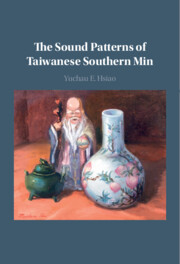
Southern Min – the most commonly spoken variant of Taiwanese – has over 100 million speakers. This book provides the first comprehensive analysis of Taiwanese Southern Min (TSM) phonology, filling a critical gap in linguistic research. It demonstrates how the language's sound patterns have evolved over time, and explores its key phonological and tonal features. Beginning with an overview of the language's phonological system, it progresses to specialized topics, including segmental and tonal mutations, tonal domains, and metrical structures. Grounded in three purpose-built corpora, it integrates empirical data and statistical analyses to illuminate phonological processes and patterns. It also explores rarely addressed topics, including phonological interfaces, the rhythms of poetry and folk ballads, and the iGeneration dialectal variety, providing analytical clarity on complex phenomena. Serving as both a detailed reference for researchers and a supplementary text for phonology and Asian linguistics courses, its illuminating insights will inspire further research into this intricate linguistic system.
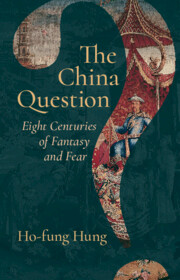
For centuries, Western scholars portrayed China either as a land of superior morality, economy, and governance or as a formidable country of pagans that posed a global threat to Western values. Idealized images of China were used to shame rulers for their incompetence, while China was demonized as an external threat to cover up domestic political failures. In the twentieth century, the geopolitics of global capitalism have facilitated more nuanced perspectives, but the diversifying of knowledge about China is far from complete. In this thought-provoking study, Ho-fung Hung finds that both Western elites and China's authoritarian regime today continue to promote many Orientalist stereotypes to advance their economic interests and political projects. He shows how big-picture historical, social, and economic changes are inextricably linked to fluctuations in the realm of ideas. Only open debate can overcome extremes of fantasy and fear.
Rice is the foremost foodstuff in terms of caloric intake for Southeast Asians and for bolstering national food security, yet writings on the region's politics have overlooked the crucial role rice production programs have played in shaping signal political and development outcomes. In this comparative historical analysis, Jamie S. Davidson argues that the performance legitimacy stemming from the Green Revolution of the 1960s and 1970s, along with the formation of rice import regimes, best explain durable rice protectionism in the Philippines, Malaysia, and Indonesia, the region's large rice importers. Even though the direct effects of the Green Revolution eventually faded, he demonstrates that past policy success can inform policymaking for decades after remarkable sectoral performance subsides. This innovative account and its conclusions will be of interest to scholars and students of development studies, comparative political economy and Asian studies.