To save content items to your account,
please confirm that you agree to abide by our usage policies.
If this is the first time you use this feature, you will be asked to authorise Cambridge Core to connect with your account.
Find out more about saving content to .
To save content items to your Kindle, first ensure no-reply@cambridge.org
is added to your Approved Personal Document E-mail List under your Personal Document Settings
on the Manage Your Content and Devices page of your Amazon account. Then enter the ‘name’ part
of your Kindle email address below.
Find out more about saving to your Kindle.
Note you can select to save to either the @free.kindle.com or @kindle.com variations.
‘@free.kindle.com’ emails are free but can only be saved to your device when it is connected to wi-fi.
‘@kindle.com’ emails can be delivered even when you are not connected to wi-fi, but note that service fees apply.
Discoveries in late 20th-century paleoanthropology strongly support an early Out of Africa model. Well-dated sites like Dmanisi and Atapuerca, at Europe’s eastern and western gateways, have provided significant human remains and evidence of early activity. Subsequent findings have filled chronological gaps, confirming that between 1 and 1.5 million years ago, Europe was a key region for human evolution.
However, while these sites are invaluable for reconstructing early human life, many records remain scarce, fragmented, or found in low-resolution contexts, limiting broad interpretations. Two Iberian Peninsula sites stand out as exceptions: Gran Dolina TD6.2 and Pit-1 at Barranc de la Boella. These sites have yielded high-resolution data, allowing for detailed reconstructions of Early Pleistocene foraging behaviors in Europe. Additionally, lower-resolution but complementary records contribute to assembling the broader evolutionary puzzle.
A million years is an extremely vast amount of time: The time spanning the oldest evidence of our genus, found in the modern northern Ethiopian badlands, presumably documenting its first steps at around 2.8 Ma (Villmoare et al., 2015), to the earliest presence of humans in Europe, currently dated to about 1.5 Ma (Parés et al., 2006; Lozano-Fernández et al., 2015). The oldest uncontroversial archaeological record, dated to 2.6 Ma in Ethiopia (Semaw et al., 1997), which preserves a small (but evolutionarily extraordinary) package of behavioral features comprising the earliest evidence of stone tool use, of animal carcass processing, and meat-eating and, potentially, the earliest traces of central-place foraging by a primate, contains also the oldest evidence of the socio-reproductive behavior of our earliest human ancestors. All of it was labeled for its technological innovation: the Oldowan; the sometimes curated, sometimes expedient transformation of cobbles into flakes and other flaked artifacts, transported and used across substantial parts of the ecosystems to which those hominins adapted.
Teleonomic interpretations of human evolution question whether behaviors like hunting, meat-eating, food sharing, and intra-group cooperation existed in extinct hominins. This perspective assumes H. sapiens as the pinnacle of hominin evolution. However, such behaviors may not require the complex cognitive capacities of modern human brains. Early H. erectus, with brains within the lower range of modern humans and more robust, agile anatomies, may have been highly efficient foragers. Their adaptive success likely stemmed from culturally selected behaviors rather than advanced cognition alone.
The gracilization of H. sapiens may be rooted in shifts in reproductive and social behaviors rather than improvements in foraging strategies. Brain expansion in our species was likely driven by the evolution of complex communication, symbolism, and social interaction, forming the basis of modern human social networks. This alternative perspective generates testable hypotheses regarding behavior preserved in the archaeological record. Under this model, hunting emerges as a byproduct rather than a driver of early human socio-reproductive structures.
The exceptional archaeological record of Olduvai Gorge has been central to interpretations of early human behavior. However, many models rely on a progressive evolutionary framework and homologous analogies from chimpanzees and other primates, despite their anatomical and adaptive divergence from early Homo. The conflicting interpretations that arise highlight the limitations of these models, which often depict hominins with behaviors undocumented in extant mammals. Additionally, the tendency to conceptualize humans as unique has hindered our understanding of early human behavior.
We propose a different approach, focusing on ecological rather than phylogenetic comparisons. By emphasizing shared anatomical, physiological, and behavioral patterns with organisms adapted to similar environments, we provide a novel perspective on early human behavior. This comparative behavioral ecology framework offers a more empirically grounded and testable way to interpret Oldowan sites. It moves beyond anthropocentric assumptions and allows for the formulation of null hypotheses that had not been previously considered. Our approach reframes early human behavior within the broader context of ecological adaptation, providing insights that align early Homo with other similarly adapted organisms rather than isolating them from the rest of the organic world.
Debates on human behavioral evolution have largely focused on African and European records, while Asia’s contribution remains underrepresented. Despite the significance of the Asian Pleistocene fossil record, its behavioral insights have been hindered by limited taphonomic research, restricted dissemination, and shifting academic trends. Many key Chinese archaeofaunal sites, particularly in karstic contexts, contain complex palimpsests that challenge traditional taphonomic methods prone to equifinality.
Advancements in artificial intelligence and computational archaeology now offer new ways to address these challenges. Machine learning classifiers, computer vision through convolutional neural networks, and 3D deep learning architectures enable precise discrimination of bone surface modifications. These techniques refine carnivore agency identification down to the taxon level and provide mathematical certainty in agency attribution, aiding in disentangling complex palimpsests.
This study highlights key Chinese archaeofaunal records, particularly Zhoukoudian, and proposes methodological approaches to improve their resolution. By integrating these cutting-edge techniques, the Asian Pleistocene record can take a more central role in discussions on early human behavioral variability. This research aims to establish a model for applying the “new taphonomy” globally, enhancing our understanding of hominin activities and their ecological contexts.
Narratives on early human behaviour figure prominently in most popular textbooks, scientific papers, conferences, and graphic dissemination venues. When the processual New Archaeology became popular in the 1960s, the main criticism of these narratives was that they uncritically overprinted the present to the past, lacking proper evolutionary perspectives and a scientific method. Nevertheless, paradoxically, the past sixty years of mixed application of middle-range theory and processual approaches have not improved in any meaningful way our understanding of the behavioural component of the early archaeological record, despite the occasional focus on site formation, and the scientific coating provided by the use of different analytical techniques borrowed from physics and chemistry. Archaeologists have been unearthing new sites year after year and extending the archaeological record uncontroversially until at least 2.6 million years ago. We have gained knowledge of the chronologies of these new sites, of their general paleoecological contextualization, and on technical aspects that are not of general interest to the nonprofessional readership; however, in the process, the main disciplinary purpose of the archaeology of early humans has been sent to hibernate. This statement may sound far-fetched and even controversial.
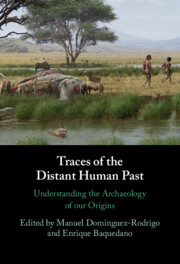
Traces of the Distant Human Past offers a critical examination of early human behavior by challenging traditional narratives and pushing for a more scientific, theoretically informed approach to archaeology. Emphasizing the importance of understanding early humans within their environmental context, the contributors to this volume propose a shift towards theoretical frameworks and ecological perspectives in archaeological research. They highlight the scarcity of well-preserved archaeological sites, making a strong case for high-resolution analyses and the need for new methodologies, including the use of artificial intelligence in taphonomy. By questioning the scientific rigor of current practices and advocating for hypothesis-driven research, this volume not only informs but also inspires a reevaluation of the approaches that can be applied to an interpretation of the evidence for human evolution in the archaeological record. It will be an essential resource for those interested in advancing the field and gaining a deeper understanding of human origins.
The Nightwatchman extends the literature on colonial photography and dress by exploring the representation of black men in South African portraiture. The Nightwatchman: Representing Black Men in Colonial South Africa brings into focus African men in colonial uniforms as a subject of portraiture. While colonial governments co-opted and conscripted Africans into military and policing services, it was after the Zulu defeat of the English in the battle of Isandlwana that a genre of photography developed around images of the 'Zulu warrior' and 'Zulu policeman'.
In this illustrated collection of essays, Hlonipha Mokoena extends the literature on colonial ethnographic photography by creating a narrative of nightwatchman portraiture from the rich archive of images. Although the origins of this genre lay in the representation of 'Fingoes' (amaMfengu) during the frontier wars, she argues that the spectacle of the Zulu male body was inaugurated after the last Zulu king, Cetshwayo, was photographed as a posing subject.
While much research has focused on the African man employed in emasculating labour or as a functionary of settler power, this book shifts debates about how the body moves in history. Placed in uniform, the male subject becomes aestheticised and admired. Mokoena focuses on the sartorial selection processes and co-optation of colonial aesthetic culture that constructed the idea of the Nonqgqayi or nightwatchman as a fully formed photographic presence. The beauty captured in these images upends conceptions of colonial photography as a tool of oppression.
This book examines the buildings used as reception centres for asylum seekers in central Italy to reveal how they reflect the European migration crisis and EU border management. It highlights key debates on the EU border, including their logistical management, the profit-driven industry they create and their colonial implications.
This book examines the impact of coal mining on the lives of former-labour tenant and rural communities in post-apartheid South Africa. No Last Place to Rest: Coal Mining and Dispossession in South Africa is an exploration of the ongoing struggles faced by families whose lives have been upended by the relentless expansion of coal mining operations in the Mpumalanga and KwaZulu-Natal provinces. These regions, burdened with the task of fulfilling the nation's energy needs and boosting the country's economy, witness daily the harsh realities of land dispossession that extend far beyond the mere loss of property.
Dineo Skosana presents a compelling argument that dispossession remains a present-day reality and crisis, contradicting the notion that it is merely a relic of the past in the post-apartheid landscape. She challenges the narrow perspective that measures land loss in material and economic terms only. By considering the impact of grave relocations - a common occurrence in these mining-dominated locales - she demonstrates the profound spiritual anguish and dehumanisation communities endure as their lands are excavated and families lose their sacred connections with their ancestors. Skosana argues that the act of dispossession of both the living and the dead from their land wounds the collective soul of a people, eroding their cultural heritage, collective identity and sense of belonging.
The Empire does not require that its servants love each other, merely that they perform their duty.
In pursuit of the nightwatchman across the centuries and vagaries of colonial and imperial policies, one constant remains – no matter the race and ethnicity of the nightwatchman, the battles over the ‘soldier of fortune’ remained largely pecuniary. As stated in earlier arguments, the assumption in much of the literature on colonial conflict and warfare is that colonial and imperial governments invested and expended large amounts of money and resources in defence of the colonial empire or territory. As the lives of David Stuurman, Andries Botha, Johnny Fingo and now ‘Cash’ demonstrate, the opposite is true. Colonial and imperial governments were loath to spend money on warfare, especially when the prize was a scattered and incoherent conglomeration of colonies and republics. The defence of the colony, it has been demonstrated, rested on the shoulders of black and brown men who were often paid meagre wages and were awarded measly booty to engage in the dangerous and capricious business of war work. Even when there was what could be called a formal declaration of war – the Anglo-Boer War, World War I and World War II – the participation of black and brown men was largely still contingent, informal, and ultimately auxiliary.