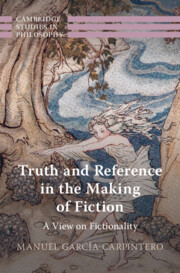
Book contents
- Truth and Reference in the Making of Fiction
- Cambridge Studies in Philosophy
- Truth and Reference in the Making of Fiction
- Copyright page
- Dedication
- Contents
- Acknowledgments
- Introduction
- Chapter 1 Truth in Fiction
- Chapter 2 On the Mood for Fiction
- Chapter 3 Fictional Worlds
- Chapter 4 Fictive Imaginings as Entertainings
- Chapter 5 Desires and Emotions in Response to Fiction
- Chapter 6 Fictional Narrators
- Chapter 7 Interpretation and Ontology
- Chapter 8 Learning from Fiction
- Chapter 9 Fictional Characters and Fictional Reference
- References
- Index
Chapter 1 - Truth in Fiction
Published online by Cambridge University Press: aN Invalid Date NaN

Book contents
- Truth and Reference in the Making of Fiction
- Cambridge Studies in Philosophy
- Truth and Reference in the Making of Fiction
- Copyright page
- Dedication
- Contents
- Acknowledgments
- Introduction
- Chapter 1 Truth in Fiction
- Chapter 2 On the Mood for Fiction
- Chapter 3 Fictional Worlds
- Chapter 4 Fictive Imaginings as Entertainings
- Chapter 5 Desires and Emotions in Response to Fiction
- Chapter 6 Fictional Narrators
- Chapter 7 Interpretation and Ontology
- Chapter 8 Learning from Fiction
- Chapter 9 Fictional Characters and Fictional Reference
- References
- Index
Summary
The chapter appraises David Lewis’s seminal work on truth in fiction. This will allow us to make an important distinction between three uses of fictive discourse, including the one that Lewis’s work focuses on: discourse characterizing the content of fictions. The chapter examines variations of standard criticisms of Lewis’s account, aiming to show that, if developed as Lewis suggests in his 1983 “Postscript A,” his proposals on the topic are – as Hanley puts it – as good as it gets. Thus elaborated, Lewis’s account can resist these objections, and it offers a better picture of fictional discourse than recent resurrections of other classic works of the 1970s by Kripke, van Inwagen, and Searle. The turn that Lewis suggests, and which the chapter recommends, draws on the remaining outstanding contribution from that time, that of Walton, which is to be examined in Chapter 3.
Information
- Type
- Chapter
- Information
- Truth and Reference in the Making of FictionA View on Fictionality, pp. 14 - 34Publisher: Cambridge University PressPrint publication year: 2026
Accessibility standard: Unknown
Why this information is here
This section outlines the accessibility features of this content - including support for screen readers, full keyboard navigation and high-contrast display options. This may not be relevant for you.Accessibility Information
Accessibility compliance for the PDF of this book is currently unknown
and may be updated in the future.