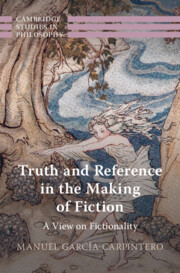
Book contents
- Truth and Reference in the Making of Fiction
- Cambridge Studies in Philosophy
- Truth and Reference in the Making of Fiction
- Copyright page
- Dedication
- Contents
- Acknowledgments
- Introduction
- Chapter 1 Truth in Fiction
- Chapter 2 On the Mood for Fiction
- Chapter 3 Fictional Worlds
- Chapter 4 Fictive Imaginings as Entertainings
- Chapter 5 Desires and Emotions in Response to Fiction
- Chapter 6 Fictional Narrators
- Chapter 7 Interpretation and Ontology
- Chapter 8 Learning from Fiction
- Chapter 9 Fictional Characters and Fictional Reference
- References
- Index
Chapter 9 - Fictional Characters and Fictional Reference
Published online by Cambridge University Press: 18 December 2025

Book contents
- Truth and Reference in the Making of Fiction
- Cambridge Studies in Philosophy
- Truth and Reference in the Making of Fiction
- Copyright page
- Dedication
- Contents
- Acknowledgments
- Introduction
- Chapter 1 Truth in Fiction
- Chapter 2 On the Mood for Fiction
- Chapter 3 Fictional Worlds
- Chapter 4 Fictive Imaginings as Entertainings
- Chapter 5 Desires and Emotions in Response to Fiction
- Chapter 6 Fictional Narrators
- Chapter 7 Interpretation and Ontology
- Chapter 8 Learning from Fiction
- Chapter 9 Fictional Characters and Fictional Reference
- References
- Index
Summary
Fictional discourse is, primarily, discourse that is used to produce literary fictions; but there is also the ‘metafictional’ discourse used to talk about fictions, i.e., to report their contents or other features. On a traditional view articulated by Searle, primary fictional discourse doesn’t have any specific semantics; sentences there just have the semantics that they would have in their standard uses. Fiction-makers convey their fictions by pretending to use sentences in their standard ways without doing so, and without giving them a specific, dedicated representational point with a semantics of its own. This Mere Pretense view is less popular nowadays than it used to be. A question the now more popular alternative Dedicated Representation view raises is: What is the contribution of intuitively empty names to such a dedicated semantics? Many supporters of the traditional Mere Pretense view, including Searle, argue that, in the metafictional uses to which they grant a semantics, apparently empty names are not in fact empty; rather, they each refer to some more or less exotic entity. Some of those who grant a dedicated semantics to primary fictional discourse, like Salmon and others, extend this realist view to it. This chapter aims to uphold considerations that have already been raised by irrealists against these proposals, by highlighting their counterintuitive features and explaining in our theoretical setting why they are bad.
Information
- Type
- Chapter
- Information
- Truth and Reference in the Making of FictionA View on Fictionality, pp. 182 - 196Publisher: Cambridge University PressPrint publication year: 2026
Accessibility standard: Unknown
Why this information is here
This section outlines the accessibility features of this content - including support for screen readers, full keyboard navigation and high-contrast display options. This may not be relevant for you.Accessibility Information
Accessibility compliance for the PDF of this book is currently unknown
and may be updated in the future.