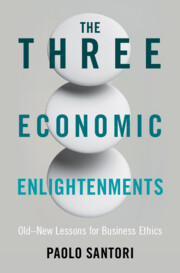
The Three Economic Enlightenments

-
Select format
-
- Publisher:
- Cambridge University Press
- Publication date:
- 04 November 2025
- 13 November 2025
- ISBN:
- 9781009620925
- 9781009620949
- 9781009620918
- Dimensions:
- (229 x 152 mm)
- Weight & Pages:
- 0.447kg, 204 Pages
- Dimensions:
- (229 x 152 mm)
- Weight & Pages:
- 0.303kg, 204 Pages
You may already have access via personal or institutional login
Show more authors 
You may already have access via personal or institutional login
Book description
When people wonder about the appropriate course of action in a given situation, they are already engaging in moral reasoning. This also applies to the field of business, where an understanding of ethics could help businesspeople and market participants make morally informed decisions. This book aims to enlarge the body of ethical theories available in Business Ethics by illustrating three moral principles relevant to economic agents based on the ideas of Immanuel Kant, Antonio Genovesi, and Adam Smith. All three authors were prominent figures in the eighteenth-century European Enlightenment movement and have much to teach us about the origins of modern economics. Additionally, the book provides specific examples relating to contemporary business situations, focusing on the ethical challenges posed by incomplete contracts. Overall, this book demonstrates that the historical evolution of economic and philosophical concepts remains pertinent to current dialogues in Business Ethics.
Reviews
‘With clarity, originality, and philosophical depth, Paolo Santori offers a much-needed contribution to business ethics. By bringing together Smith, Genovesi, and Kant, The Three Economic Enlightenments unveils a compelling vision of markets grounded in justice, cooperation, and moral imagination.’
Vittorio Pelligra - Professor of Economics, University of Cagliari
‘Paolo Santori offers a highly original take on business ethics, grounded in the work of three 18th century writers who thought seriously about the ethics of market exchange. Wisely steering clear of grand moral schemes, Santori draws out the implications of their ideas for concrete issues in business ethics. The reader will find insightful discussions of Smith’s ‘invisible hand’, Genovesi’s ‘civil economy’ of mutual assistance, and Kant’s idea of a moral duty to honour the spirit of incomplete contracts.’
Robert Sugden - Professor of Economics, University of East Anglia
‘This book is a timely plea for us to desist from moral bickering and see if we can have a sensible discussion about what sort of society we want to live in. The book is informative, perceptive and gracefully written. Paolo Santori outlines the three basic moral principles (mutual assistance, honouring the spirit of beneficial contracts, self-interest) of the three economic enlightenments proposed by Genovesi, Kant and Smith, in relation to the traditional triad of virtue ethics, deontology, consequentialism. The aim is to show the relevance of these principles for modern issues in Business Ethics and, in particular, for tackling the ever-increasing ethical dilemmas in present-day global economic affairs. In the final chapter, the author speaks of the urgency to move towards a fourth economic enlightenment, capable of expanding the framework of the three economic enlightenments of the past. This is something highly original and a major contribution to the revival of thinking in business ethics. A must-read for anyone interested in the wealth and health of nations.’
Stefano Zamagni - University of Bologna and Johns Hopkins University SAIS Europe
Contents
Contents
Metrics
Altmetric attention score
Full text views
Full text views helpTotal number of HTML views: 0
Total number of PDF views: 0 *
 Loading metrics...
* Views captured on Cambridge Core between #date#. This data will be updated every 24 hours.
Usage data cannot currently be displayed.
Accessibility standard: Unknown
Why this information is here
This section outlines the accessibility features of this content - including support for screen readers, full keyboard navigation and high-contrast display options. This may not be relevant for you.
Accessibility Information
Accessibility compliance for the PDF of this book is currently unknown and may be updated in the future.