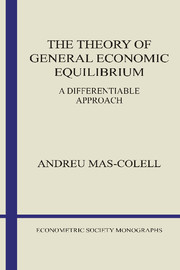
Introduction
Published online by Cambridge University Press: 05 January 2013

Summary
Until the end of World War II mathematical economics was almost synonymous with the application of differential calculus to economics. It was on the strength of this technique that the mathematical approach to economics was initiated by Cournot (1838) and that the theory of general economic equilibrium was created by Walras (1874) and Pareto (1909). Hicks's Value and Capital (1939) and Samuelson's Foundations of Economic Analysis (1947) represent the culmination of this classical era.
After World War II general equilibrium theory advanced gradually toward the center of economics, but the process was accompanied by a dramatic change of techniques: an almost complete replacement of the calculus by convexity theory and topology. In the fundamental books of the modern tradition, such as Debreu's Theory of Value (1959), Arrow and Harm's General Competitive Analysis (1971), Scarf's Computation of Equilibrium Prices (1982), and Hildenbrand's Core and Equilibria of a Large Economy (1974), derivatives either are entirely absent or play, at most, a peripheral role.
Why did this change occur? Appealing to the combined impact of Leontief's input-output analysis, Dantzig and Koopmans's linearprogramming, and von Neumann and Morgenstern's theory of games, would be correct but begs the question. Schematizing somewhat (or perhaps a great deal), we could mention two internal weaknesses of the traditional calculus approach that detracted from its rigor and, more importantly, impeded progress.
Information
- Type
- Chapter
- Information
- The Theory of General Economic EquilibriumA Differentiable Approach, pp. 1 - 5Publisher: Cambridge University PressPrint publication year: 1985
Accessibility standard: Unknown
Why this information is here
This section outlines the accessibility features of this content - including support for screen readers, full keyboard navigation and high-contrast display options. This may not be relevant for you.Accessibility Information
Accessibility compliance for the PDF of this book is currently unknown
and may be updated in the future.
- 29
- Cited by