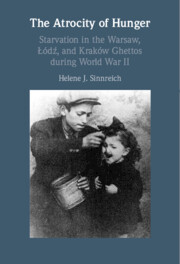

During World War II, the Germans put the Jews in Nazi-occupied Poland into ghettos which restricted their movement and, most crucially for their survival, access to food. The Germans saw the Jews as 'useless eaters,' and denied them sufficient food for survival. The hunger which resulted from this intentional starvation impacted every aspect of Jewish life inside the ghettos. This book focuses on the Jews in the Łódź, Warsaw, and Kraków ghettos as they struggled to survive the deadly Nazi ghetto and, in particular, the genocidal famine conditions. Jews had no control over Nazi food policy but they attempted to survive the deadly conditions of Nazi ghettoization through a range of coping mechanisms and survival strategies. In this book, Helene Sinnreich explores their story, drawing from diaries and first-hand accounts of the victims and survivors. This title is also available as Open Access on Cambridge Core.
Finalist, 2025 Sybil Halpern Milton Memorial Book Prize, German Studies Association
‘This is a wonderful book on an important yet understudied topic. Using the themes of food and hunger to analyze everyday life and experience in three Nazi ghettoes, Sinnreich significantly expands our understanding of Jewish experience during the Holocaust. Her careful attention to the symbolic, social, and material functions of food is especially impressive.’
Alice Weinreb - Loyola University Chicago
‘The book explores how socioeconomic status, gender, and religion affected access to food. It also depicts Jewish communal and individual efforts to smuggle, barter, or steal in order to stave off food deprivation. … Highly recommended.’
M. Rice Source: Choice
‘Sinnreich's book is thoroughly researched and skillfully constructed, effectively achieving her aim to narrate the stories of Jews navigating the challenges of surviving the genocidal famine conditions imposed by Nazi ghettoization. Holocaust scholars, famine researchers, and students exploring everyday life during this period will find Sinnreich's The Atrocity of Hunger to be a valuable resource for deepening our comprehension of Jewish experiences during the Holocaust, particularly in relation to the profound impact of hunger.’
Anne van Mourik Source: H-Net
‘[An] absorbing, horrifying, and - by thinking broadly about what she terms ‘the atrocity of hunger’ - smartly conceived study worth careful attention, not only for students of the Holocaust but also for those working on famines and mass violence in general. … Sinnreich’s attention to nuance and context makes this book such an important addition to our knowledge about the Holocaust, about hunger and starvation, and about life and death in the ghettos.’
Katrin Paehler Source: German Studies Review
‘Through victim-centered history of the Jewish experience during the war, this book is an important contribution to both the history of the Holocaust and the diversity of victims’ experiences as well as to the emerging scholarship on genocidal famine. It provides rich insight into the experience of war and in particular its emotive dimensions. Focusing on daily life in three major ghettos in occupied Poland, Sinnreich explores how Jews as individuals, Jewish households, and Jewish communities exercised agency and coped - with variousresults - with hunger … thorough and captivating.’
Katarzyna Person Source: Yad Vashem
Loading metrics...
* Views captured on Cambridge Core between #date#. This data will be updated every 24 hours.
Usage data cannot currently be displayed.
This section outlines the accessibility features of this content - including support for screen readers, full keyboard navigation and high-contrast display options. This may not be relevant for you.
Accessibility compliance for the PDF of this book is currently unknown and may be updated in the future.
