Book contents
- Frontmatter
- Dedication
- Contents
- Foreword
- Contributors
- Introduction
- 1 It's never too soon to start
- 2 How children begin to read
- 3 Creating young readers: teachers and librarians at work
- 4 The six dimensions of the ‘honeycomb’ model, and its implications for literacy, libraries and literature in New Zealand
- 5 The Summer Reading Challenge in libraries: a continuing success
- 6 Stockport does Book Idol! A case study linking libraries and schools to inspire reading for pleasure
- 7 There and back again: restoring reading to the classroom
- 8 Promoting excellence: shadowing the CILIP Carnegie and Kate Greenaway Medals
- 9 Choice and motivation: local book awards
- 10 The sport of reading
- 11 Adventures in the book trade: libraries and partnerships
- 12 The hard-to-reach reader in the 21st century
- 13 Creative reading and insideadog.com.au
- Index
- Miscellaneous Endmatter
- Miscellaneous Endmatter
- misc-endmatter
1 - It's never too soon to start
Published online by Cambridge University Press: 08 June 2018
Edited by

Book contents
- Frontmatter
- Dedication
- Contents
- Foreword
- Contributors
- Introduction
- 1 It's never too soon to start
- 2 How children begin to read
- 3 Creating young readers: teachers and librarians at work
- 4 The six dimensions of the ‘honeycomb’ model, and its implications for literacy, libraries and literature in New Zealand
- 5 The Summer Reading Challenge in libraries: a continuing success
- 6 Stockport does Book Idol! A case study linking libraries and schools to inspire reading for pleasure
- 7 There and back again: restoring reading to the classroom
- 8 Promoting excellence: shadowing the CILIP Carnegie and Kate Greenaway Medals
- 9 Choice and motivation: local book awards
- 10 The sport of reading
- 11 Adventures in the book trade: libraries and partnerships
- 12 The hard-to-reach reader in the 21st century
- 13 Creative reading and insideadog.com.au
- Index
- Miscellaneous Endmatter
- Miscellaneous Endmatter
- misc-endmatter
Summary
[T]he first step, as you know, is always what matters most, particularly when we are dealing with those who are young and tender. That is the time when they are taking shape and when any impression we choose to make leaves a permanent mark.
(Plato, 428–348 BC)Introduction
We all know, almost by instinct, that reading is a good thing, and we know that it is good to read to young children, but it took the Bookstart project, piloted in 1992, to support this belief with research evidence. This chapter is, in a way, a celebration of reading and a celebration of the joy that parents, carers and children experience when they share stories, pictures and rhymes as a regular and important part of their lives. This is not about teaching children to read – others are dealing with that – but about the practicalities and the benefits of reading to children from the very start of their lives.
Reading is still a good thing and, even as technological advances offer different ways of delivering text and pictures, reading continues to be central in life, and certainly in the process of education. Feeling good about books will make children keen to get to school and to learn to read, and the more they read the better readers they will become. Fast, fluent readers who have developed reading stamina will deal well with the whole curriculum and its reading demands and will grow into adults who have reading as a resource for the whole of their lives. They will be able to use books for pleasure, information, experience, solace, escape and so much more, and their lives will be enriched by their ability to access, by whatever means, the mass of fiction and non-fiction now available.
Pleasurable early reading experiences give babies and young children positive feelings about books. When a baby touches a small bath-book in the water and listens to someone who is known and loved talk about the duck and the story and is lifted from the bath, wrapped in a warm, fluffy towel, and cuddled on a knee and invited to look and listen as a beautiful picture book is read and talked about, they begin to know that books are good things.
Information
- Type
- Chapter
- Information
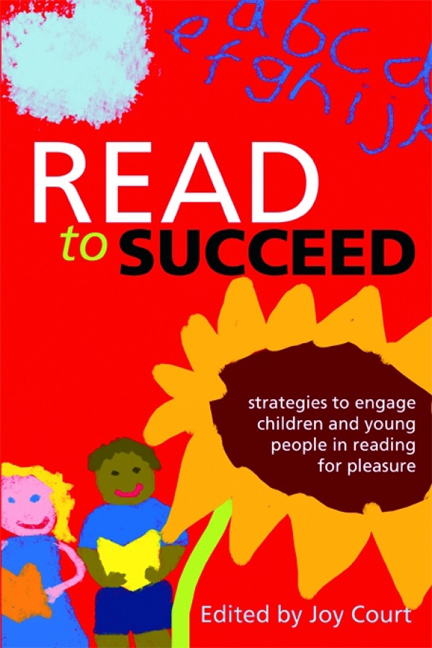
- Read to SucceedStrategies to Engage Children and Young People in Reading for Pleasure, pp. 1 - 14Publisher: FacetPrint publication year: 2011
Accessibility standard: Unknown
Why this information is here
This section outlines the accessibility features of this content - including support for screen readers, full keyboard navigation and high-contrast display options. This may not be relevant for you.Accessibility Information
Accessibility compliance for the PDF of this book is currently unknown
and may be updated in the future.
- 1
- Cited by