Book contents
- Frontmatter
- Dedication
- Contents
- Foreword
- Contributors
- Introduction
- 1 It's never too soon to start
- 2 How children begin to read
- 3 Creating young readers: teachers and librarians at work
- 4 The six dimensions of the ‘honeycomb’ model, and its implications for literacy, libraries and literature in New Zealand
- 5 The Summer Reading Challenge in libraries: a continuing success
- 6 Stockport does Book Idol! A case study linking libraries and schools to inspire reading for pleasure
- 7 There and back again: restoring reading to the classroom
- 8 Promoting excellence: shadowing the CILIP Carnegie and Kate Greenaway Medals
- 9 Choice and motivation: local book awards
- 10 The sport of reading
- 11 Adventures in the book trade: libraries and partnerships
- 12 The hard-to-reach reader in the 21st century
- 13 Creative reading and insideadog.com.au
- Index
- Miscellaneous Endmatter
- Miscellaneous Endmatter
- misc-endmatter
2 - How children begin to read
Published online by Cambridge University Press: 08 June 2018
By
Edited by

Book contents
- Frontmatter
- Dedication
- Contents
- Foreword
- Contributors
- Introduction
- 1 It's never too soon to start
- 2 How children begin to read
- 3 Creating young readers: teachers and librarians at work
- 4 The six dimensions of the ‘honeycomb’ model, and its implications for literacy, libraries and literature in New Zealand
- 5 The Summer Reading Challenge in libraries: a continuing success
- 6 Stockport does Book Idol! A case study linking libraries and schools to inspire reading for pleasure
- 7 There and back again: restoring reading to the classroom
- 8 Promoting excellence: shadowing the CILIP Carnegie and Kate Greenaway Medals
- 9 Choice and motivation: local book awards
- 10 The sport of reading
- 11 Adventures in the book trade: libraries and partnerships
- 12 The hard-to-reach reader in the 21st century
- 13 Creative reading and insideadog.com.au
- Index
- Miscellaneous Endmatter
- Miscellaneous Endmatter
- misc-endmatter
Summary
Introduction
One of the reasons why I work in the area of children's reading development is because my brother experienced substantial difficulties learning to read and write and was finally identified as experiencing developmental dyslexia at the age of 35. I watched him labour over reading activities and struggle with expressing himself in writing, and I watched the impact that these experiences had on his confidence and behaviour during childhood and early adulthood. His difficulties contrasted starkly with my own love of reading and writing, and this made me reflect on why he experienced so much difficulty in something that I saw as effortless and enjoyable.
As a researcher, I know that reading is something that is learned, and therefore is something that must be taught. Children at risk of reading and writing difficulties can be identified early in childhood and supported with the right tuition and resources both at home and at school. My own work has been concerned with these issues of early identification and effective intervention, but there is still a great deal to be learned about effective literacy tuition.
This chapter is intended to offer a simple introduction to the topic of early reading development, which will give an idea of the initial stages that readers go through on their journey towards skilled, fluent reading. This is followed by some more practical material on what skills and activities appear to be important for reading development at different stages of the journey. The aim of this material is to offer the reader some food for thought on how both typically and atypically developing readers can be supported during these early stages of reading through activities that you can try out both as an individual and professionally in the context of library-based sessions with children. Much of this is based on my own research interests and personal views, and what is offered here is a taster of what the research literature has to offer, rather than being an exhaustive overview of everything we currently know on the topic. I hope that you find it as interesting as I do.
Information
- Type
- Chapter
- Information
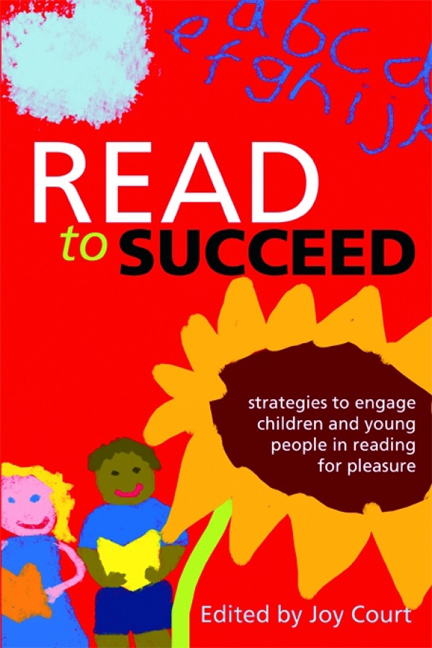
- Read to SucceedStrategies to Engage Children and Young People in Reading for Pleasure, pp. 15 - 28Publisher: FacetPrint publication year: 2011
Accessibility standard: Unknown
Why this information is here
This section outlines the accessibility features of this content - including support for screen readers, full keyboard navigation and high-contrast display options. This may not be relevant for you.Accessibility Information
Accessibility compliance for the PDF of this book is currently unknown
and may be updated in the future.