Book contents
- Frontmatter
- Contents
- Foreword
- Preface
- Acknowledgments
- 1 Synopsis
- Part I Fundamental concepts of finance
- Part II Systems with finite number of degrees of freedom
- Part III Quantum field theory of interest rates models
- A Mathematical background
- Brief glossary of financial terms
- Brief glossary of physics terms
- List of main symbols
- References
- Index
Foreword
Published online by Cambridge University Press: 22 February 2010

Book contents
- Frontmatter
- Contents
- Foreword
- Preface
- Acknowledgments
- 1 Synopsis
- Part I Fundamental concepts of finance
- Part II Systems with finite number of degrees of freedom
- Part III Quantum field theory of interest rates models
- A Mathematical background
- Brief glossary of financial terms
- Brief glossary of physics terms
- List of main symbols
- References
- Index
Summary
After a few early isolated cases in the 1980s, since the mid-1990s hundreds of papers dealing with economics and finance have invaded the physics preprint server xxx.lanl.gov/cond-mat, initially devoted to condensed matter physics, and now covering subjects as different as computer science, biology or probability theory. The flow of paper posted on this server is still increasing – roughly one per day – addressing a range of problems, from financial data analysis to analytical option-pricing methods, agent-based models of financial markets and statistical models of wealth distribution or company growth. Some papers are genuinely beautiful, others are rediscoveries of results known by economists, and unfortunately some are simply crazy.
A natural temptation is to apply the tools one masters to other fields. In the case of physics and finance, this temptation is extremely strong. The sophisticated tools developed in the last 50 years to deal with statistical mechanics and quantum mechanics problems are often of immediate interest in finance and in economics. Perturbation theory, path integral (Feynman–Kac) methods, random matrix and spin-glass theory are useful for option pricing, portfolio optimization and game theoretical situations, and many new insights have followed from such transfers of knowledge.
Within theoretical physics, quantum field theory has a special status and is regarded by many as the queen of disciplines, that has allowed one to unravel the most intimate intricacies of nature, from quantum electrodynamics to critical phenomena. In the present book, Belal Baaquie tells us how these methods can be applied to finance problems, and in particular to the modelling of interest rates.
Information
- Type
- Chapter
- Information
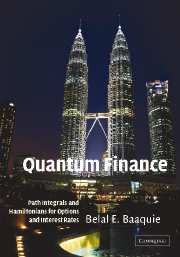
- Quantum FinancePath Integrals and Hamiltonians for Options and Interest Rates, pp. xi - xiiPublisher: Cambridge University PressPrint publication year: 2004
Accessibility standard: Unknown
Why this information is here
This section outlines the accessibility features of this content - including support for screen readers, full keyboard navigation and high-contrast display options. This may not be relevant for you.Accessibility Information
Accessibility compliance for the PDF of this book is currently unknown
and may be updated in the future.