Book contents
- Frontmatter
- Contents
- List of figures, tables, and maps
- Preface
- 1 Introduction: the problem and the people
- 2 Between village and bush
- 3 Body and cosmos
- 4 Sex, procreation, and menstruation
- 5 Male and female
- 6 Kin, clan, and connubium
- 7 Feasts of death (i): de-conception and re-conception
- 8 Feasts of death (ii): the sons of Akaisa
- 9 Tikopia and the Trobriands
- 10 Conclusions: indigenous categories, cultural wholes, and historical process
- Appendixes
- Notes
- Bibliography
- Index
Book contents
- Frontmatter
- Contents
- List of figures, tables, and maps
- Preface
- 1 Introduction: the problem and the people
- 2 Between village and bush
- 3 Body and cosmos
- 4 Sex, procreation, and menstruation
- 5 Male and female
- 6 Kin, clan, and connubium
- 7 Feasts of death (i): de-conception and re-conception
- 8 Feasts of death (ii): the sons of Akaisa
- 9 Tikopia and the Trobriands
- 10 Conclusions: indigenous categories, cultural wholes, and historical process
- Appendixes
- Notes
- Bibliography
- Index
Summary
Not without humor, Bush Mekeo villagers will occasionally retell the story of how their ancestors first came to be known as the “Bush” Mekeo. Whenever a government patrol entered the area during the early years of contact, they say, their ancestors hid in the bush until the strangers had left. Once, upon entering a deserted village, a patrol officer remarked, “Oh, so these must be the ‘Bush’ Mekeo, because they are always hiding in the bush.” Figuratively speaking, the Bush Mekeo have remained “in hiding” ever since. In his classic study, The Melanesians of British New Guinea, Seligmann does refer to “a small but uncertain number of villages on the middle reaches of the Biaru River [which] must be considered to constitute an ethnographical annexe to Mekeo” (1910:311); but now, even after nearly a century of contact with Europeans, the Bush Mekeo are still essentially unknown to the outside world. Although there have been numerous in-depth studies of their closest neighbors, virtually nothing substantively new concerning the Bush Mekeo themselves or their culture has appeared. This book is partially intended to help fill this lacuna and bring the Bush Mekeo, as they would say, “out of hiding.”
This book, however, also attempts something rather more theoretical and, for that reason, potentially fruitful in other ways. In the course of struggling to interpret Bush Mekeo tradition in my own thought as a “total social phenomenon,” a structure of an unanticipated form gradually took shape. It became clear that the meanings of many (if not most) of the cultures diverse contexts are ordered by and through it. That structure, as it turns out, is generally fourfold or quadripartite.
Information
- Type
- Chapter
- Information
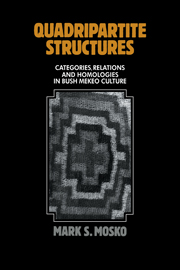
- Quadripartite StructuresCategories, Relations and Homologies in Bush Mekeo Culture, pp. xi - xivPublisher: Cambridge University PressPrint publication year: 1985
Accessibility standard: Unknown
Why this information is here
This section outlines the accessibility features of this content - including support for screen readers, full keyboard navigation and high-contrast display options. This may not be relevant for you.Accessibility Information
Accessibility compliance for the PDF of this book is currently unknown
and may be updated in the future.
- 1
- Cited by