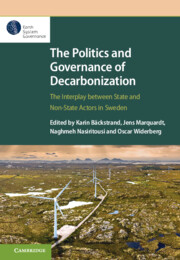
This book examines how, and under what conditions, states – in collaboration with non-state actors – can govern a societal transformation toward large-scale decarbonization in line with the goals of the Paris Agreement. It advances an innovative analytical framework on how the state governs through collaborative climate governance to foster cooperation, deliberation, and consensus between state and non-state actors. The book focuses on Sweden, which aims to become a fossil-free state. The chapters analyze Sweden's progress toward net-zero emissions, its role in international climate governance, and how the COVID-19 pandemic affected climate networks. Providing valuable policy insights for other countries endeavoring to decarbonize, this book is a useful reference for graduate students and researchers in climate governance, political science, and international relations. It is one of a series of publications associated with the Earth System Governance Project. For more publications, see www.cambridge.org/earth-system-governance. This title is also available as Open Access on Cambridge Core.
Loading metrics...
* Views captured on Cambridge Core between #date#. This data will be updated every 24 hours.
Usage data cannot currently be displayed.
This section outlines the accessibility features of this content - including support for screen readers, full keyboard navigation and high-contrast display options. This may not be relevant for you.
Accessibility compliance for the PDF of this book is currently unknown and may be updated in the future.

