
Skip to main content Accessibility help
×
  • Cited by 25
    • Show more authors
    • Open Access
      You have digital access to this book
    • Select format
    • Publisher:
      Cambridge University Press
      Publication date:
      30 May 2024
      06 June 2024
      ISBN:
      9781009053433
      9781316511633
      9781009054362
      Creative Commons:
      Creative Common License - CC Creative Common License - BY Creative Common License - NC Creative Common License - ND
      This content is Open Access and distributed under the terms of the Creative Commons Attribution licence CC-BY-NC-ND 4.0.
      https://creativecommons.org/creativelicenses
      Dimensions:
      (229 x 152 mm)
      Weight & Pages:
      0.77kg, 434 Pages
      Dimensions:
      (228 x 152 mm)
      Weight & Pages:
      0.63kg, 434 Pages
    Open Access
    You have digital access to this book
    Selected: Digital
    View content
    Add to cart View cart Buy from Cambridge.org

    Book description

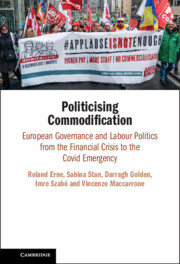
    This book examines the new economic governance (NEG) regime that the EU adopted after 2008. Its novel research design captures the supranational formulation of NEG prescriptions and their uneven deployment across countries (Germany, Italy, Ireland, Romania), policy areas (employment relations, public services), and sectors (transport, water, healthcare). NEG led to a much more vertical mode of EU integration, and its commodification agenda unleashed a plethora of union and social-movement protests, including transnationally. The book presents findings that are crucial for the prospects of European democracy, as labour politics is essential in framing the struggles about the direction of NEG along a commodification–decommodification axis rather than a national–EU axis. To shed light on corresponding processes at EU level, it upscales insights on the historical role that labour movements have played in the development of democracy and welfare states. This title is also available as Open Access on Cambridge Core.

    Awards

    Honorable Mention, 2025 Best Book Prize, University Association for Contemporary European Studies

    Short-listed, 2025 Best Book Prize, University Association for Contemporary European Studies

    Honorable Mention, 2025 Brian Farrell Book Prize, Political Studies Association of Ireland

    Reviews

    ‘An enduring legacy of the financial crisis is the EU’s embrace of a new economic governance regime, which imitates that of private sector multinational corporations. In this path-breaking, multi-dimensional comparative analysis, Erne and colleagues compellingly draw out the consequences for: the changed character of European integration; the (im)balance between the EU’s economic and social dimensions; the EU’s underdeveloped democratic polity; and counter interventions by social movements and organised labour.’

    Paul Marginson - Emeritus Professor of Industrial Relations, University of Warwick

    ‘Politicising Commodification provides original and rigorous analysis of the EU’s new economic governance regime - from 2008 up to and including the Recovery and Resilience Facility - that calls academics and policymakers to pay heed to the democratic challenges that the EU must face.’

    Imelda Maher - Sutherland Professor of European Law, University College Dublin

    ‘This is a trail-blazing book in several different ways. First, it develops a new approach to policy analysis that researchers in many fields will find helpful and worthy of imitation. Second, it presents original research on European Union policy on an unusual and instructive selection of countries and sectors. Finally, and perhaps most important, it shows how the study of policies must include conflict around and protest against those policies, and their impact in turn on the policymakers.’

    Colin Crouch - Emeritus Professor, University of Warwick

    ‘This work analyses the post-2008 transformation of EU interventions on employment relations and public services from horizontal market integration to more vertical country-specific policy prescriptions, surveillance, and enforcement. It documents the extent to which this change offered concrete targets for contentious transnational counter-movements, but also generated obstacles to transnational collective action, setting countries in competition with one another. The book is a bold and fresh attempt to analyse EU politics with a commodification-decommodification approach rather than the usual national-EU axis.’

    Stefano Bartolini - Emeritus Professor, European University Institute

    ‘This is a book for anyone interested in the dynamics of European integration. Rarely have the causes and consequences of ‘functional spill-over’ been so clearly captured and explored.’

    Philippe C. Schmitter - Emeritus Professor, European University Institute

    ‘Politicising Commodification offers fascinating new insights on how the new economic governance in the EU is deployed differentially across member states and various policies. While strengthening integration, it also triggers important political responses by civil society. The book is key to understanding how European policymaking works.’

    Adrienne Heritier - Emeritus Professor, European University Institute

    ‘Based on an original theoretical model and rich empirical evidence, this volume contributes much to our knowledge of the threats for democracy as well as the potential for resistance.’

    Donatella della Porta - Professor of Political Sciences, Scuola Normale Superiore, Firenze

    ‘This book makes sense of the relationships between EU economic governance, policy developments, and political conflict in a unique - comparative, cross-sectoral, and longitudinal - fashion across labour markets, as well as transport, water, and healthcare services. It gathers an impressive sum of cutting-edge qualitative research providing the big picture as well as a critical assessment.’

    Amandine Crespy - Professor of Political Science and EU Studies, Université libre de Bruxelles

    ‘Politicising Commodification constitutes a true tour de force.’

    Martin Seeleib-Kaiser - Professor of Comparative Public Policy, Universität Tübingen

    ‘This is rich and ambitious book will be of interest to EU policy scholars across disciplines.’

    Gráinne de Búrca - Professor of Law, European University Institute

    ‘This is an impressively detailed study of the EU’s new economic governance regime, which has imposed neoliberal prescriptions to some extent by stealth, as exemplified in four countries and three sectors. The authors offer a nuanced assessment of the possibilities for resistance.’

    Richard Hyman - Emeritus Professor of Industrial Relations, London School of Economics and Political Science

    ‘This major research monograph charts the post-2008 shift from market-driven horizontal European integration to a political mode of vertical integration. As the authors make clear, it is trade unions and social movements that are in a key position to challenge the overarching commodification script. A must read for everyone interested in shifting Europe towards a union of social justice!’

    Andreas Bieler - Professor of Political Economy, University of Nottingham

    ‘This book offers an empirically rich, methodologically innovative, and theoretically sophisticated analysis of the EU’s shift to its new economic governance regime after the financial crisis of 2008 and its political and social consequences.’

    Elke Heins - Senior Lecturer in Social Policy, University of Edinburgh

    ‘This book is an essential contribution to the debate on EU governance, its relationship to labour politics, and the future of democratic governance in Europe.’

    Paul Copeland - Professor of Public Policy, Queen Mary University of London

    ‘The book offers a fascinating analysis of the profound institutional shifts during the euro crisis. In their detailed, meticulous, and broadly based analysis, the authors demonstrate that the EU continues to pursue a market-liberal agenda even after the euro crisis, implementing it with the help of vertical intervention mechanisms. … It makes an important contribution to the debate on the future and democratization of the EU by not only presenting a detailed analysis of the NEG regime but also developing new conceptual tools for understanding the dynamics of European governance.’

    Felix Syrovatka Source: Politische Vierteljahresschrift

    Refine List

    Actions for selected content:

    Select all | Deselect all
    • View selected items
    • Export citations
    • Download PDF (zip)
    • Save to Kindle
    • Save to Dropbox
    • Save to Google Drive

    Save Search

    You can save your searches here and later view and run them again in "My saved searches".

    Please provide a title, maximum of 40 characters.
    ×

    Contents

    Full book PDF
    • Politicising Commodification
      pp i-ii
    • Copyright page
      pp iv-iv
    • Contents
      pp v-vi
    • Figure and Tables
      pp vii-viii
    • Tables in the Online Appendix
      pp ix-x
    • Authors
      pp xi-xii
    • Acknowledgements
      pp xiii-xvi
    • Abbreviations
      pp xvii-xxii
    • 1 - Introduction
      pp 1-10
    • Part I - Analytical Framework
      pp 11-92
    • 2 - European Economic Governance and Labour Politics
      pp 13-36
    • 3 - A Paradigm Shift in Understanding EU Integration and Labour Politics
      pp 37-52
    • 4 - How to Assess the Policy Orientation of the EU’s NEG Prescriptions?
      pp 53-72
    • 5 - Contextualising the EU’s NEG Prescriptions and Research Design
      pp 73-92
    • Part II - EU Economic Governance in Two Policy Areas
      pp 93-164
    • 6 - EU Governance of Employment Relations and Its Discontents
      pp 95-131
    • 7 - EU Governance of Public Services and Its Discontents
      pp 132-164
    • Part III - EU Economic Governance in Three Sectors
      pp 165-266
    • 8 - EU Governance of Transport Services and Its Discontents
      pp 167-203
    • 9 - EU Governance of Water Services and Its Discontents
      pp 204-230
    • 10 - EU Governance of Healthcare and Its Discontents
      pp 231-266
    • Part IV - Comparative Analysis and Post-Pandemic Developments
      pp 267-358
    • 11 - Labour Politics and the EU’s NEG Prescriptions across Areas and Sectors
      pp 269-306
    • 12 - The EU’s Shift to a Post-Covid NEG Regime
      pp 307-322
    • 13 - The Policy Orientation of the EU’s Post-Covid NEG Regime and Its Discontents
      pp 323-352
    • 14 - Conclusion
      pp 353-358
    • Glossary
      pp 359-362
    • References
      pp 363-392
    • Index
      pp 393-412

    Metrics

    Altmetric attention score

    Full text views

    Total number of HTML views: 0
    Total number of PDF views: 0 *
    Loading metrics...

    Book summary page views

    Total views: 0 *
    Loading metrics...

    * Views captured on Cambridge Core between #date#. This data will be updated every 24 hours.

    Usage data cannot currently be displayed.

    Accessibility standard: Unknown

    Why this information is here

    This section outlines the accessibility features of this content - including support for screen readers, full keyboard navigation and high-contrast display options. This may not be relevant for you.

    Accessibility Information

    Accessibility compliance for the PDF of this book is currently unknown and may be updated in the future.
