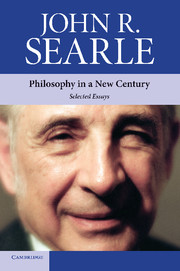
Book contents
- Frontmatter
- Contents
- Original place of publication of the essays
- Introduction
- 1 Philosophy in a new century
- 2 Social ontology: some basic principles (with a new addendum by the author)
- 3 The Turing Test: fifty-five years later
- 4 Twenty-one years in the Chinese Room
- 5 Is the brain a digital computer?
- 6 The phenomenological illusion
- 7 The self as a problem in philosophy and neurobiology
- 8 Why I am not a property dualist
- 9 Fact and value, “is” and “ought,” and reasons for action
- 10 The unity of the proposition
- Name index
- Subject index
- References
7 - The self as a problem in philosophy and neurobiology
Published online by Cambridge University Press: 05 June 2012

Book contents
- Frontmatter
- Contents
- Original place of publication of the essays
- Introduction
- 1 Philosophy in a new century
- 2 Social ontology: some basic principles (with a new addendum by the author)
- 3 The Turing Test: fifty-five years later
- 4 Twenty-one years in the Chinese Room
- 5 Is the brain a digital computer?
- 6 The phenomenological illusion
- 7 The self as a problem in philosophy and neurobiology
- 8 Why I am not a property dualist
- 9 Fact and value, “is” and “ought,” and reasons for action
- 10 The unity of the proposition
- Name index
- Subject index
- References
Summary
THE PHILOSOPHICAL PROBLEM OF THE SELF
There are a large number of different problems concerning the self in psychology, neurobiology, philosophy, and other disciplines. I have the impression that many of the problems of the self studied in neurobiology concern various forms of pathology – defects in the integrity, coherence, or functioning of the self. I will have nothing to say about these pathologies because I know next to nothing about them. I will only mention those pathologies, such as the split-brain patients, that are directly relevant to the philosophical problems of the self.
In philosophy, the traditional problem of the self is the problem of personal identity. Indeed, in the standard Encyclopedia of Philosophy, (Edwards, 1967) the entry “self” just says “see personal identity.” The problem of personal identity is the problem of stating the criteria by which we identify someone as the same person through changes. Thus, for example, the problem of personal identity arises in such a question as, What fact about me, here and now, makes me the same person as the person who bore my name and lived in my house twenty years ago? There are a number of criteria of personal identity and they do not always yield the same result. I will get to these shortly.
Information
- Type
- Chapter
- Information
- Philosophy in a New CenturySelected Essays, pp. 137 - 151Publisher: Cambridge University PressPrint publication year: 2008
References
(ed.) (1967), The Encyclopedia of Philosophy (New York: MacMillan & the Free Press), vol. 7.
(1985), The Social Brain: Discovering the Networks of the Mind (New York: Perseus Group Books).Google Scholar
(1951), A Treatise of Human Nature (Oxford: Oxford University Press), Book I, Part Ⅲ, Section Ⅵ: Of Personal Identity.Google Scholar
(1997), Critique of Pure Reason, trans. and (Cambridge: Cambridge University Press, 1997).Google Scholar
(1924), An Essay Concerning Human Understanding, ed. (Oxford: Oxford University Press).Google Scholar
Accessibility standard: Unknown
Why this information is here
This section outlines the accessibility features of this content - including support for screen readers, full keyboard navigation and high-contrast display options. This may not be relevant for you.Accessibility Information
Accessibility compliance for the PDF of this book is currently unknown
and may be updated in the future.
- 4
- Cited by