Book contents
- Natural Property Rights
- Natural Property Rights
- Copyright page
- Contents
- Acknowledgments
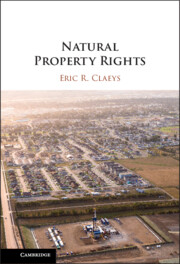
- Note on Cover
- Table of Cases
- Table of Legislative Materials
- Table of Multiple Edition Works
- Part I Foundations
- Part II The Natural Right to Property
- Part III Property Law
- 8 Justifying Ownership
- 9 Limiting Ownership
- 10 Designing Property Rights
- 11 Subdividing Ownership Rights
- Part IV Property in Common Law and Public Law
- Index
- References
10 - Designing Property Rights
from Part III - Property Law
Published online by Cambridge University Press: 17 April 2025

Book contents
- Natural Property Rights
- Natural Property Rights
- Copyright page
- Contents
- Acknowledgments
- Note on Cover
- Table of Cases
- Table of Legislative Materials
- Table of Multiple Edition Works
- Part I Foundations
- Part II The Natural Right to Property
- Part III Property Law
- 8 Justifying Ownership
- 9 Limiting Ownership
- 10 Designing Property Rights
- 11 Subdividing Ownership Rights
- Part IV Property in Common Law and Public Law
- Index
- References
Summary
This chapter studies doctrines that consolidate different real-world resources into different res in property law. Some such doctrines classify individual real-world resources as separate res; others consolidate several resources into single res in law. The requirements for natural property rights, namely, claim communication and productive use, provide satisfying foundations for thing design doctrines. The doctrines are then implemented in law and policy via practical reason. This chapter studies doctrines associated with accession, specification, confusion, fugitive or fugacious minerals, the ad coelum maxim, the ratione soli maxim, and fixtures. This chapter also studies how property in land, water flow, and chattels all limit one another. This chapter also studies contemporary policy debates about hydraulic fracturing, including property in oil and natural gas trapped in shale or “tight” rocks.
Information
- Type
- Chapter
- Information
- Natural Property Rights , pp. 174 - 200Publisher: Cambridge University PressPrint publication year: 2025
References
American Law Institute. 1965. Restatement (Second) of Torts. St Paul, MN: American Law Institute Publishers.Google Scholar
Anderson, Owen L. 2011. “Lord Coke, the Restatement, and Modern Trespass Law,” Texas Journal of Oil, Gas & Energy Law 6 (2): 204–40.Google Scholar
Angell, Joseph K. 1854. A Treatise on the Law of Watercourses with An Appendix Containing Statutes of Flowing and Forms of Declarations, 7th ed., Perkins, J.C. ed. Boston, MA: Little, Brown, and Co., 1877.Google Scholar
Arnold, Earl C. 1922. “The Law of Accession of Personal Property,” Columbia Law Review 22 (2): 103–20.Google Scholar
Blackstone, William. 1765–69/1979. Commentaries on the Laws of England. Chicago, IL: University of Chicago Press.Google Scholar
Brady, Maureen E. 2019. “The Forgotten History of Metes and Bounds,” Yale Law Journal 128 (4): 872–953.Google Scholar
Brown, Ray A. 1955. The Law of Personal Property, 2nd ed. Chicago, IL: Callaghan & Co.Google Scholar
Carroll, Andrea B. 2006. “Examining a Comparative Law Myth: Two Hundred Years of Riparian Misconception,” Tulane Law Review 80 (3): 902–45.Google Scholar
Claeys, Eric R. 2013. “Productive Use in Acquisition, Accession, and Labour Theory,” in Philosophical Foundations of Property Law, Penner, James E. & Smith, Henry E. eds. Oxford: Oxford University Press, pp. 13–46.CrossRefGoogle Scholar
Claeys, Eric R. 2019. “Property, Concepts, and Functions,” Boston College Law Review 60 (1): 1–70.Google Scholar
Coke, Edwardo. 1628/1809. The First Part of the Institutes of the Laws of England, or, A Commentary upon Littleton: Not the Name of the Author Only, but of the Law Itself, 16th ed., Hargrave, Francis, & Butler, Charles eds. London: Luke Hansard & Sons.Google Scholar
Daintith, Terence. 2010. Finders Keepers: How the Law of Capture Shaped the World Oil Economy. Washington, DC: Earthscan.CrossRefGoogle Scholar
Epstein, Richard A. 2015. “Property Rights in Water, Spectrum, and Minerals,” University of Colorado Law Review 86 (2): 389–429.Google Scholar
Hardwicke, Robert E. 1935. “The Rule of Capture and Its Implications as Applied to Oil and Gas,” Texas Law Review 13 (4): 391–422.Google Scholar
Hume, David. 1739. A Treatise of Human Nature, Norton, David F., & Norton, Mary J. eds. New York: Oxford University Press, Inc., 2007.Google Scholar
Kramer, Bruce M. 2014. “Horizontal Drilling and Trespass: A Challenge to the Norms of Property and Tort Law,” Colorado Natural Resources, Energy & Environmental Law Review 25 (2): 291–338.Google Scholar
Lifshitz, Yael R. 2021. “The Geometry of Property,” University of Toronto Law Journal 71 (4): 480–509.Google Scholar
Lindley, Curtis H. 1914/1988. A Treatise on the American Law Relating to Mines and Mineral Lands within the Public Land States and Territories and Governing the Acquisition and Enjoyment of Mining Rights in Lands of the Public Domain, 3rd ed. Littleton, CO: Fred B. Rothman & Co.Google Scholar
Lueck, Dean. 1995. “The Role of First Possession and the Design of the Law,” Journal of Law and Economics 38 (2): 393–436.CrossRefGoogle Scholar
Martin, Patrick H. and Kramer, Bruce M.. 2023. Williams & Meyers, Oil and Gas Law. New York: LexisNexis, Matthew Bender.Google Scholar
Merrill, Thomas W. 2009. “Accession and Original Ownership,” Journal of Legal Analysis 1 (2): 459–510.Google Scholar
Merrill, Thomas W. 2013. “Four Questions about Fracking,” Case Western Law Review 63 (4): 971–93.Google Scholar
Merrill, Thomas W., & Smith, Henry E.. 2023. “Briggs v. Southwestern Energy Production: Hydraulic Fracturing and Subsurface Trespass,” Journal of Tort Law 16 (1): 1–23.CrossRefGoogle Scholar
Michelman, Frank I. 1982. “Ethics, Economics, and the Law of Property,” in NOMOS XXIV: Ethics, Economics, and the Law, Pennock, Ronald J. & Chapman, John W. eds. New York: New York University Press, pp. 3–40.Google Scholar
Newman, Christopher M. 2011. “Transformation in Property and Copyright,” Villanova Law Review 56 (2): 251–325.Google Scholar
Newman, Christopher M. 2018. “Using Things, Defining Property,” in Property Theory: Legal and Political Perspectives, Otsuka, Michael & Penner, James eds. Cambridge: Cambridge University Press, pp. 69–98.CrossRefGoogle Scholar
Ragsdale, Terry D. 1993. “Hydraulic Fracturing: The Stealthy Subsurface Trespass,” Tulsa Law Journal 28 (3): 311–47.Google Scholar
Restatement. See entries under “American Law Institute.”Google Scholar
Schremmer, Joseph A. 2023. “Subsurface Trespass: Private Remedies and Public Regulation,” Nebraska Law Review 101 (4): 1005–79.Google Scholar
Smith, Henry E. 2002. “Exclusion versus Governance: Two Strategies for Delineating Property Rights,” Journal of Legal Studies 31 (2): S453–S487.Google Scholar
Smith, Henry E. 2007. “Intellectual Property as Property: Delineating Entitlements in Information,” Yale Law Journal 116 (8): 1742–822.Google Scholar
Smith, Henry E. 2014. “The Thing about Exclusion,” William and Mary Brigham-Kanner Property Rights Conference Journal 3: 95–123.Google Scholar
United Nations Conference on Trade and Development. 1995. “State Participation and Privatization in the Minerals Sector,” report by the UNCTAD Secretariat. Geneva: United Nations Trade and Development Board.Google Scholar
Accessibility standard: Unknown
Why this information is here
This section outlines the accessibility features of this content - including support for screen readers, full keyboard navigation and high-contrast display options. This may not be relevant for you.Accessibility Information
Accessibility compliance for the PDF of this book is currently unknown
and may be updated in the future.