Book contents
- Frontmatter
- Dedication
- Contents
- Introduction
- 1 The Machiavellian Moment: On Modes of Expansion
- 2 A Taxonomy of Unions
- 3 The European Republic
- 4 The American Moment
- 5 The Necessity of Compromise
- 6 The European Congress as Peace Pact
- 7 Germany, from Staatenbund to Bundesstaat
- 8 The Peace Movement’s Federal Utopianism
- 9 Peace through Union
- 10 Europe’s Anti-Federalist Moment
- 11 The Hour for Union
- 12 Europe’s Federalist Moment
- Conclusion
- Epilogue: The United States of Europe
- Acknowledgements
- Index
This chapter is part of a book that is no longer available to purchase from Cambridge Core
9 - Peace through Union
Book contents
- Frontmatter
- Dedication
- Contents
- Introduction
- 1 The Machiavellian Moment: On Modes of Expansion
- 2 A Taxonomy of Unions
- 3 The European Republic
- 4 The American Moment
- 5 The Necessity of Compromise
- 6 The European Congress as Peace Pact
- 7 Germany, from Staatenbund to Bundesstaat
- 8 The Peace Movement’s Federal Utopianism
- 9 Peace through Union
- 10 Europe’s Anti-Federalist Moment
- 11 The Hour for Union
- 12 Europe’s Federalist Moment
- Conclusion
- Epilogue: The United States of Europe
- Acknowledgements
- Index
Summary
Abstract
The international peace movement's finest hour arrived after the First World War, when its century-old priorities of arbitration, disarmament, and a European or trans-Atlantic league of nations formed the platform for the negotiations at Versailles. The League delivered on part of its promise by uniting the majority of Europe's states in an international peace union. But the exclusion of Germany and Soviet Russia, and the American decision to stay out, would significantly limit its impact. Meanwhile, in Germany, a second postwar federal union was created in the form of the Weimar Republic. It, too, seemed to deliver on a promise first formulated in Frankfurt in 1848 by constructing a democratic constitution that tied the states and the federal centre together.
Keywords: Federal union, peace movement, League of Nations, Weimar
Federal union in the Third Peace Movement
In his address to the Banquet of the 1904 World Peace Congress in Boston, the American philosopher William James warned his audience to be under no illusion about the challenge they faced. Peace may have seemed the reasonable option, but “[r]eason is one of the feeblest of nature's forces,” especially in confrontation with “[o]ur noted enemy (…) the bellicosity of human nature” (James, 845 “The plain truth,” he observed despondently, “is that people want war. (…) War, they feel, is human nature at its uttermost. It is a sacrament. Society would rot, they think, without the mystical blood payment” (846) Warning that “[w]e do ill (…) to talk much of a universal peace or of a general disarmament,” he called on the delegates instead to “organise in every conceivable way the practical machinery for making each successive chance of war abortive. Seize every pretext, no matter how small, for arbitration methods, and multiply the precedents” (847)
For a movement that had spent much of the nineteenth century formulating seemingly impossible aspirations, the switch to a pragmatic approach was clearly a challenge. Still, of its three overarching goals, arbitration was the area where most progress was likely to be achieved.
Information
- Type
- Chapter
- Information
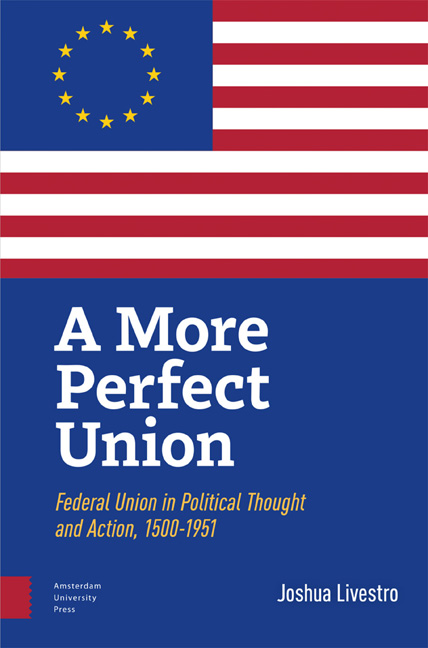
- A More Perfect UnionFederal Union in Political Theory and Practice, 1500-1951, pp. 341 - 398Publisher: Amsterdam University PressPrint publication year: 2024
Accessibility standard: Unknown
Why this information is here
This section outlines the accessibility features of this content - including support for screen readers, full keyboard navigation and high-contrast display options. This may not be relevant for you.Accessibility Information
Accessibility compliance for the PDF of this book is currently unknown
and may be updated in the future.