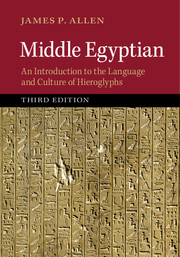
Book contents
- Frontmatter
- Contents
- List of Figures
- Preface
- Lesson 1 Language and Writing
- Lesson 2 Unliteral Signs
- Lesson 3 Multiliteral Signs
- Lesson 4 Nouns
- Lesson 5 Pronouns
- Lesson 6 Adjectives
- Lesson 7 Adjectival and Nominal Sentences
- Lesson 8 Prepositions and Adverbs
- Lesson 9 Numbers
- Lesson 10 Adverbial Sentences
- Lesson 11 Non-verbal Sentences
- Lesson 12 Verbs
- Lesson 13 The Infinitival Forms
- Lesson 14 The Pseudo-verbal Construction
- Lesson 15 The Imperative and Particles
- Lesson 16 The Stative
- Lesson 17 The sdm.n.f
- Lesson 18 The sdm.f
- Lesson 19 The Other Forms of the Suffix Conjugation
- Lesson 20 Adverb Clauses
- Lesson 21 Noun Clauses
- Lesson 22 Relative Clauses
- Lesson 23 The Active Participle
- Lesson 24 The Passive Participle
- Lesson 25 Emphatic Sentences
- Lesson 26 Middle Egyptian Grammar
- Sign List
- Dictionary
- Text References
- Answers to the Exercises
- Index
Lesson 1 - Language and Writing
Published online by Cambridge University Press: 05 July 2014

Book contents
- Frontmatter
- Contents
- List of Figures
- Preface
- Lesson 1 Language and Writing
- Lesson 2 Unliteral Signs
- Lesson 3 Multiliteral Signs
- Lesson 4 Nouns
- Lesson 5 Pronouns
- Lesson 6 Adjectives
- Lesson 7 Adjectival and Nominal Sentences
- Lesson 8 Prepositions and Adverbs
- Lesson 9 Numbers
- Lesson 10 Adverbial Sentences
- Lesson 11 Non-verbal Sentences
- Lesson 12 Verbs
- Lesson 13 The Infinitival Forms
- Lesson 14 The Pseudo-verbal Construction
- Lesson 15 The Imperative and Particles
- Lesson 16 The Stative
- Lesson 17 The sdm.n.f
- Lesson 18 The sdm.f
- Lesson 19 The Other Forms of the Suffix Conjugation
- Lesson 20 Adverb Clauses
- Lesson 21 Noun Clauses
- Lesson 22 Relative Clauses
- Lesson 23 The Active Participle
- Lesson 24 The Passive Participle
- Lesson 25 Emphatic Sentences
- Lesson 26 Middle Egyptian Grammar
- Sign List
- Dictionary
- Text References
- Answers to the Exercises
- Index
Summary
1.1 Family
Egyptian is the ancient and original language of Egypt. It belongs to the language family known as Afro-Asiatic or Hamito-Semitic and is related to both of that family's branches: North African languages such as Berber and Beja, and Asiatic languages such as Arabic, Ethiopic, and Hebrew. Within Afro-Asiatic, Egyptian is unique. It has features that are common to both branches, although it is closer to the African side of the family.
1.2 History
Egyptian first appeared in writing shortly before 3200 BC and remained a living language until the eleventh century AD. Beginning with the Muslim conquest of Egypt in AD 641, Arabic gradually replaced Egyptian as the dominant language in Egypt. Today, the language of Egypt is Arabic. Egyptian is a dead language, like Latin, which can only be studied in writing, though it is still spoken in the rituals of the Coptic (Egyptian Christian) Church.
Throughout its long lifetime, Egyptian underwent tremendous changes. Scholars classify its history into two phases and five major stages:
Earlier Egyptian
1) Old Egyptian is the first stage of the language. Although Egyptian writing is first attested before 3200 BC, these early inscriptions (called Archaic Egyptian) consist only of names and labels. Old Egyptian proper is dated from approximately 2700 BC, when the first extensive texts appeared, until about 2100 BC.
Information
- Type
- Chapter
- Information
- Middle EgyptianAn Introduction to the Language and Culture of Hieroglyphs, pp. 1 - 14Publisher: Cambridge University PressPrint publication year: 2014
Accessibility standard: Unknown
Why this information is here
This section outlines the accessibility features of this content - including support for screen readers, full keyboard navigation and high-contrast display options. This may not be relevant for you.Accessibility Information
Accessibility compliance for the PDF of this book is currently unknown
and may be updated in the future.