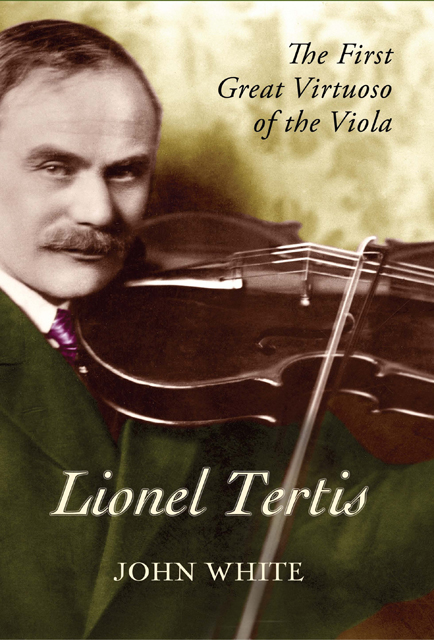
Book contents
- Frontmatter
- Dedication
- Contents
- List of illustrations
- Foreword
- Preface
- Acknowledgements
- 1 The Tertis Family
- 2 Early Career
- 3 The Great War
- 4 The Chamber Music Players
- 5 American Tours
- 6 Return to the Royal Academy of Music
- 7 The Elgar and Walton Concertos
- 8 The BBC Orchestra, Delius, Bax and Vaughan Williams
- 9 A Shock Retirement
- 10 The Richardson–Tertis Viola
- 11 The Second World War
- 12 Promoting the Tertis Model Viola
- 13 Return to America and Eightieth Birthday Celebrations
- 14 Second Marriage and Last Appearance
- 15 TV Profile and Ninetieth Birthday
- 16 Final Years
- Notes
- Appendix 1 Tertis’s Violas
- Appendix 2 The Tertis Model Viola
- Appendix 3 Tertis’s Writings and Talks
- Appendix 4 Tertis’s BBC Appearances
- Appendix 5 Tertis’s Honours
- Appendix 6 Music with Tertis Connections
- Appendix 7 The Tertis Bequest
- Appendix 8 The Tertis Legacy
- Discography
- Bibliography
- Index
Book contents
- Frontmatter
- Dedication
- Contents
- List of illustrations
- Foreword
- Preface
- Acknowledgements
- 1 The Tertis Family
- 2 Early Career
- 3 The Great War
- 4 The Chamber Music Players
- 5 American Tours
- 6 Return to the Royal Academy of Music
- 7 The Elgar and Walton Concertos
- 8 The BBC Orchestra, Delius, Bax and Vaughan Williams
- 9 A Shock Retirement
- 10 The Richardson–Tertis Viola
- 11 The Second World War
- 12 Promoting the Tertis Model Viola
- 13 Return to America and Eightieth Birthday Celebrations
- 14 Second Marriage and Last Appearance
- 15 TV Profile and Ninetieth Birthday
- 16 Final Years
- Notes
- Appendix 1 Tertis’s Violas
- Appendix 2 The Tertis Model Viola
- Appendix 3 Tertis’s Writings and Talks
- Appendix 4 Tertis’s BBC Appearances
- Appendix 5 Tertis’s Honours
- Appendix 6 Music with Tertis Connections
- Appendix 7 The Tertis Bequest
- Appendix 8 The Tertis Legacy
- Discography
- Bibliography
- Index
Summary
The 1939–1945 War – return to the concert platform – the new viola – RCM – Dunhill's Triptych – NYO – BBC
When war was declared on 3 September 1939 all theatres, cinemas and concert halls were closed by order of the Home Office. Even the BBC stopped doing anything at all creative, and filled the airwaves with news, theatre organ music and records, while the BBC Symphony Orchestra was immediately evacuated to Bristol. It can be seen with hindsight that this panic action was all mistaken, but at that stage, during the ‘phoney war’, no one was quite sure what horrors the Germans might perpetrate. The first musician to do anything positive was Myra Hess, who cancelled a lucrative American tour and, acting on an inspired suggestion by her pianist friend Denise Lassimonne, started organizing her famous lunchtime concerts. In common with other museums and galleries, the National Gallery in Trafalgar Square had been emptied of all its treasures, and it was there that the daily concerts began on Tuesday 10 October, with more than 1,000 people crowding in to hear Hess herself launch the series. (The Home Office had given permission for an audience of 200.) For the first few months the Tuesday and Friday programmes were repeated in the late afternoon, but eventually these repeats were discontinued. The concerts had an enormous effect on music-lovers’ morale and Hess always considered them her greatest achievement.
Although Tertis was nearly sixty-three at the outbreak of war, he was desperate to do something to help the cause, and realized very quickly that he would have to go back on his 1937 decision never to play the viola again. Borrowing Eric Coates's Testore, he once again started to practise, with the aim of giving concerts for war charities. He announced his reappearance, and gave two recitals with William Murdoch at the Wigmore Hall on Saturday afternoons 4 and 25 November, using a Richardson viola rather than the Testore. The concert on 4 November was widely reviewed in the press. Ferruccio Bonavia had this to say in the December issue of Musical Times:
There is no viola player like Lionel Tertis, and his return to the concert platform after an absence of two years was not less eventful because it took place not at Queen's but at the Wigmore Hall or because he played Sonatas and not Concertos.
Information
- Type
- Chapter
- Information
- Lionel TertisThe First Great Virtuoso of the Viola, pp. 176 - 208Publisher: Boydell & BrewerPrint publication year: 2006
Accessibility standard: Unknown
Why this information is here
This section outlines the accessibility features of this content - including support for screen readers, full keyboard navigation and high-contrast display options. This may not be relevant for you.Accessibility Information
Accessibility compliance for the PDF of this book is currently unknown
and may be updated in the future.