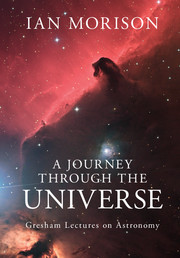
Book contents
- Frontmatter
- Dedication
- Contents
- Preface
- Acknowledgements
- 1 Watchers of the skies
- 2 Our Sun
- 3 Aspects of our Solar System
- 4 The rocky planets
- 5 The hunt for Planet X
- 6 Voyages to the outer planets
- 7 Harbingers of doom
- 8 Impact!
- 9 Four hundred years of the telescope
- 10 The family of stars
- 11 Aging stars
- 12 The search for other worlds
- 13 Are we alone? The search for life beyond the Earth
- 14 Our island Universe
- 15 Wonders of the southern sky
- 16 Proving Einstein right
- 17 Black holes: no need to be afraid
- 18 It’s about time
- 19 Hubble’s heritage: the astronomer and the telescope that honours his name
- 20 The violent Universe
- 21 The invisible Universe: dark matter and dark energy
- 22 The afterglow of creation
- 23 To infinity and beyond: a view of the cosmos
- Index
- Plate section
- References
6 - Voyages to the outer planets
Published online by Cambridge University Press: 05 October 2014

Book contents
- Frontmatter
- Dedication
- Contents
- Preface
- Acknowledgements
- 1 Watchers of the skies
- 2 Our Sun
- 3 Aspects of our Solar System
- 4 The rocky planets
- 5 The hunt for Planet X
- 6 Voyages to the outer planets
- 7 Harbingers of doom
- 8 Impact!
- 9 Four hundred years of the telescope
- 10 The family of stars
- 11 Aging stars
- 12 The search for other worlds
- 13 Are we alone? The search for life beyond the Earth
- 14 Our island Universe
- 15 Wonders of the southern sky
- 16 Proving Einstein right
- 17 Black holes: no need to be afraid
- 18 It’s about time
- 19 Hubble’s heritage: the astronomer and the telescope that honours his name
- 20 The violent Universe
- 21 The invisible Universe: dark matter and dark energy
- 22 The afterglow of creation
- 23 To infinity and beyond: a view of the cosmos
- Index
- Plate section
- References
Summary
Perhaps one of the greatest achievements of unmanned space flight has been the wealth of information – not to say stunning images – that resulted from NASA’s programme to send probes to the outer parts of our Solar System. Here we will chart nearly 40 years of exploration, from the Pioneer and Voyager probes in the seventies and eighties to the Galileo spacecraft’s study of Jupiter around the turn of the millennium and, more recently, the Cassini and Huygens probes studying Saturn and Titan.
Pioneer 10
Pioneer 10 was launched from Cape Canaveral on 2 March 1972 and was the first spacecraft to travel through the asteroid belt to reach Jupiter. It entered the asteroid belt on 15 July that year – a region 280 million km wide and 80 million km thick. The material in the belt encompasses sizes from dust particles up to the major asteroids travelling at speeds up to 72,000 km/h, and scientists had feared Pioneer 10 might not be able to negotiate its way through. It was even thought that the debris within the asteroid belt would be so thick that any spacecraft would be destroyed. Happily, these worries proved to be unfounded.
Information
- Type
- Chapter
- Information
- A Journey through the UniverseGresham Lectures on Astronomy, pp. 70 - 90Publisher: Cambridge University PressPrint publication year: 2014
References
The Planets: A Journey Through the Solar System by (Quercus).
Space Travel Guides: The Outer Planets by (Franklin Watts).
Voyager: Exploring the Outer Planets by (FLT Publications).
Accessibility standard: Unknown
Why this information is here
This section outlines the accessibility features of this content - including support for screen readers, full keyboard navigation and high-contrast display options. This may not be relevant for you.Accessibility Information
Accessibility compliance for the PDF of this book is currently unknown
and may be updated in the future.