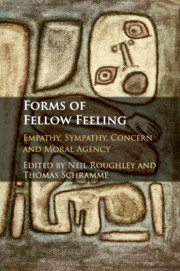
IV - Fellow Feeling and the Development of Prosociality
Published online by Cambridge University Press: 28 December 2017

Summary
A summary is not available for this content so a preview has been provided. Please use the Get access link above for information on how to access this content.
Information
- Type
- Chapter
- Information
- Forms of Fellow FeelingEmpathy, Sympathy, Concern and Moral Agency, pp. 163 - 242Publisher: Cambridge University PressPrint publication year: 2018
References
References
Blair, R. J. R. 1999. Responsiveness to Distress Cues in the Child with Psychopathic Tendencies. Personality and Individual Differences, 27, 135–45.CrossRefGoogle Scholar
Blum, L. A. 1980. Friendship, Altruism and Morality. London: Routledge and Kegan Paul.Google Scholar
Carlo, G.; Mestre, M. V.; McGinley, M. M.; Samper, P.; Tur, A. and Sandman, D. 2012. The Interplay of Emotional Instability, Empathy, and Coping on Prosocial and Aggressive Behaviors. Personality and Individual Differences, 53, 675–80. doi:10.1016/j.paid.2012.05.022CrossRefGoogle Scholar
Davidov, M. and Grusec, J. E. 2006. Untangling the Links of Parental Responsiveness to Distress and Warmth to Child Outcomes. Child Development, 77 (1), 44–58. doi: 10.1111/j.1467-8624.2006.00855.x.Google Scholar
Eisenberg, N. 1986. Altruistic Emotion, Cognition, and Behavior. Hillsdale, N.J: Erlbaum.Google Scholar
Eisenberg, N. and Fabes, R. A. 1990. Empathy: Conceptualization, Assessment, and Relation to Prosocial Behavior. Motivation and Emotion, 14 , 131–49.CrossRefGoogle Scholar
Eisenberg, N. and Lennon, R. 1983. Sex Differences in Empathy and Related Capacities. Psychological Bulletin, 94 (1), 100. doi:10.1037/0033-2909.94.1.100CrossRefGoogle Scholar
Eisenberg, N. and Miller, P. 1987. The Relation of Empathy to Prosocial and Related Behaviors. Psychological Bulletin, 101 , 91–119. doi:10.1037/0033-2909.101.1.91CrossRefGoogle ScholarPubMed
Eisenberg, N. and Okun, M. A. 1996. The Relations of Dispositional Regulation and Emotionality to Elders’ Empathy-Related Responding and Affect while Volunteering. Journal of Personality, 64, 157–83. doi:10.1111/j.1467–6494.1996.tb00818.xCrossRefGoogle ScholarPubMed
Eisenberg, N. and Spinrad, T. L. 2004. Emotion-Related Regulation: Sharpening the Definition. Child Development, 75 , 334–9. doi:10.1111/j.1467-8624.2004.00674.xCrossRefGoogle ScholarPubMed
Eisenberg, N.; Cameron, E.; Tryon, K. and Dodez, R. 1981. Socialization of Prosocial Behavior in the Preschool Classroom. Developmental Psychology, 17, 773–82. doi:10.1037/0012-1649.17.6.773Google Scholar
Eisenberg, N.; Carlo, G.; Murphy, B. and Van Court, P. 1995. Prosocial Development in Late Adolescence: A Longitudinal Study. Child Development, 66, 1179–97. doi:10.2307/1131806CrossRefGoogle ScholarPubMed
Eisenberg, N.; Cumberland, A. and Spinrad, T. L. 1998. Parental Socialization of Emotion. Psychological Inquiry, 9, 241–73. doi:10.1207/s15327965pli0904_1Google ScholarPubMed
Eisenberg, N.; Fabes, R. A.; Bustamante, D.; Mathy, R. M.; Miller, P. and Lindholm, E. 1988. Differentiation of VicariouslyInduced Emotional Reactions in Children. Developmental Psychology, 24, 237–46. doi:10.1037/0012-1649.24.2.237CrossRefGoogle Scholar
Eisenberg, N.; Fabes, R A.; Carlo, G., et al. 1992. The Relations of Maternal Practices and Characteristics to Children’s Vicarious Emotional Responsiveness. Child Development, 63, 583–602. doi:10.2307/1131348CrossRefGoogle ScholarPubMed
Eisenberg, N.; Fabes, R. A.; Miller, P. A., et al. 1989. The Relations of Sympathy and Personal Distress to Prosocial Behavior: A Multimethod Study. Journal of Personality and Social Psychology, 57, 55–66. doi:10.1037/0022-3514.57.1.55CrossRefGoogle ScholarPubMed
Eisenberg, N.; Fabes, R. A.; Miller, P. A.; Shell, C.; Shea, R. and May-Plumlee, T. 1990. Preschoolers’ Vicarious Emotional Responding and Their Situational and Dispositional Prosocial Behavior. Merrill-Palmer Quarterly, 36, 507–29.Google Scholar
Eisenberg, N.; Fabes, R. A. and Murphy, B. C. 1996. Parents’ Reactions to Children’s Negative Emotions: Relations to Children’s Social Competence and Comforting Behavior. Child Development, 67, 2227–47. doi:10.2307/1131620CrossRefGoogle ScholarPubMed
Eisenberg, N.; Fabes, R. A.; Murphy, B. et al. 1994. The Relations of Emotionality and Regulation to Dispositional and Situational Empathy-Related Responding. Journal of Personality and Social Psychology, 66, 776–97. doi:10.1037/0022-3514.66.4.776CrossRefGoogle ScholarPubMed
Eisenberg, N.; Fabes, R. A.; Murphy, B.; Karbon, M.; Smith, M. and Maszk, P. 1996. The Relations of Children’s Dispositional Empathy-Related Responding to Their Emotionality, Regulation, and Social Functioning. Developmental Psychology, 32, 195–209. doi:10.1037/0012-1649.32.2.195CrossRefGoogle Scholar
Eisenberg, N.; Fabes, R. A.; Schaller, M.; Carlo, G. and Miller, P. A. 1991a. The Relations of Parental Characteristics and Practices to Children’s Vicarious Emotional Responding. Child Development, 62, 1393–1408. doi:10.2307/1130814CrossRefGoogle ScholarPubMed
Eisenberg, N.; Fabes, R. A.; Schaller, M.; et al. 1991b. Personality and Socialization Correlates of Vicarious Emotional Responding. Journal of Personality and Social Psychology, 61, 459–70. doi:10.1037/0022-3514.61.3.459CrossRefGoogle ScholarPubMed
Eisenberg, N.; Fabes, R. A.; Shepard, S. A.; Murphy, B. C.; Jones, J. and Guthrie, I. K. 1998. Contemporaneous and Longitudinal Prediction of Children’s Sympathy from Dispositional Regulation and Emotionality. Developmental Psychology, 34, 910–24. doi:10.1037/0012-1649.34.5.910CrossRefGoogle ScholarPubMed
Eisenberg, N.; Fabes, R. A. and Spinrad, T. L. 2006. Prosocial Behavior. In: Eisenberg, N. (vol. ed.) and Damon, W. and Lerner, R. M. (series eds.), Handbook of Child Psychology, 6th edn. New York: Wiley, vol. III: Social, Emotional, and Personality Development, 646–718.Google Scholar
Eisenberg, N.; Guthrie, I. K.; Cumberland, A. et al. 2002. Prosocial Development in Early Adulthood: A Longitudinal Study. Journal of Personality and Social Psychology, 82, 993–1066. doi:10.1037//0022-3514.82.6.993CrossRefGoogle ScholarPubMed
Eisenberg, N.; Guthrie, I. K.; Murphy, B. C.; Shepard, S. A.; Cumberland, A. and Carlo, G. 1999. Consistency and Development of Prosocial Dispositions: A Longitudinal Study. Child Development, 70, 1360–72. doi:10.1111/1467–8624.00100CrossRefGoogle ScholarPubMed
Eisenberg, N.; Hofer, C.; Sulik, M. J. and Liew, J. 2014. The Development of Prosocial Moral Reasoning and a Prosocial Orientation in Young Adulthood: Concurrent and Longitudinal Correlates. Developmental Psychology, 50, 58–70. doi: 10.1037/a0032990CrossRefGoogle Scholar
Eisenberg, N.; Liew, J. and Pidada, S. 2001. The Relations of Parental Emotional Expressivity with the Quality of Indonesian Children’s Social Functioning. Emotion, 1 , 116–36. doi:10.1037/1528-3542.1.2.116CrossRefGoogle ScholarPubMed
Eisenberg, N.; Liew, J. and Pidada, S. 2004. The Longitudinal Relations of Regulation and Emotionality to Quality of Indonesian Children’s Socioemotional Functioning. Developmental Psychology, 40 , 790–804. doi:10.1037/0012-1649.40.5.790CrossRefGoogle ScholarPubMed
Eisenberg, N.; McCreath, H. and Ahn, R. 1988. Vicarious Emotional Responsiveness and Prosocial Behavior: Their Interrelations in Young Children. Personality and Social Psychology Bulletin, 14 , 298–311. doi:10.1177/0146167288142008CrossRefGoogle Scholar
Eisenberg, N.; Michalik, N.; Spinrad, T. L. et al. 2007. Relations of Effortful Control and Impulsivity to Children’s Sympathy: A Longitudinal Study. Cognitive Development, 22, 544–67. doi:10.1016/j.cogdev.2007.08.003CrossRefGoogle ScholarPubMed
Eisenberg, N.; Miller, P. A.; Shell, R.; McNalley, S. and Shea, C. 1991. Prosocial Development in Adolescence: A Longitudinal Study. Developmental Psychology, 27, 849–57. doi:10.1037/0012-1649.27.5.849CrossRefGoogle Scholar
Eisenberg, N.; Schaller, M.; Fabes, R. A. et al. 1988. The Differentiation of Personal Distress and Sympathy in Children and Adults. Developmental Psychology, 24, 766–75. doi:10.1037/0012-1649.24.6.766CrossRefGoogle Scholar
Eisenberg, N.; Shea, C. L.; Carlo, G. and Knight, G. 1991. Empathy-Related Responding and Cognition: A ‘Chicken and the Egg’ Dilemma. In: Kurtines, W. and Gewirtz, J. (eds.), Handbook of Moral Behavior and Development. Hillsdale, NJ: Erlbaum, vol. II: Research, 63–88.Google Scholar
Eisenberg, N.; Spinrad, T. L. and Knafo-Noam, A. 2015. Prosocial Development. In: Lamb, M. (ed.) and Lerner, R. M. (vol. ed.), Handbook of Child Psychology and Developmental Science, 7th edn. New York: Wiley, vol. III: Socioemotional Processes, 610–56.Google Scholar
Eisenberg, N.; VanSchyndel, S. K. and Hofer, C. 2015. The Association of Maternal Socialization in Childhood and Adolescence with Adult Offspring’s Sympathy/Caring. Developmental Psychology, 51, 7–16. doi:10.1037/a0038137CrossRefGoogle Scholar
Eisenberg, N.; VanSchyndel, S. K. and Spinrad, T. L. 2016. Prosocial Motivation: Inferences from an Opaque Body of Work. Child Development, 87(6), 1668–78. doi: 10.1111/cdev.12638CrossRefGoogle Scholar
Eisenberg, N.; Zhou, Q. and Koller, S. 2001. Brazilian Adolescents’ Prosocial Moral Judgment and Behavior: Relations to Sympathy, Perspective Taking, Gender-Role Orientation, and Demographic Characteristics. Child Development, 72, 518–34. doi:10.1111/1467–8624.00294CrossRefGoogle ScholarPubMed
Eisenberg-Berg, N. and Hand, M. 1979. The Relationship of Preschoolers’ Reasoning about Prosocial Moral Conflicts to Prosocial Behavior. Child Development, 50, 356–63. doi:10.2307/1129410CrossRefGoogle Scholar
Fabes, R. A.; Eisenberg, N.; Karbon, M.; Bernzweig, J.; Speer, A. L. and Carlo, G. 1994a. Socialization of Children’s Vicarious Emotional Responding and Prosocial Behavior: Relations with Mothers’ Perceptions of Children’s Emotional Reactivity. Developmental Psychology, 30, 44–55. doi:10.1037/0012-1649.30.1.44CrossRefGoogle Scholar
Fabes, R. A.; Eisenberg, N.; Karbon, M.; Troyer, D. and Switzer, G. 1994b. The Relations of Children’s Emotion Regulation to Their Vicarious Emotional Responses and Comforting Behavior. Child Development, 65, 1678–93. doi:10.2307/1131287CrossRefGoogle Scholar
Feldman, R. 2007. Mother–Infant Synchrony and the Development of Moral Orientation in Childhood and Adolescence: Direct and Indirect Mechanisms of Developmental Continuity. American Journal of Orthopsychiatry, 77, 582–97. doi:10.1037/0002-9432.77.4.582CrossRefGoogle ScholarPubMed
Feshbach, N. D. 1982. Sex Differences in Empathy and Social Behavior in Children. In: Eisenberg, N. (ed.), The Development of Prosocial Behavior. New York: Academic Press, 315–38.Google Scholar
Feshbach, N. D. and Feshbach, S. 1969. The Relationship between Empathy and Aggression in Two Age Groups. Developmental Psychology, 1, 102–7. doi:10.1037/h0027016CrossRefGoogle Scholar
Frick, P.J. 1998. Conduct Disorders and Severe Antisocial Behavior. New York: Plenum.CrossRefGoogle Scholar
Hoffman, M. L. 1987. The Contribution of Empathy to Justice and Moral Judgment. In: Eisenberg, N. and Strayer, J. (eds.), Empathy and Its Development. Cambridge: Cambridge University Press, 47–80.Google Scholar
Hume, D. 1777. Enquiries Concerning the Human Understanding and Concerning the Principles of Morals. Oxford: Clarendon Press, 2nd edn, 1966.CrossRefGoogle Scholar
Jolliffe, D. and Farrington, D. P. 2011. Is Low Empathy Related to Bullying after Controlling for Individual and Social Background Variables? Journal of Adolescence, 34, 59–71. doi:10.1016/j.adolescence.2010.02.001CrossRefGoogle ScholarPubMed
Knafo, A.; Zahn-Waxler, C.; Van Hulle, C.; Robinson, J. L. and Rhee, S. H. 2008. The Developmental Origins of a Disposition toward Empathy: Genetic and Environmental Contributions. Emotion, 8, 737–52. doi:10.1037/a0014179CrossRefGoogle ScholarPubMed
Kohlberg, L. 1981. The Philosophy of Moral Development: Moral Stages and the Idea of Justice. San Francisco, CA: Harper and Row.Google Scholar
Lennon, R.; Eisenberg, N. and Carroll, J. 1983. The Assessment of Empathy in Early Childhood. Journal of Applied Developmental Psychology, 4, 295–302. doi:10.1016/0193-3973(83)90024-2CrossRefGoogle Scholar
Malti, T.; Eisenberg, N.; Kim, H. and Buchmann, M. 2013. Developmental Trajectories of Sympathy, Moral Emotion Attributions, and Moral Reasoning: The Role of Parental Support. Social Development, 22, 773–93. doi: 10.1111/sode.12031CrossRefGoogle Scholar
Mehrabian, A. and Epstein, N. 1972. A Measure of Emotional Empathy. Journal of Personality, 40, 525.CrossRefGoogle ScholarPubMed
Miller, P. A. and Eisenberg, N. 1988. The Relation of Empathy to Aggressive and Externalizing/Antisocial Behavior. Psychological Bulletin, 103, 324–44. doi:10.1037/0033-2909.103.3.324CrossRefGoogle ScholarPubMed
Murphy, B. C.; Shepard, S. A.; Eisenberg, N.; Fabes, R. A. and Guthrie, I. K. 1999. Contemporaneous and Longitudinal Relations of Dispositional Sympathy to Emotionality, Regulation, and Social Functioning. Journal of Early Adolescence, 19, 66–97. doi:10.1177/0272431699019001004CrossRefGoogle Scholar
Okun, M. A.; Shepard, S. A. and Eisenberg, N. 2000. The Relations of Emotionality and Regulation to Dispositional Empathy-Related Responding among Volunteers-in-Training. Personality and Individual Differences, 28, 367–82. doi:10.1016/S0191-8869(99)00107-5CrossRefGoogle Scholar
Padilla-Walker, L. M.; Carlo, G.; Christensen, K. J. and Yorgason, J. B. 2012. Bidirectional Relations between Authoritative Parenting and Adolescents’ Prosocial Behaviors. Journal of Research on Adolescence, 22, 400–8. doi:10.1111/j.1532-7795.2012.00807.xCrossRefGoogle Scholar
Rothbart, M. K. and Bates, J. E. 2006. Temperament. In: Damon, W. and Lerner, R. M. (eds.), Handbook of Child Psychology, 6th edn. Hoboken, NJ: Wiley, vol. III: Social, Emotional, and Personality Development, 99–166.Google Scholar
Spinrad, T. L.; Losoya, S.; Eisenberg, N.; Fabes, R. A.; Shepard, S. A.; Cumberland, A.; Guthrie, I. K. and Murphy, B. C. 1999. The Relation of Parental Affect and Encouragement to Children’s Moral Emotions and Behaviour. Journal of Moral Education, 28, 323–37. doi:10.1080/030572499103115CrossRefGoogle Scholar
Taylor, Z. E.; Eisenberg, N. and Spinrad, T. L. 2015. Respiratory Sinus Arrhythmia, Effortful Control, and Parenting as Predictors of Children’s Sympathy across Early Childhood. Developmental Psychology, 61, 17–25. doi: 10.1037/a0038189CrossRefGoogle Scholar
Taylor, Z. E.; Eisenberg, N.; Spinrad, T. L.; Eggum, N. D. and Sulik, M. J. 2013. The Relations of Ego-Resiliency and Emotion Socialization to the Development of Empathy and Prosocial Behavior across Early Childhood. Emotion, 13, 822–31. doi 10.1037/a0032894.CrossRefGoogle Scholar
Trommsdorff, G.; Friedlmeier, W. and Mayer, B. 2007. Sympathy, Distress, and Prosocial Behavior of Preschool Children in Four Cultures. International Journal of Behavioral Development, 31, 284–93. doi:10.1177/0165025407076441CrossRefGoogle Scholar
Underwood, B. and Moore, B. 1982. Perspective-Taking and Altruism. Psychological Bulletin, 91, 143–73. doi:10.1037/0033-2909.91.1.143CrossRefGoogle Scholar
Vaish, A.; Carpenter, M. and Tomasello, M. 2009. Sympathy through Affective Perspective Taking and Its Relation to Prosocial Behavior in Toddlers. Developmental Psychology, 45, 534–43. doi:10.1037/a0014322CrossRefGoogle ScholarPubMed
Valiente, C.; Eisenberg, N.; Fabes, R. A.; Shepard, S. A.; Cumberland, A. and Losoya, S. H. 2004. Prediction of Children’s Empathy-Related Responding from Their Effortful Control and Parents’ Expressivity. Developmental Psychology, 40, 911–26. doi:10.1037/0012-1649.40.6.911CrossRefGoogle ScholarPubMed
Zahn-Waxler, C.; Robinson, J. L. and Emde, R. N. 1992. The Development of Empathy in Twins. Developmental Psychology, 28, 1038–47. doi:10.1037/0012-1649.28.6.1038CrossRefGoogle Scholar
Zhou, Q.; Eisenberg, N.; Losoya, S. H. et al. 2002. The Relations of Parental Warmth and Positive Expressiveness to Children’s Empathy-Related Responding and Social Functioning: A Longitudinal Study. Child Development, 73, 893–915. doi:10.1111/1467–8624.00446CrossRefGoogle ScholarPubMed
References
Aknin, L. B., Hamlin, J. K. and Dunn, E. W.. 2012. Giving Leads to Happiness in Young Children. PLoS One, 7, e39211. doi: 10.1371/journal.pone.0039211.CrossRefGoogle ScholarPubMed
Apter-Levy, Y., Feldman, M., Vakart, A, Ebstein, R. P. and Feldman, R.. 2013. Impact of Maternal Depression across the First 6 Years of Life on the Child’s Mental Health, Social Engagement, and Empathy: The Moderating Role of Oxytocin. American Journal of Psychiatry, 170, 1161–8. doi: 10.1176/appi.ajp.2013.12121597.CrossRefGoogle ScholarPubMed
Avinun, R., Israel, S., Shalev, I., et al. 2011. AVPR1A Variant Associated with Preschoolers’ Lower Altruistic Behavior. PLoS One, 6, e25274. doi: 10.1371/journal.pone.0025274.CrossRefGoogle ScholarPubMed
Bakermans-Kranenburg, M. J. and van IJzendoorn, M. H.. 2008. Oxytocin Receptor (OXTR) and Serotonin Transporter (5-HTT) Genes Associated with Observed Parenting. Social Cognitive and Affective Neuroscience, 3, 128–34. doi: 10.1093/scan/nsn004.CrossRefGoogle ScholarPubMed
Bakermans-Kranenburg, M. J. and van IJzendoorn, M. H.. 2011. Differential Susceptibility to Rearing Environment Depending on Dopamine-Related Genes: New Evidence and a Meta-Analysis. Development and Psychopathology, 23, 39–52. doi: 10.1017/S0954579410000635.CrossRefGoogle ScholarPubMed
Baron-Cohen, S. 2002. The Extreme Male Brain Theory of Autism. Trends in Cognitive Sciences, 6, 248–54. doi: 10.1016/S13646613(02)019046.CrossRefGoogle ScholarPubMed
Batson, C. D. and Shaw, L. L.. 1990. Evidence for Altruism: Toward a Pluralism of Prosocial Motives. Psychological Inquiry, 2, 107–22. doi: 10.1207/s15327965pli0202_1.Google Scholar
Beardslee, W. R., Gladstone, T. R., Wright, E. J. and Cooper, A. B.. 2003. A Family-Based Approach to the Prevention of Depressive Symptoms in Children at Risk: Evidence of Parental and Child Change. Pediatrics, 112, e119–31. doi: 10.1542/peds.112.2.e119.CrossRefGoogle Scholar
Bloom, P. 2014. Against Empathy. Boston Review. bostonreview.net/forum/paul-bloom-against-empathy (accessed November 2016).Google Scholar
Cameron, D., Inzlicht, M. and Cunningham, W.. 2015. Empathy Is Actually a Choice. New York Times. nyti.ms/1GcEOYR (accessed November 2016).Google Scholar
Campbell, S. B., Leezenbaum, N. B., Schmidt, E. N., Day, T. N. and Brownell, C. A.. 2015. Concern for Another’s Distress in Toddlers at High and Low Genetic Risk for Autism Spectrum Disorder. Journal of Autism and Developmental Disorders, 45, 3594–605. doi: 10 1007/s10803-015-2505-7.CrossRefGoogle ScholarPubMed
Campos, J. J., Witherington, D., Anderson, D. I., Frankel, C. I., Uchiyama, I. and Barbu-Roth, M.. 2008. Rediscovering Development in Infancy. Child Development, 79, 1625–32. doi: 10.1111/j.1467-8624.2008.01212.x.CrossRefGoogle ScholarPubMed
Castiello, U., Becchio, C., Zoia, S., et al. 2010. Wired to Be Social: The Ontogeny of Human Interaction. PloS one, 5, e13199. doi: 10.1371/journal.pone.0013199.CrossRefGoogle ScholarPubMed
Chapman, E., Baron-Cohen, S., Auyeung, B., Knickmeyer, R., Taylor, K. and Hackett, G.. 2006. Fetal Testosterone and Empathy: Evidence from the Empathy Quotient (EQ) and the “Reading the Mind in the Eyes” Test. Social Neuroscience, 1, 135–48. doi: 10.1080/17470910600992239.CrossRefGoogle ScholarPubMed
Cheng, Y., Hung, A. Y. and Decety, J.. 2012. Dissociation between Affective Sharing and Emotion Understanding in Juvenile Psychopaths. Development and Psychopathology, 24, 623–36. doi: 10.1017/S095457941200020X.CrossRefGoogle ScholarPubMed
Cialdini, R. B. 1991. Altruism or Egoism? That Is (Still) the Question. Psychological Inquiry, 2, 124–6. doi: 10.1207/s15327965pli0202_3.CrossRefGoogle Scholar
Coatsworth, J. D., Duncan, L. G., Nix, R. L., et al. 2015. Integrating Mindfulness with Parent Training: Effects of the Mindfulness-Enhanced Strengthening Families Program. Developmental Psychology, 51, 26–35. doi: 10.1037/a0038212.CrossRefGoogle ScholarPubMed
Cohn, J. F., Campbell, S. B. and Ross, S.. 1991. Infant Response in the Still-Face Paradigm at 6 Months Predicts Avoidant and Secure Attachment at 12 Months. Development and Psychopathology, 3, 367–76. doi: 10.1017/S0954579400007574.CrossRefGoogle Scholar
Constantinescu, M. and Hines, M.. 2012. Relating Prenatal Testosterone Exposure to Postnatal Behavior in Typically Developing Children: Methods and Findings. Child Development Perspectives, 6, 407–13. doi: 10.1111/j.17508606.2012.00257.x.CrossRefGoogle Scholar
Cowell, J. M. and Decety, J.. 2015a. Precursors to Morality in Development as a Complex Interplay between Neural, Socioenvironmental, and Behavioral Facets. Proceedings of the National Academy of Sciences, 112, 12657–62. doi: 10.1073/pnas.1508832112.CrossRefGoogle ScholarPubMed
Cowell, J. M. and Decety, J.. 2015b. The Neuroscience of Implicit Moral Evaluation and Its Relation to Generosity in Early Childhood. Current Biology, 25, 93–7. doi: 10.1016/j.cub.2014.11.002.CrossRefGoogle ScholarPubMed
Cummings, E. M., Zahn-Waxler, C. and Radke-Yarrow, M.. 1981. Young Children’s Responses to Expressions of Anger and Affection by Others in the Family. Child Development, 52, 1274–82. doi: 10.2307/1129516.CrossRefGoogle Scholar
Darwin, C., 1872. The Expression of the Emotions in Man and Animals. London: John Marry.CrossRefGoogle Scholar
Davidov, M., Vaish, A., Knafo-Noam, A. and Hastings, P. D.. 2016. The Motivational Foundations of Prosocial Behavior from a Developmental Perspective: Evolutionary Roots and Key Psychological Mechanisms. Introduction to Special Section. Child Development, 87(6), 1655–67.Google ScholarPubMed
Davidov, M., Zahn-Waxler, C., Roth-Hanania, R. and Knafo, A.. 2013. Concern for Others in the First Year of Life: Theory, Evidence, and Avenues for Research. Child Development Perspectives, 7, 126–31. doi: 10.1111/cdep.12028.CrossRefGoogle Scholar
Davidov, M., Zahn-Waxler, C., Roth-Hanania, R., Paz, Y., Orlitsky, J. and Uzefovsky, F.. 2017. Links between Affective and Cognitive Empathy in Infancy and Later Prosocial Behaviors. Symposium presentation at the Biennial Meetings for the Society for the Society for Research on Child Development. Austin, Texas, April 5–8, 2017.Google Scholar
Decety, J. 2011. The Neuroevolution of Empathy. Annals of the New York Academy of Sciences, 1231, 35–45. doi: 10.1159/000317771.CrossRefGoogle ScholarPubMed
Decety, J. 2015a. How Evolutionary Theory and Neuroscience Contribute to Understanding the Development of Prosociality: Commentary. Prosocial Behaviour. www.child-encyclopedia.com/prosocial-behaviour/according-experts/how-evolutionary-theory-and-neuroscience-contribute (accessed November 2016).Google Scholar
Decety, J. 2015b. The Neural Pathways, Development and Functions of Empathy. Current Opinion in Behavioral Sciences, 3, 1–6. doi: 10.1016/j.cobeha.2014.12.001.CrossRefGoogle Scholar
Decety, J. and Cowell, J. M.. 2014. The Complex Relation between Morality and Empathy. Trends in Cognitive Sciences, 18, 337–9. doi: 10.1016/j.tics.2014.04.008.CrossRefGoogle ScholarPubMed
Decety, J. and Cowell, J. M.. 2017. Interpersonal Harm Aversion as a Necessary Foundation for Morality: A Developmental Neuroscience perspective. Development and Psychopathology, epub ahead of print.CrossRefGoogle Scholar
Decety, J., Bartal, I. B. A., Uzefovsky, F. and Knafo-Noam, A.. 2016. Empathy as a Driver of Prosocial Behaviour: Highly Conserved Neurobehavioural Mechanisms across Species. Phil. Trans. R. Soc. B, 371, 20150077. doi: 10.1098/rstb.2015.0077.CrossRefGoogle ScholarPubMed
Decety, J. and Howard, L. H.. 2013. The Role of Affect in the Neurodevelopment of Morality. Child Development Perspectives, 7, 49–54. doi: 10.1111/cdep.12020.CrossRefGoogle Scholar
Decety, J. and Michalska, K. J.. 2010. Neurodevelopmental Changes in the Circuits Underlying Empathy and Sympathy from Childhood to Adulthood. Developmental Science, 13, 886–99. doi: 10.1111/j.1467-7687.2009.00940.x.CrossRefGoogle ScholarPubMed
Decety, J., Michalska, K. J., Akitsuki, Y. and Lahey, B. B.. 2009. Atypical Empathic Responses in Adolescents with Aggressive Conduct Disorder: A Functional MRI Investigation. Biological Psychology, 80, 203–11. doi: 10.1016/j.biopsycho.2008.09.004.CrossRefGoogle ScholarPubMed
Decety, J. and Svetlova, M.. 2012. Putting Together Phylogenetic and Ontogenetic Perspectives on Empathy. Developmental Cognitive Neuroscience, 2, 1–24. doi: 10.1016/j.dcn.2011.05.003.CrossRefGoogle ScholarPubMed
DiLalla, L. F., Bersted, K. and John, S. G.. 2015. Evidence of Reactive Gene-Environment Correlation in Preschoolers’ Prosocial Play with Unfamiliar Peers. Developmental Psychology, 51, 1464–75. doi: 10.1037/dev0000047.CrossRefGoogle ScholarPubMed
Eisenberg, N., Fabes, R. A. and Spinrad, T. L.. 2007. Handbook of Child Psychology, vol. III, Prosocial Development. doi: 10.1002/9780470147658.chpsy0311.Google Scholar
Eisenberg, N., VanSchyndel, S. K. and Hofer, C.. 2015. The Association of Maternal Socialization in Childhood and Adolescence with Adult Offsprings’ Sympathy/Caring. Developmental Psychology, 51, 7–16. doi: 10.1037/a0038137.CrossRefGoogle ScholarPubMed
Else-Quest, N. M., Hyde, J. S., Goldsmith, H. H. and Van Hulle, C. A.. 2006. Gender Differences in Temperament: A Meta-Analysis. Psychological Bulletin, 132, 33–72. doi: 10.1037/0033-2909.132.1.33.CrossRefGoogle ScholarPubMed
Flook, L., Goldberg, S. B., Pinger, L. and Davidson, R. J.. 2015. Promoting Prosocial Behavior and Self-Regulatory Skills in Preschool Children through a Mindfulness-Based Kindness Curriculum. Developmental Psychology, 51, 44–51. doi: 10.1037/a0038256.CrossRefGoogle ScholarPubMed
Geangu, E., Benga, O., Stahl, D. and Striano, T.. 2010. Contagious Crying beyond the First Days of Life. Infant Behavior and Development, 33, 279–88. doi: 10.1016/j.infbeh.2010.03.004.CrossRefGoogle ScholarPubMed
Gill, K. L. and Calkins, S. D.. 2003. Do Aggressive/Destructive Toddlers Lack Concern for Others? Behavioral and Physiological Indicators of Empathic Responding in 2-Year-Old Children. Development and Psychopathology, 15, 55–71. doi: 10.1017.S095457940300004X.CrossRefGoogle ScholarPubMed
Gopnik, A. 2009. The Philosophical Baby: What Children’s Minds Tell Us about Truth, Love and the Meaning of Life. New York: Random House.Google Scholar
Grossmann, T. and Johnson, M. H.. 2007. The Development of the Social Brain in Human Infancy. European Journal of Neuroscience, 25, 909–19. doi: 10.1111/j.1460-9568.2007.05379.x.CrossRefGoogle ScholarPubMed
Hamlin, J. K. 2015. The Infantile Origins of Our Moral Brains. In: Decety, J. and Wheatley, T. (eds), The Moral Brain – Multidisciplinary Perspectives. Cambridge, MA: MIT Press, 105–22.Google Scholar
Hamlin, J. K., Wynn, K. and Bloom, P.. 2007. Social Evaluation by Preverbal Infants. Nature, 450, 557–9. doi: 10.1038/nature06288.CrossRefGoogle ScholarPubMed
Hastings, P. D., Miller, J. G., Kahle, S. and Zahn-Waxler, C.. 2014. The Neurobiological Bases of Empathic Concern for Others. In: Killen, M. and Smetana, J. G. (eds.), Handbook of Moral Development, second edition. New York/London: Psychology Press, 411–34.Google Scholar
Hastings, P. D., Zahn-Waxler, C., Robinson, J., Usher, B. and Bridges, D.. 2000. The Development of Concern for Others in Children with Behavior Problems. Developmental Psychology, 36, 531–46. doi: 10.1037//0O12 1649.36.5.531.CrossRefGoogle ScholarPubMed
Haviland, J. M. and Lelwica, M.. 1987. The Induced Affect Response: 10-Week-Old Infants’ Responses to Three Emotion Expressions. Developmental Psychology, 23, 97–104. doi: 10.1037/0012-1649.23.1.97.CrossRefGoogle Scholar
Hay, D. F., Nash, A. and Pedersen, J.. 1981. Responses of Six-Month-Olds to the Distress of Their Peers. Child Development, 52, 1071–5. doi: 10.2307/1129114.CrossRefGoogle Scholar
Hobson, J. A., Harris, R., García-Pérez, R. and Hobson, R. P.. 2009. Anticipatory Concern: A Study in Autism. Developmental Science, 12, 249–63. doi: 10.1111/j.14677687.2008.00762.x.CrossRefGoogle ScholarPubMed
Hoffman, M. L. 1975. Developmental Synthesis of Affect and Cognition and its Implications for Altruistic Motivation. Developmental Psychology, 11, 607–22. doi: 10.1037/0012-1649.11.5.607.CrossRefGoogle Scholar
Hutman, T., Rozga, A., DeLaurentis, A. D., Barnwell, J. M., Sugar, C. A. and Sigman, M.. 2010. Response to Distress in Infants at Risk for Autism: A Prospective Longitudinal Study. Journal of Child Psychology and Psychiatry, 51, 1010–20. doi 10.1111/j.1469-7610.2010.02270.x.CrossRefGoogle ScholarPubMed
Hutman, T., Rozga, A., DeLaurentis, A., Sigman, M. and Dapretto, M.. 2012. Infants’ Pre-Empathic Behaviors Are Associated with Language Skills. Infant Behavior and Development, 35, 561–9. doi: 10.1016/j.infbeh.2012.05.007.CrossRefGoogle ScholarPubMed
Jones, N. A., Field, T. and Davalos, M.. 2000. Right Frontal EEG Asymmetry and Lack of Empathy in Preschool Children of Depressed Mothers. Child Psychiatry and Human Development, 30, 189–204. doi: 10.1023/A:1021399605526.CrossRefGoogle ScholarPubMed
Killen, M. and Smetana, J. (eds.) 2005. Handbook of Moral Development. New York: Psychology Press.Google Scholar
Klimes-Dougan, B. and Kistner, J.. 2001. Physically Abused Preschoolers’ Responses to Peers’ Distress. Developmental Psychology, 26, 599–602. doi: 10.1037/00121649.26.4.599.CrossRefGoogle Scholar
Knafo, A., Israel, S. and Ebstein, R. P.. 2011. Heritability of Children’s Prosocial Behavior and Differential Susceptibility to Parenting by Variation in the Dopamine Receptor D4 Gene. Development and Psychopathology, 23, 53–67. doi: 10.1017/S0954579410000647.CrossRefGoogle ScholarPubMed
Knafo, A., Zahn-Waxler, C., Van Hulle, C., Robinson, J. L. and Rhee, S. H.. 2008. The Developmental Origins of a Disposition toward Empathy: Genetic and Environmental Contributions. Emotion, 8, 737–52.CrossRefGoogle ScholarPubMed
Knickmeyer, R., Baron-Cohen, S., Raggatt, P. and Taylor, K.. 2005. Fetal Testosterone, Social Relationships, and Restricted Interests in Children. Journal of Child Psychology and Psychiatry, 46, 198–210. doi: 10.1111/j.1469 7610.2004.00349.x.CrossRefGoogle ScholarPubMed
Knickmeyer, R., Baron-Cohen, S., Raggatt, P., Taylor, K. and Hackett, G.. 2006. Fetal Testosterone and Empathy. Hormones and Behavior, 49, 282–92. doi: 10.1016/j.yhbeh.2005.08.010.CrossRefGoogle ScholarPubMed
Lahey, B. B., Hart, E. L., Pliszka, S., Applegate, B. and McBurnett, K.. 1993. Neurophysiological Correlate of Conduct Disorder: A Rationale and a Review of Research. Journal of Clinical Child Psychology, 22, 141–53. doi: 10.1207/s15374424jccp2202_2.CrossRefGoogle Scholar
Liddle, M. J. E., Bradley, B. S. and Mcgrath, A.. 2015. Baby Empathy: Infant Distress and Peer Prosocial Responses. Infant Mental Health Journal, 36(4), 446–58. doi: 10.1002/imhj.21519.CrossRefGoogle ScholarPubMed
Light, S. and Zahn-Waxler, C.. 2011. Nature and Forms of Empathy in the First Years of Life. In: Decety, J. (ed.), Empathy: From Bench to Bedside. Cambridge, MA: MIT Press, 109–30.Google Scholar
Light, S. N., Coan, J. A., Zahn-Waxler, C., Frye, C., Goldsmith, H. H. and Davidson, R. J.. 2009. Empathy Is Associated with Dynamic Change in Prefrontal Brain Electrical Activity during Positive Emotion in Children. Child Development, 80, 1210–31. doi: 10.1111/j.1467-8624.2009.01326.x.CrossRefGoogle ScholarPubMed
Luby, J., Belden, A., Sullivan, J., Hayen, R., McCadney, A. and Spitznagel, E.. 2009. Shame and Guilt in Preschool Depression: Evidence for Elevations in Self-Conscious Emotions in Depression as Early as Age 3. Journal of Child Psychology and Psychiatry, 50, 1156–66. doi: 10.1111/j.14697610.2009.02077.x.CrossRefGoogle Scholar
MacLean, P. D. 1985. Brain Evolution Relating to Family, Play, and the Separation Call. Archives of General Psychiatry, 42, 405–17. doi: 10.1001/archpsyc.1985.01790270095011.CrossRefGoogle ScholarPubMed
Marsh, A. A., Finger, E. C., Fowler, K. A., et al. 2013. Empathic Responsiveness in Amygdala and Anterior Cingulate Cortex in Youths with Psychopathic Traits. Journal of Child Psychology and Psychiatry, 54, 900–10. doi: 10.1111/jcpp.12063.CrossRefGoogle ScholarPubMed
Marsh, A. A., Finger, E. C., Mitchell, D. G., et al. 2008. Reduced Amygdala Response to Fearful Expressions in Children and Adolescents with Callous-Unemotional Traits and Disruptive Behavior Disorders. American Journal of Psychiatry, 165, 712–20. doi: 10.1176/appi.ajp.2007.07071145.CrossRefGoogle ScholarPubMed
McClure, E. B. 2000. A Meta-Analytic Review of Sex Differences in Facial Expression Processing and Their Development in Infants, Children, and Adolescents. Psychological Bulletin, 126, 424–53. doi: 10.1037/0033 2909.126.3.424.CrossRefGoogle ScholarPubMed
McDonald, N. M. and Messinger, D. S.. 2012. Empathic Responding in Toddlers at Risk for an Autism Spectrum Disorder. Journal of Autism and Developmental Disorders, 42, 1566–73. doi: 10.1007/s10803-011-1390-y.CrossRefGoogle ScholarPubMed
McDonald, N. M., Baker, J. K. and Messinger, D. S.. 2016. Oxytocin and Parent-Child Interaction in the Development of Empathy among Children at Risk for Autism. Developmental Psychology, 52, 735–45. doi: 10.1037/dev0000104.CrossRefGoogle ScholarPubMed
Ortiz, J. and Raine, A.. 2004. Heart Rate Level and Antisocial Behavior in Children and Adolescents: A Meta-Analysis. Journal of the American Academy of Child and Adolescent Psychiatry, 43, 154–62. doi: 10.1097/00004583 20040200000010.Google ScholarPubMed
Pinker, S. 2011. The Better Angels of Our Nature: Why Violence Has Declined. New York: Viking.Google Scholar
Putnam, S. K., Lopata, C., Thomeer, M. L., Volker, M. A. and Rodgers, J. D.. 2015. Salivary Cortisol Levels and Diurnal Patterns in Children with Autism Spectrum Disorder. Journal of Developmental and Physical Disabilities, 27, 453–65. doi: 10.1007/s1088201594282.CrossRefGoogle Scholar
Radke-Yarrow, M., Zahn-Waxler, C., Richardson, D. T., Susman, A. and Martinez, P.. 1994. Caring Behavior in Children of Clinically Depressed and Well Mothers. Child Development, 65, 1405–14. doi: 10.1111/j.1467 8624.1994.tb00825.x.CrossRefGoogle ScholarPubMed
Rhee, S. H., Boeldt, D. L., Friedman, N. P., Corley, R. P., Hewitt, J. K., Young, S. E., Knafo, A., Robinson, J., Waldman, I. D., Van Hulle, C. A. and Zahn-Waxler, C.. 2013. The Role of Language in Concern and Disregard for Others in the First Years of Life. Developmental Psychology, 49, 197–214. doi: 10.1037/a0028318.CrossRefGoogle ScholarPubMed
Rhee, S. H., Friedman, N. P., Boeldt, D. L., Corley, R. P., Hewitt, J, Knafo, A., Lahey, B. B., Robinson, J., Van Hulle, C. A., Waldman, I. D., Young, S. E. and Zahn-Waxler, C.. 2013. Early Concern and Disregard for Others as Predictors of Antisocial Behavior. Journal of Child Psychology and Psychiatry, 54, 157–66. doi:10.1111/j.14697610.2012.02574.x.CrossRefGoogle ScholarPubMed
Robinson, J. L., Zahn-Waxler, C., Emde, R.N. 1994. Patterns of Development in Early Empathic Behavior: Environmental and Child Constitutional Influences. Social Development, 3, 125–46. doi: 10.1111/j.1467–9507.1994.tb00032.x.CrossRefGoogle Scholar
Roth-Hanania, R., Davidov, M. and Zahn-Waxler, C.. 2011. Empathy Development from 8 to 16 Months: Early Signs of Concern for Others. Infant Behavior and Development, 34, 447–58. doi: 10.1016/j.infbeh.2011.04.007.CrossRefGoogle ScholarPubMed
Rutter, M., Caspi, A. and Moffitt, T. E.. 2003. Using Sex Differences in Psychopathology to Study Causal Mechanisms: Unifying Issues and Research Strategies. Journal of Child Psychology and Psychiatry, 44, 1092–115. doi: 10.1111/14697610.00194.CrossRefGoogle ScholarPubMed
Sallquist, J., Eisenberg, N., Spinrad, T. L., Eggum, N. D. and Gaertner, B. M.. 2009. Assessment of Preschoolers’ Positive Empathy: Concurrent and Longitudinal Relations with Positive Emotion, Social Competence, and Sympathy. Journal of Positive Psychology, 4, 223–33. doi 10.1080/17439760902819444.CrossRefGoogle ScholarPubMed
Scheeren, A. M., Koot, H. M., Mundy, P. C., Mous, L. and Begeer, S.. 2013. Empathic Responsiveness of Children and Adolescents with High-Functioning Autism Spectrum Disorder. Autism Research, 6, 362–71. doi: 10.1002/aur.1299.CrossRefGoogle ScholarPubMed
Singer, T. 2006. The Neuronal Basis and Ontogeny of Empathy and Mind Reading: Review of Literature and Implications for Future Research. Neuroscience and Biobehavioral Reviews, 30, 855–63. doi: 10.1016/j.neubiorev.2006.06.011.CrossRefGoogle ScholarPubMed
Smith, A. 1759/1790. The Theory of Moral Sentiments, edited by Raphael, D. D. and Macfie, A. L.. Indianapolis: Liberty Fund 1982.Google Scholar
Sterzer, P., Stadler, C., Poustka, F. and Kleinschmidt, A.. 2007. A Structural Neural Deficit in Adolescents with Conduct Disorder and Its Association with Lack of Empathy. Neuroimage, 37, 335–342. doi: 10.1016/j.neuroimage.2007.04.043.CrossRefGoogle ScholarPubMed
Vaish, A. 2016. Flexible Concern: The Development of Multidetermined and Context-Dependent Empathic Responding. Child Development Perspectives, 10, 143–8. doi: 10.1111/cdep.12178.CrossRefGoogle Scholar
Vaish, A. This volume. Sophisticated Concern in Early Childhood.Google Scholar
Van de Vondervoort, J. W. and Hamlin, J. K.. 2016. Evidence for Intuitive Morality: Preverbal Infants Make Sociomoral Evaluations. Child Development Perspectives, 10, 149–54. doi: 10.1111/cdep.12175.CrossRefGoogle Scholar
Van Hulle, C., Zahn-Waxler, C., Robinson, J. L., Rhee, S. H., Hastings, P. D. and Knafo, A.. 2013. Autonomic Correlates of Children’s Concern and Disregard for Others. Social Neuroscience, 8, 275–90. doi: 10.1080/17470919.2013.791342.CrossRefGoogle ScholarPubMed
Volbrecht, M. M., Lemery-Chalfant, K., Aksan, N., Zahn-Waxler, C. and Goldsmith, H. H.. 2007. Examining the Familial Link between Positive Affect and Empathy Development in the Second Year. Journal of Genetic Psychology, 168, 105–30. doi: 10.3200/GNTP.168.2.105-130.CrossRefGoogle ScholarPubMed
Wagner, N. J., Mills-Koonce, W. R., Willoughby, M. T., Zvara, B. and Cox, M. J.. 2015. Parenting and Children’s Representations of Family Predict Disruptive and Callous-Unemotional Behaviors. Developmental Psychology, 51, 935–48. doi: 10.1037/a0039353.CrossRefGoogle ScholarPubMed
Waller, R., Gardner, F. and Hyde, L. W.. 2013. What Are the Associations between Parenting, Callous-Unemotional Traits, and Antisocial Behavior in Youth? A Systematic Review of Evidence. Clinical Psychology Review, 33, 593–608. doi: 10.1016/j.cpr.2013.03.001.CrossRefGoogle ScholarPubMed
Yarrow, M. R., Scott, P. M. and Waxler, C. Z.. 1973. Learning Concern for Others. Developmental Psychology, 8, 240–60. doi: 10.1037/h0034159.CrossRefGoogle Scholar
Young, S., Fox, N. and Zahn-Waxler, C.. 1999. The Relations between Temperament and Empathy in 2-Year-Olds. Developmental Psychology, 35(5), 1189–97. doi: 10.1037/00121649.35.5.1189.CrossRefGoogle ScholarPubMed
Zahn-Waxler, C. and Radke-Yarrow, M.. 1982. The Development of Altruism: Alternative Research Strategies. In: Eisenberg, N. (ed.), The Development of Prosocial Behavior. New York/London: Academic Press, 109–37.Google Scholar
Zahn-Waxler, C. and Schoen, A.. 2016. Empathy, Prosocial Behaviour and Adjustment: Clinical Aspects of Surfeits and Deficits in Concern for Others. Prosocial Behaviour. www.child-encyclopedia.com/prosocial-behaviour/according-experts/empathy-prosocial-behaviour-and-adjustment-clinical-aspects (accessed November 2016).Google Scholar
Zahn-Waxler, C. and Van Hulle, C.. 2011. Empathy, Guilt and Depression: When Caring for Others Becomes Costly to Children. In: Oakley, B. et al. (eds.), Pathological Altruism. New York: Oxford University Press, 243–59.Google Scholar
Zahn-Waxler, C., Friedman, S. L. and Cummings, E. M.. 1983. Children’s Emotions and Behaviors in Response to Infants’ Cries. Child Development, 54, 1522–8. doi: 10.2307/1129815.CrossRefGoogle ScholarPubMed
Zahn-Waxler, C., Iannotti, R. J., Cummings, E. M. and Denham, S.. 1990. Antecedents of Problem Behaviors in Children of Depressed Mothers. Development and Psychopathology, 2, 271–91. doi: 10.1017/S0954579400000778.CrossRefGoogle Scholar
Zahn-Waxler, C., Kochanska, G., Krupnick, J. and McKnew, D.. 1990. Patterns of Guilt in Children of Depressed and Well Mothers. Developmental Psychology, 26, 51–9. doi: 10.1037/00121649.26.1.51.CrossRefGoogle Scholar
Zahn-Waxler, C., Radke-Yarrow, M. and King, R. A.. 1979. Child Rearing and Children's Prosocial Initiations toward Victims of Distress. Child Development, 50, 319–30.Google Scholar
Zahn-Waxler, C., Radke-Yarrow, M., Wagner, E. and Chapman, M.. 1992. Development of Concern for Others. Developmental Psychology, 28, 126–36. doi: 10.1037/00121649.28.1.126.CrossRefGoogle Scholar
Zahn-Waxler, C., Robinson, J. L. and Emde, R. N.. 1992. The Development of Empathy in Twins. Developmental Psychology, 28, 1038–47. doi: 10.1037/00121649.28.6.1038.CrossRefGoogle Scholar
Zahn-Waxler, C., Shirtcliff, E. A. and Marceau, K.. 2008. Disorders of Childhood and Adolescence: Gender and Psychopathology. Annu. Rev. Clin. Psychol., 4, 275–303. doi: 102.10.1146/annurev.clinpsy.3.022806.0913.CrossRefGoogle ScholarPubMed
References
Batson, C. D. 1991. The Altruism Question: Toward a Social-Psychological Answer. Hillsdale, NJ: Erlbaum.Google Scholar
Batson, C. D. 1998. Altruism and Prosocial Behavior. In: Gilbert, D. T., Fiske, S. T. and Lindzey, G. (eds.), The Handbook of Social Psychology. Boston: McGraw-Hill, vol. II, 282–316.Google Scholar
Batson, C. D.; Batson, J. G.; Slingsby, J. K.; Harrell, K. L.; Peekna, H. M. and Todd, R. M. 1991. Empathic Joy and the Empathy-Altruism Hypothesis. Journal of Personality and Social Psychology, 61 (3), 413–26.CrossRefGoogle ScholarPubMed
Batson, C. D.; Duncan, B. D.; Ackerman, P.; Buckley, T. and Birch, K. 1981. Is Empathic Emotion a Source of Altruistic Motivation? Journal of Personality and Social Psychology, 40 (2), 290–302.CrossRefGoogle Scholar
Batson, C. D.; Early, S. and Salvarini, G. 1997. Perspective Taking: Imagining How Another Feels versus Imagining How You Would Feel. Personality and Social Psychology Bulletin, 23 (7), 751–8.CrossRefGoogle Scholar
Batson, C. D.; Fultz, J. and Schoenrade, P. A. 1987. Adults’ Emotional Reactions to the Distress of Others. In: Eisenberg, N. and Strayer, J. (eds.), Empathy and Its Development. Cambridge: Cambridge University Press, 163–85.Google Scholar
Batson, C. D.; Sager, K.; Garst, E.; Kang, M.; Rubchinsky, K. and Dawson, K. 1997. Is Empathy-Induced Helping Due to Self–Other Merging? Journal of Personality and Social Psychology, 73 (3), 495–509.CrossRefGoogle Scholar
Bell, M. A. and Wolfe, C. D. 2004. Emotion and Cognition: An Intricately Bound Developmental Process. Child Development, 75 (2), 366–70.CrossRefGoogle ScholarPubMed
Bischof-Köhler, D. 1991. The Development of Empathy in Infants. In: Lamb, M. E. and Keller, H. (eds.), Infant Development: Perspectives from German Speaking Countries. Hillsdale, NJ: Lawrence Erlbaum Associates, 245–73.Google Scholar
Blair, R. J. R. 1995. A Cognitive Developmental Approach to Morality: Investigating the Psychopath. Cognition, 57 (1), 1–29.CrossRefGoogle ScholarPubMed
Butterworth, G. 1992. Origins of Self-Perception in Infancy. Psychological Inquiry, 3 (2), 103–11.CrossRefGoogle Scholar
Chiarella, S. S. and Poulin-Dubois, D. 2013. Cry Babies and Pollyannas: Infants Can Detect Unjustified Emotional Reactions. Infancy, 18 (suppl. 1), E81–E96. doi: 10.1111/infa.12028CrossRefGoogle ScholarPubMed
Cikara, M.; Bruneau, E. G. and Saxe, R. R. 2011. Us and Them: Intergroup Failures of Empathy. Current Directions in Psychological Science, 20 (3), 149–53. doi: 10.1177/0963721411408713CrossRefGoogle Scholar
Dahl, A.; Schuck, R. K. and Campos, J. J. 2013. Do Young Toddlers Act on Their Social Preferences? Developmental Psychology, 49 (10), 1964–70.CrossRefGoogle Scholar
Davidov, M.; Zahn-Waxler, C.; Roth-Hanania, R. and Knafo, A. 2013. Concern for Others in the First Year of Life: Theory, Evidence, and Avenues for Research. Child Development Perspectives, 7 (2), 126–31. doi: 10.1111/cdep.12028CrossRefGoogle Scholar
de Waal, F. B. M. 2008. Putting the Altruism Back into Altruism: The Evolution of Empathy. Annual Review of Psychology, 59, 279–300.CrossRefGoogle ScholarPubMed
Decety, J. 2010. The Neurodevelopment of Empathy in Humans. Developmental Neuroscience, 32 (4), 257–67.CrossRefGoogle ScholarPubMed
Decety, J. and Jackson, P. L. 2006. A Social-Neuroscience Perspective on Empathy. Current Directions in Psychological Science, 15 (2), 54–8.CrossRefGoogle Scholar
Decety, J. and Lamm, C. 2006. Human Empathy through the Lens of Social Neuroscience. Scientific World Journal, 6, 1146–63.CrossRefGoogle ScholarPubMed
Decety, J. and Meyer, M. 2008. From Emotion Resonance to Empathic Understanding: A Social Developmental Neuroscience Account. Development and Psychopathology, 20 (special iss. 04), 1053–80. doi: 10.1017/S0954579408000503CrossRefGoogle ScholarPubMed
Decety, J. and Sommerville, J. A. 2003. Shared Representations between Self and Other: A Social Cognitive Neuroscience View. Trends in Cognitive Sciences, 7 (12), 527–33.CrossRefGoogle Scholar
Decety, J. and Svetlova, M. 2012. Putting Together Phylogenetic and Ontogenetic Perspectives on Empathy. Developmental Cognitive Neuroscience, 2 (1), 1–24.CrossRefGoogle ScholarPubMed
Dimberg, U. and Öhman, A. 1996. Behold the Wrath: Psychophysiological Responses to Facial Stimuli. Motivation and Emotion, 20 (2), 149–82.CrossRefGoogle Scholar
Dimberg, U.; Thunberg, M. and Elmehed, K. 2000. Unconscious Facial Reactions to Emotional Facial Expressions. Psychological Science, 11 (1), 86–9.CrossRefGoogle ScholarPubMed
Dondi, M.; Simion, F. and Caltran, G. 1999. Can Newborns Discriminate between Their Own Cry and the Cry of Another Newborn Infant? Developmental Psychology, 35 (2), 418–26.CrossRefGoogle ScholarPubMed
Eisenberg, N. 1986. Altruistic Emotion, Cognition, and Behavior. Hillsdale, NJ: Erlbaum.Google Scholar
Eisenberg, N. 1991. Meta-Analytic Contributions to the Literature on Prosocial Behavior. Personality and Social Psychology Bulletin, 17 (3), 273–82.CrossRefGoogle Scholar
Eisenberg, N. 2000. Emotion, Regulation, and Moral Development. Annual Review of Psychology, 51, 665–97.CrossRefGoogle ScholarPubMed
Eisenberg, N. and Eggum, N. D. 2009. Empathic Responding: Sympathy and Personal Distress. In: Decety, J. and Ickes, W. (eds.), The Social Neuroscience of Empathy. Cambridge, MA: MIT Press, 71–83.CrossRefGoogle Scholar
Eisenberg, N. and Fabes, R. A. 1990. Empathy: Conceptualization, Measurement, and Relation to Prosocial Behavior. Motivation and Emotion, 14 (2), 131–49.CrossRefGoogle Scholar
Eisenberg, N. and Miller, P. A. 1987. The Relation of Empathy to Prosocial and Related Behaviors. Psychological Bulletin, 101 (1), 91–119.CrossRefGoogle ScholarPubMed
Eisenberg, N. and Strayer, J. 1987. Critical Issues in the Study of Empathy. In: Eisenberg, N. and Strayer, J. (eds.), Empathy and Its Development. New York: Cambridge University Press, 3–13.Google Scholar
Eisenberg, N.; Fabes, R. A.; Miller, P. A. et al. 1989. Relation of Sympathy and Personal Distress to Prosocial Behavior: A Multimethod Study. Journal of Personality and Social Psychology, 57 (1), 55–66.CrossRefGoogle ScholarPubMed
Eisenberg, N.; Fabes, R. A.; Murphy, B.; Karbon, M.; Smith, M. and Maszk, P. 1996. The Relations of Children’s Dispositional Empathy-Related Responding to Their Emotionality, Regulation, and Social Functioning. Developmental Psychology, 32 (2), 195–209.CrossRefGoogle Scholar
Eisenberg, N.; Fabes, R. A.; Shepard, S. A. et al. 1997. Contemporaneous and Longitudinal prediction of Children’s Social Functioning From Regulation and Rmotionality. Child Development, 68 (4), 642–64.Google Scholar
Eisenberg, N.; Guthrie, I. K.; Murphy, B. C.; Shepard, S. A.; Cumberland, A. and Carlo, G. 1990. Consistency and Development of Prosocial Dispositions: A Longitudinal Study. Child Development, 70 (6), 1360–72.Google Scholar
Eisenberg, N.; Murphy, B. and Shepard, S. 1997. The Development of Empathic Accuracy. In: Ickes, W. (ed.), Empathic Accuracy. New York: Guilford Press, 73–116.Google Scholar
Eisenberg, N.; Shea, C. L.; Carlo, G. and Knight, G. P. 1991. Empathy-Related Responding and Cognition: A “Chicken and the Egg” Dilemma. In: Kurtines, W. and Gewirtz, J. (eds.), Handbook of Moral Behavior and Development. Hillsdale, NJ: Lawrence Erlbaum Associates, vol. II: Research, 63–88.Google Scholar
Eisenberg, N.; Spinrad, T. L. and Sadovsky, A. 2006. Empathy-Related Responding in Children. In: Killen, M. and Smetana, J. G. (eds.), Handbook of Moral Development. Mahwah, NJ: Lawrence Erlbaum Associates, 517–49.Google Scholar
Eisenberg, N.; Valiente, C. and Champion, C. 2004. Empathy-Related Responding: Moral, Social, and Socialization Correlates. In: Miller, A. G. (ed.), The Social Psychology of Good and Evil: Understanding Our Capacity for Kindness and Cruelty. New York: Guilford Press, 386–415.Google Scholar
Eisenberg-Berg, N. and Lennon, R. 1980. Altruism and the Assessment of Empathy in the Preschool Years. Child Development, 51 (2), 552–7.CrossRefGoogle Scholar
Feshbach, N. D. 1978. Studies of Empathic Behavior in Children. In: Maher, B. A. (ed.), Progress in Experimental Personality Research. New York: Academic Press, vol. VIII, 1–47.Google Scholar
Feshbach, N. D. and Roe, K. 1968. Empathy in Six- and Seven-Year-Olds. Child Development, 39 (1), 133–45.CrossRefGoogle ScholarPubMed
Geangu, E.; Benga, O.; Stahl, D. and Striano, T. 2010. Contagious Crying beyond the First Days of Life. Infant Behavior and Development, 33 (3), 279–88.CrossRefGoogle ScholarPubMed
Grossmann, T. 2013. Mapping Prefrontal Cortex Functions in Human Infancy. Infancy, 18 (3), 303–24.CrossRefGoogle Scholar
Gu, X. and Han, S. 2007. Attention and Reality Constraints on the Neural Processes of Empathy for Pain. NeuroImage, 36 (1), 256–67.CrossRefGoogle ScholarPubMed
Hastings, P. D.; Miller, J. G.; Kahle, S. and Zahn-Waxler, C. 2014. The Neurobiological Bases of Empathic Concern for Others. In: Killen, M. and Smetana, J. G. (eds.), Handbook of Moral Development, 2nd edn. New York/London: Psychology Press, 411–34.Google Scholar
Hay, D. F. and Cook, K. V. 2007. The Transformation of Prosocial Behavior from Infancy to Childhood. In: Brownell, C. A. and Kopp, C. B. (eds.), Socioemotional Development in the Toddler Years. New York: Guilford Press, 100–31.Google Scholar
Hein, G. and Singer, T. 2008. I Feel How You Feel but Not Always: The Empathic Brain and Its Modulation. Current Opinion in Neurobiology, 18 (2), 153–8.CrossRefGoogle ScholarPubMed
Hepach, R.; Vaish, A. and Tomasello, M. 2012a. Young Children Are Intrinsically Motivated to See Others Helped. Psychological Science, 23 (9), 967–72.CrossRefGoogle ScholarPubMed
Hepach, R.; Vaish, A. and Tomasello, M. 2012b. Young Children Sympathize Less in Response to Unjustified Emotional Distress. Developmental Psychology, 49 (6), 1132–38.Google ScholarPubMed
Hepach, R.; Vaish, A. and Tomasello, M. 2013. A New Look at Children’s Prosocial Motivation. Infancy, 18 (1), 67–90.CrossRefGoogle Scholar
Hobson, J. A.; Harris, R.; García-Pérez, R. and Hobson, P. 2009. Anticipatory Concern: A Study in Autism. Developmental Science, 12 (2), 249–63.CrossRefGoogle ScholarPubMed
Hodges, S. D. and Biswas-Diener, R. 2007. Balancing the Empathy Expense Account: Strategies for Regulating Empathic Response. In: Farrow, T. F. D. and Woodruff, P. W. R. (eds.), Empathy in Mental Illness. New York: Cambridge University Press, 389–407.CrossRefGoogle Scholar
Hodges, S. D. and Klein, K. J. K. 2001. Regulating the Costs of Empathy: The Price of Being Human. Journal of Socio-Economics, 30 (5), 437–52.Google Scholar
Hoffman, M. L. 1975 . Developmental Synthesis of Affect and Cognition and Its Implications for Altruistic Motivation. Developmental Psychology, 11 (5), 607–22.CrossRefGoogle Scholar
Hoffman, M. L. 1981. Is Altruism Part of Human Nature? Journal of Personality and Social Psychology, 40 (1), 121–37.CrossRefGoogle Scholar
Hoffman, M. L. 1982. Development of Prosocial Motivation: Empathy and Guilt. In: Eisenberg, N. (ed.), The Development of Prosocial Behavior. New York: Academic Press, 281–338.CrossRefGoogle Scholar
Hoffman, M. L. 1984. Interaction of Affect and Cognition in Empathy. In: Izard, C. E., Kagan, J. and Zajonc, R. B. (eds.), Emotion, Cognition, and Behavior. New York: Cambridge University Press, 103–31.Google Scholar
Hoffman, M. L. 2000. Empathy and Moral Development: Implications for Caring and Justice. Cambridge: Cambridge University Press.CrossRefGoogle Scholar
Hoffman, M. L. 2007. The Origins of Empathic Morality in Toddlerhood. In: Brownell, C. A. and Kopp, C. B. (eds.), Socioemotional Development in the Toddler Years: Transitions and Transformations. New York: Guilford Press, 132–45.Google Scholar
Hume, D. 1776. An Enquiry Concerning the Principles of Morals. Notre Dame, IN: University of Notre Dame Press, 1965.Google Scholar
Iannotti, R. J. 1985. Naturalistic and Structured Assessments of Prosocial Behavior in Preschool Children: The Influence of Empathy and Perspective Taking. Developmental Psychology, 21 (1), 46–55.CrossRefGoogle Scholar
Jackson, P. L.; Brunet, E.; Meltzoff, A. N. and Decety, J. 2006. Empathy Examined through the Neural Mechanisms Involved in Imagining How I Feel versus How You Feel Pain. Neuropsychologia, 44 (5), 752–61.CrossRefGoogle Scholar
Johnson, M. H.; Grossmann, T. and Kadosh, K. C. 2009. Mapping Functional Brain Development: Building a Social Brain through Interactive Specialization. Developmental Psychology, 45 (1), 151–9.CrossRefGoogle ScholarPubMed
Karniol, R. 1982. Settings, Scripts, and Self-Schemata: A Cognitive Analysis of the Development of Prosocial Behavior. In: Eisenberg, N. (ed.), The Development of Prosocial Behavior. New York: Academic Press, 251–78.Google Scholar
Kärtner, , , J.; Keller, H. and Chaudhary, N. 2010. Cognitive and Social Influences on Early Prosocial Behavior in Two Sociocultural Contexts. Developmental Psychology, 46 (4), 905–14.CrossRefGoogle ScholarPubMed
Kenward, B. and Dahl, M. 2011. Preschoolers Distribute Scarce Resources According to the Moral Valence of Recipients’ Previous Actions. Developmental Psychology, 47 (4), 1054–64.CrossRefGoogle Scholar
Keysers, C. and Gazzola, V. 2014. Dissociating the Ability and Propensity for Empathy. Trends in Cognitive Sciences, 18 (4), 163–6.CrossRefGoogle ScholarPubMed
Knafo, A.; Zahn-Waxler, C.; Van Hulle, C.; Robinson, J. L. and Rhee, S. H. 2008. The Developmental Origins of a Disposition toward Empathy: Genetic and Environmental Contributions. Emotion, 8 (6), 737–52.CrossRefGoogle ScholarPubMed
Kochanska, G. 1991. Socialization and Temperament in the Development of Guilt and Conscience. Child Development, 62 (6), 1379–92.CrossRefGoogle Scholar
Kochanska, G. 1995. Children’s Temperament, Mother’s Discipline, and Security of Attachment: Multiple Pathways to Emerging Internalization. Child Development, 66 (3), 597–615.CrossRefGoogle Scholar
Kochanska, G.; Murray, K. T. and Harlan, E. T. 2000. Effortful Control in Early Childhood: Continuity and Change, Antecedents, and Implications for Social Development. Developmental Psychology, 36 (2), 220–32.CrossRefGoogle ScholarPubMed
Krebs, D. L. and Russell, C. 1981. Role-Taking and Altruism: When You Put Yourself in the Shoes of Another, Will They Take You to Their Owner’s Aid? In: Rushton, J. P. and Sorrentino, R. M. (eds.), Altruism and Helping Behavior. Hillsdale, NJ: Erlbaum, 137–65.Google Scholar
Lamm, C.; Batson, C. D. and Decety, J. 2007. The Neural Substrate of Human Empathy: Effects of Perspective-Taking and Cognitive Appraisal. Journal of Cognitive Neuroscience, 19 (1), 42–58.Google ScholarPubMed
Lamm, C.; Nusbaum, H. C.; Meltzoff, A. N. and Decety, J. 2007. What Are You Feeling? Using Functional Magnetic Resonance Imaging to Assess the Modulation of Sensory and Affective Responses during Empathy for Pain. PLoS One, 2 (12), e1292.CrossRefGoogle ScholarPubMed
Lanzetta, J. T. and Englis, B. S. 1989. Expectations of Cooperation and Competition and Their Effects on Observers’ Vicarious Emotional Responses. Journal of Personality and Social Psychology, 56 (4), 543–54.CrossRefGoogle Scholar
Leslie, A. M.; Mallon, R. and Dicorcia, J. A. 2006. Transgressors, Victims, and Cry Babies: Is Basic Moral Judgment Spared in Autism? Social Neuroscience, 1 (3–4), 270–83.CrossRefGoogle ScholarPubMed
Lewis, M. and Brooks-Gunn, J. 1979. Social Cognition and the Acquisition of Self. New York: Plenum Press.CrossRefGoogle Scholar
Lewis, M.; Sullivan, M. W.; Stanger, C. and Weiss, M. 1989. Self Development and Self-Conscious Emotions. Child Development, 60 (1), 146–56.CrossRefGoogle ScholarPubMed
Light, S. and Zahn-Waxler, C. 2012. Nature and Forms of Empathy in the First Years of Life. In: Decety, J. (ed.), Empathy: From Bench to Bedside. Cambridge, MA: MIT Press, 109–30.Google Scholar
Masten, C. L.; Gillen-O’Neel, C. and Brown, C. S. 2010. Children’s Intergroup Empathic Processing: The Roles of Novel Ingroup Identification, Situational Distress, and Social Anxiety. Journal of Experimental Child Psychology, 106 (2–3), 115–28.CrossRefGoogle ScholarPubMed
Miller, P. A. and Eisenberg, N. 1988. The Relation of Empathy to Aggressive and Externalizing/Antisocial Behavior. Psychological Bulletin, 103 (3), 324–44.CrossRefGoogle ScholarPubMed
Moore, C. 2007. Understanding Self and Others in the Second Year. In: Brownell, C. A. and Kopp, C. B. (eds.), Socioemotional Development in the Toddler Years. New York: Guilford Press, 43–65.Google Scholar
Nichols, S. R.; Svetlova, M. and Brownell, C. A. 2009. The Role of Social Understanding and Empathic Disposition in Young Children’s Responsiveness to Distress in Parents and Peers. Cognition, Brain, Behavior: An Interdisciplinary Journal, 13 (4), 449–78.Google Scholar
Oakley, B.; Knafo, A.; Madhavan, G. and Wilson, D. S. (eds.) 2012. Pathological Altruism. New York: Oxford University Press.Google Scholar
Pessoa, L. 2008. On the Relationship between Emotion and Cognition. Nature Reviews Neuroscience, 9 (2), 148–58.CrossRefGoogle ScholarPubMed
Preston, S. D. and de Waal, F. B. M. 2002. Empathy: Its Ultimate and Proximate Bases. Behavioral and Brain Sciences, 25 (1), 1–72.CrossRefGoogle ScholarPubMed
Preston, S. D. and Hofelich, A. J. 2012. The Many Faces of Empathy: Parsing Empathic Phenomena through a Proximate, Dynamic-Systems View of Representing the Other in the Self. Emotion Review, 4 (1), 24–33.CrossRefGoogle Scholar
Robinson, J. L.; Zahn-Waxler, C. and Emde, R. N. 1994. Patterns of Development in Early Empathic Behavior: Environmental and Child Constitutional Influences. Social Development, 3 (2), 125–45.CrossRefGoogle Scholar
Rochat, P. 2003. Five Levels of Self-Awareness as They Unfold Early in Life. Consciousness and Cognition, 12 (4), 717–31.CrossRefGoogle ScholarPubMed
Roth-Hanania, R.; Davidov, M. and Zahn-Waxler, C. 2011. Empathy Development from 8 to 16 Months: Early Signs of Concern for Others. Infant Behavior and Development, 34 (3), 447–58. doi: dx.doi.org/10.1016/j.infbeh.2011.04.007CrossRefGoogle ScholarPubMed
Rothbart, M. K. and Bates, J. E. 2006. Temperament. In: Damon, W. and Lerner, R. M. (eds.), Handbook of Child Psychology, 6th edn. Hoboken, NJ: Wiley, vol. III: Social, Emotional, and Personality Development, 99–166.Google Scholar
Ruby, P. and Decety, J. 2004. How Would You Feel versus How Do You Think She Would Feel? A Neuroimaging Study of Perspective-Taking with Social Emotions. Journal of Cognitive Neuroscience, 16 (6), 988–99.CrossRefGoogle Scholar
Rueda, M. R.; Posner, M. I. and Rothbart, M. K. 2004. Attentional Control and Self-Regulation. In: Baumeister, R. F. and Vohs, K. D. (eds.), Handbook of Self-Regulation: Research, Theory, and Applications. New York: Guilford Press, 283–300.Google Scholar
Sagi, A. and Hoffman, M. L. 1976. Empathic Distress in Newborns. Developmental Psychology, 12 (2), 175–6.CrossRefGoogle Scholar
Shamay-Tsoory, S. G. 2011. The Neural Bases for Empathy. Neuroscientist, 17 (1), 18–24.CrossRefGoogle ScholarPubMed
Simner, M. L. 1971. Newborns’ Response to the Cry of Another Infant. Developmental Psychology, 5 (1), 136–50.CrossRefGoogle Scholar
Singer, T. 2006. The Neuronal Basis and Ontogeny of Empathy and Mind Reading: Review of Literature and Implications for Future Research. Neuroscience and Biobehavioral Reviews, 30 (6), 855–63.CrossRefGoogle ScholarPubMed
Singer, T. and Lamm, C. 2009. The Social Neuroscience of Empathy. Annals of the New York Academy of Sciences, 1156, 81–96.CrossRefGoogle ScholarPubMed
Singer, T., Seymour, B., O’Doherty, J. P., Stephan, K. E., Dolan, R. J. and Frith, C. D. 2006 . Empathic Neural Responses are Modulated by the Perceived Fairness of Others. Nature, 439 (7075), 466–9.CrossRefGoogle ScholarPubMed
Sonnby-Borgström, ; Jönsson, M.; , P. and Svensson, O. 2003. Emotional Empathy as Related to Mimicry Reactions at Different Levels of Information Processing. Journal of Nonverbal Behavior, 27 (1), 3–23.CrossRefGoogle Scholar
Stel, M. and van den Bos, K. 2010. Mimicry as a Tool for Understanding the Emotions of Others. Paper presented at the Proceedings of Measuring Behavior, Eindhoven, Netherlands.Google Scholar
Stotland, E. 1969. Exploratory Investigations of Empathy. In: Berkowitz, L. (ed.), Advances in Experimental Social Psychology. New York: Academic Press, vol. IV, 271–314.Google Scholar
Svetlova, M.; Nichols, S. R. and Brownell, C. A. 2011. Toddlers’ Prosocial Behavior: From Instrumental to Empathic to Altruistic Helping. Child Development, 81 (6), 1814–27.Google Scholar
Theimer, C. E.; Killen, M. and Stangor, C. 2001. Young Children’s Evaluations of Exclusion in Gender-Stereotypic Contexts. Developmental Psychology, 37 (1), 18–27.CrossRefGoogle Scholar
Trommsdorff, G.; Friedlmeier, W. and Mayer, B. 2007. Sympathy, Distress, and Prosocial Behavior of Preschool Children in Four Cultures. International Journal of Behavioral Development, 31 (3), 284–93.CrossRefGoogle Scholar
Vaish, A. 2016. Flexible Concern: The Development of Multidetermined and Context-Dependent Empathic Responding. Child Development Perspectives, 10 (3), 149–54.Google Scholar
Vaish, A.; Carpenter, M. and Tomasello, M. 2009. Sympathy through Affective Perspective-Taking and Its Relation to Prosocial Behavior in Toddlers. Developmental Psychology, 45 (2), 534–43.CrossRefGoogle ScholarPubMed
Vaish, A.; Carpenter, M. and Tomasello, M. 2010. Young Children Selectively Avoid Helping People with Harmful Intentions. Child Development, 81 (6), 1661–9.CrossRefGoogle ScholarPubMed
Vaish, A.; Missana, M. and Tomasello, M. 2011. Three-Year-Old Children Intervene in Third-Party Moral Transgressions. British Journal of Developmental Psychology, 29 (1), 124–30.CrossRefGoogle ScholarPubMed
Vaish, A. and Warneken, F. 2012. Social-Cognitive Contributors to Young Children’s Empathic and Prosocial behavior. In: Decety, J. (ed.), Empathy: From Bench to Bedside. Cambridge, MA: MIT Press, 131–46.Google Scholar
Valiente, C.; Eisenberg, N.; Fabes, R. A.; Shepard, S. A.; Cumberland, A. and Losoya, S. H. 2004. Prediction of Children’s Empathy-Related Responding from Their Effortful Control and Parents’ Expressivity. Developmental Psychology, 40 (6), 911–26.CrossRefGoogle ScholarPubMed
Warneken, F. and Tomasello, M. 2009. The Roots of Human Altruism. British Journal of Psychology, 100 (3), 455–71.CrossRefGoogle ScholarPubMed
Xu, X.; Zuo, X.; Wang, X. and Han, S. 2009. Do You Feel My Pain? Racial Group Membership Modulates Empathic Neural Responses. Journal of Neuroscience, 29 (26), 8525–9.CrossRefGoogle Scholar
Zahn-Waxler, C. and Hulle, C. V. 2012. Empathy, Guilt, and Depression: When Caring for Others Becomes Costly to Children. In: Oakley, B., Knafo, A., Madhavan, G. and Wilson, D. S. (eds.), Pathological Altruism. New York: Oxford University Press, 321–44.Google Scholar
Zahn-Waxler, C.; Radke-Yarrow, M. and King, R. A. 1979. Child Rearing and Children’s Prosocial Initiations toward Victims of Distress. Child Development, 50 (2), 319–30.CrossRefGoogle ScholarPubMed
Zahn-Waxler, C.; Radke-Yarrow, M.; Wagner, E. and Chapman, M. 1992. Development of Concern for Others. Developmental Psychology, 28 (1), 126–36.CrossRefGoogle Scholar
Zahn-Waxler, C.; Robinson, J. L. and Emde, R. N. 1992. The Development of Empathy in Twins. Developmental Psychology, 28 (6), 1038–47.CrossRefGoogle Scholar
Accessibility standard: Unknown
Why this information is here
This section outlines the accessibility features of this content - including support for screen readers, full keyboard navigation and high-contrast display options. This may not be relevant for you.Accessibility Information
Accessibility compliance for the PDF of this book is currently unknown
and may be updated in the future.