
Skip to main content Accessibility help
×
  • Cited by 5
    • The digital format of this book is no longer available to purchase from Cambridge Core. Other formats may be available.
    • Show more authors
    • You may already have access via personal or institutional login
    • Select format
    • Publisher:
      Acumen Publishing
      Publication date:
      05 February 2013
      31 October 2009
      ISBN:
      9781844654338
      9781844651696
      9781844651702
      Dimensions:
      Weight & Pages:
      00kg,
      Dimensions:
      Weight & Pages:
      00kg,
    You may already have access via personal or institutional login
    Selected: Digital
    Add to cart View cart Buy from Cambridge.org

    Book description

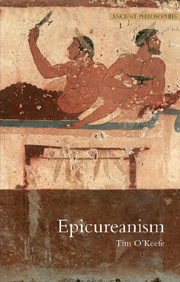
    Epicureanism was one of the major philosophical systems of the Hellenistic world. It provided a systematic account of the nature of the world and our place in it, how we can come to know the world, and how we can attain happiness. Founded by Epicurus of Samos (c.341-270 BCE) the Epicurean school of philosophy flourished for hundreds of years after Epicurus’ death, and its rediscovery helped shape the scientific revolution. This clear and engaging introduction provides lucid exposition of the central tenets of Epicurus’ philosophy. Part 1 of the book examines the fundamentals of Epicurus’ metaphysics, including atoms, cosmology, mechanistic biology, the nature and functioning of the mind, and death. Part 2 explores Epicurus’ epistemology, including his arguments against scepticism and his ideas on sensations, preconceptions and feelings. The third and final part deals with Epicurus’ ethics, exploring his arguments for hedonism, his distinctive conceptions of types of pleasure and desire, his belief in virtue, and his notions of justice and friendship. Tim O’Keefe explores the arguments supporting Epicurus’ positions, indicating their strengths and weaknesses, while showing how they connect to other parts of his philosophy and how Epicureanism hangs together as a whole. Particular stress is placed on those features that have enduring philosophical interest and which parallel debates in contemporary philosophy. O’Keefe shows Epicurus to be a philosopher of the highest order and that even after two millennia grappling with his ideas continues to reward study.

    Reviews

    "This is a splendid book. As an introduction to all aspects of ancient Epicureanism, addressed to a general readership with an interest in the history of philosophy, I cannot imagine anything better. I shall recommend it to students and colleagues as the first place to go for an engaging, clear, thoughtful, and informed overview of the subject. . . a small masterpiece."

    Source: Notre Dame Philosophical Reviews

    Refine List

    Actions for selected content:

    Select all | Deselect all
    • View selected items
    • Export citations
    • Download PDF (zip)
    • Save to Kindle
    • Save to Dropbox
    • Save to Google Drive

    Save Search

    You can save your searches here and later view and run them again in "My saved searches".

    Please provide a title, maximum of 40 characters.
    ×

    Contents


    Page 2 of 2


    Page 2 of 2


    Metrics

    Full text views

    Total number of HTML views: 0
    Total number of PDF views: 0 *
    Loading metrics...

    Book summary page views

    Total views: 0 *
    Loading metrics...

    * Views captured on Cambridge Core between #date#. This data will be updated every 24 hours.

    Usage data cannot currently be displayed.

    Accessibility standard: Unknown

    Why this information is here

    This section outlines the accessibility features of this content - including support for screen readers, full keyboard navigation and high-contrast display options. This may not be relevant for you.

    Accessibility Information

    Accessibility compliance for the PDF of this book is currently unknown and may be updated in the future.
