Decolonisation

-
Select format
-
- Publisher:
- Wits University Press
- Publication date:
- January 2026
- October 2023
- ISBN:
- 9781776148462
- 9781776148448
- Dimensions:
- Weight & Pages:
- Dimensions:
- Weight & Pages:
You may already have access via personal or institutional login
Show more authors 
You may already have access via personal or institutional login
Book description
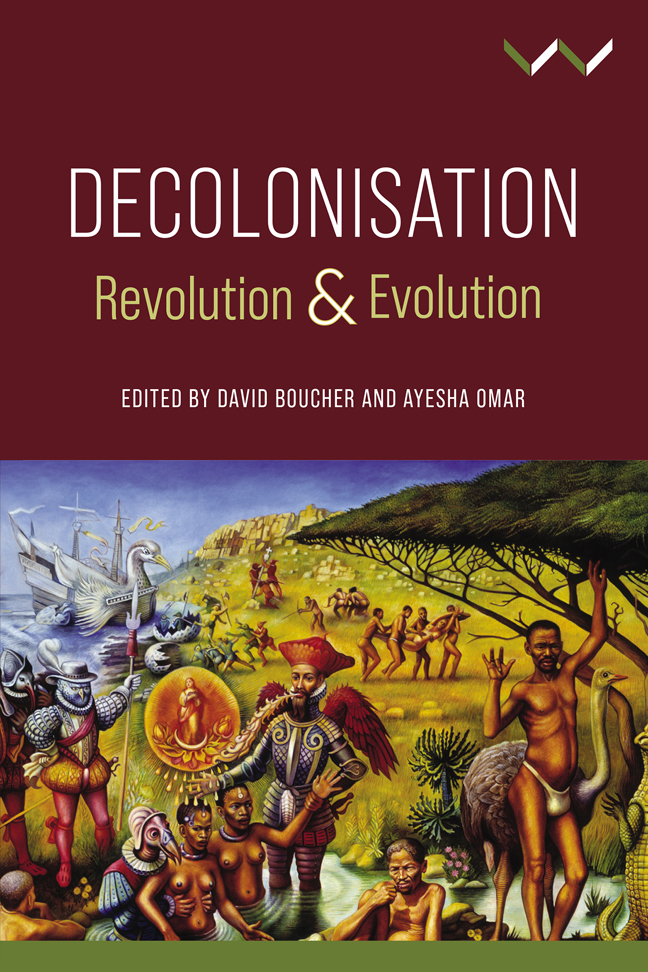
Debates about decolonisation of the mind and of our curricula reveal the dark shadow cast over the world by the adventurers of the modern era, beginning in 1492. Decolonisation explores questions of justice, injustice and inhumanity that have geographically and intellectually shaped the course of history through overlapping colonial, decolonial and postcolonial eras.
This multidisciplinary collection uses the lenses of history, philosophy, literature and education to examine aspects of colonialism and decolonisation, and their revolutionary and evolutionary manifestations which, contributors argue, occurred simultaneously in the historical and epistemological record. The problems that come into focus have a kaleidoscopic effect on how we come to understand fraught issues, from the 'invention' of blacks, to the formulation of the ideology of trusteeship and the obligations to 'lower civilisations'.
Decolonisation brings together an internationally renowned group of scholars to showcase their search for decolonial strategies within their disciplinary focus, covering ideas such as the different layers at which colonialism operates, strategies for a decolonisation that does not recolonise, and the importance of preserving and publishing in indigenous languages.
This is a much-needed reference book for students and scholars in the field of decolonisation, history, philosophy and pedagogy. The introductory chapter offers a clear and concise primer to this complex subject, covering colonialism, imperialism, decoloniality, and the various actors involved.
Contents
Contents
Metrics
Full text views
Full text views helpTotal number of HTML views: 0
Total number of PDF views: 0 *
 Loading metrics...
* Views captured on Cambridge Core between #date#. This data will be updated every 24 hours.
Usage data cannot currently be displayed.
Accessibility standard: Unknown
Why this information is here
This section outlines the accessibility features of this content - including support for screen readers, full keyboard navigation and high-contrast display options. This may not be relevant for you.
Accessibility Information
Accessibility compliance for the PDF of this book is currently unknown and may be updated in the future.