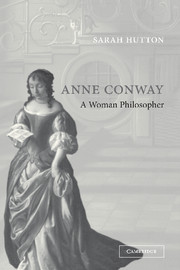
Book contents
- Frontmatter
- Contents
- Acknowledgements
- Introduction
- 1 Anne Finch, Viscountess Conway
- 2 A philosophical education
- 3 Religion and Anne Conway
- 4 Anne Conway and Henry More
- 5 John Finch, Thomas Hobbes and Margaret Cavendish
- 6 Experimental physick: Boyle, Greatrakes, Stubbe
- 7 Physic and philosophy: Van Helmont, father and son
- 8 Kabbalistical dialogues
- 9 Quakerism and George Keith
- 10 Last years
- 11 Legacy
- Bibliography
- Index
Introduction
Published online by Cambridge University Press: 22 September 2009

Book contents
- Frontmatter
- Contents
- Acknowledgements
- Introduction
- 1 Anne Finch, Viscountess Conway
- 2 A philosophical education
- 3 Religion and Anne Conway
- 4 Anne Conway and Henry More
- 5 John Finch, Thomas Hobbes and Margaret Cavendish
- 6 Experimental physick: Boyle, Greatrakes, Stubbe
- 7 Physic and philosophy: Van Helmont, father and son
- 8 Kabbalistical dialogues
- 9 Quakerism and George Keith
- 10 Last years
- 11 Legacy
- Bibliography
- Index
Summary
The year 1690 saw the appearance in Holland of an anonymous octavo volume entitled Opuscula philosophica. The second of the three opuscula it contained was entitled Principia philosophiae antiquissimae et recentissimae. Two years later, an English translation of this work was published, with the title The Principles of the Most Ancient and Modern Philosophy: Concerning God, Christ, and the Creature; that is, concerning Spirit and Matter in General. The preface to the book explains that it was a translation by one ‘J. C.’ of ‘a little treatise published since the Author's Death’, originally published in Latin in Amsterdam. No author is named, but the address to the reader explains that it ‘was written not many Years ago, by a certain English countess, a Woman learned beyond her Sex’. The Latin edition, of which this is a translation, gives no further clues as to the identity of this erudite Countess, but her authorship treatise was not altogether a secret in the early Enlightenment. In his biography (1710) of Henry More, Richard Ward prints the preface originally prepared for publication with this treatise, and gives an account of its author, ‘the Lady Viscountess Conway’, whom he describes as the ‘Heroine pupil’ of the Cambridge Platonist, Henry More (1614–87). The unpublished preface speaks of her ‘singular Quickness and Apprehensiveness of Understanding’ and her ‘marvellous Sagacity and Prudence in any Affairs of Moment’.
Information
- Type
- Chapter
- Information
- Anne ConwayA Woman Philosopher, pp. 1 - 13Publisher: Cambridge University PressPrint publication year: 2004
Accessibility standard: Unknown
Why this information is here
This section outlines the accessibility features of this content - including support for screen readers, full keyboard navigation and high-contrast display options. This may not be relevant for you.Accessibility Information
Accessibility compliance for the PDF of this book is currently unknown
and may be updated in the future.