
Book contents
- Frontmatter
- Dedication
- Contents
- Preface
- General Notations
- 1 Introduction
- 2 Enzymatic Adaptation
- 3 Early Development of Cybernetic Models
- 4 Revisiting Cybernetic Laws via Optimal Control Theory
- 5 Toward Modeling of Metabolic Networks
- 6 The Hybrid Cybernetic Model (HCM)
- 7 The Lumped Hybrid Cybernetic Model (L-HCM)
- 8 Predicting Dynamic Behavior of Mutant Strains with L-HCM
- 9 Nonlinear Analysis of Cybernetic Models
- 10 Metabolic Modeling Landscape
- References
- Index
- References
References
Published online by Cambridge University Press: 29 September 2018

Book contents
- Frontmatter
- Dedication
- Contents
- Preface
- General Notations
- 1 Introduction
- 2 Enzymatic Adaptation
- 3 Early Development of Cybernetic Models
- 4 Revisiting Cybernetic Laws via Optimal Control Theory
- 5 Toward Modeling of Metabolic Networks
- 6 The Hybrid Cybernetic Model (HCM)
- 7 The Lumped Hybrid Cybernetic Model (L-HCM)
- 8 Predicting Dynamic Behavior of Mutant Strains with L-HCM
- 9 Nonlinear Analysis of Cybernetic Models
- 10 Metabolic Modeling Landscape
- References
- Index
- References
Summary
A summary is not available for this content so a preview has been provided. Please use the Get access link above for information on how to access this content.
Information
- Type
- Chapter
- Information
- Cybernetic Modeling for Bioreaction Engineering , pp. 252 - 265Publisher: Cambridge University PressPrint publication year: 2018
References
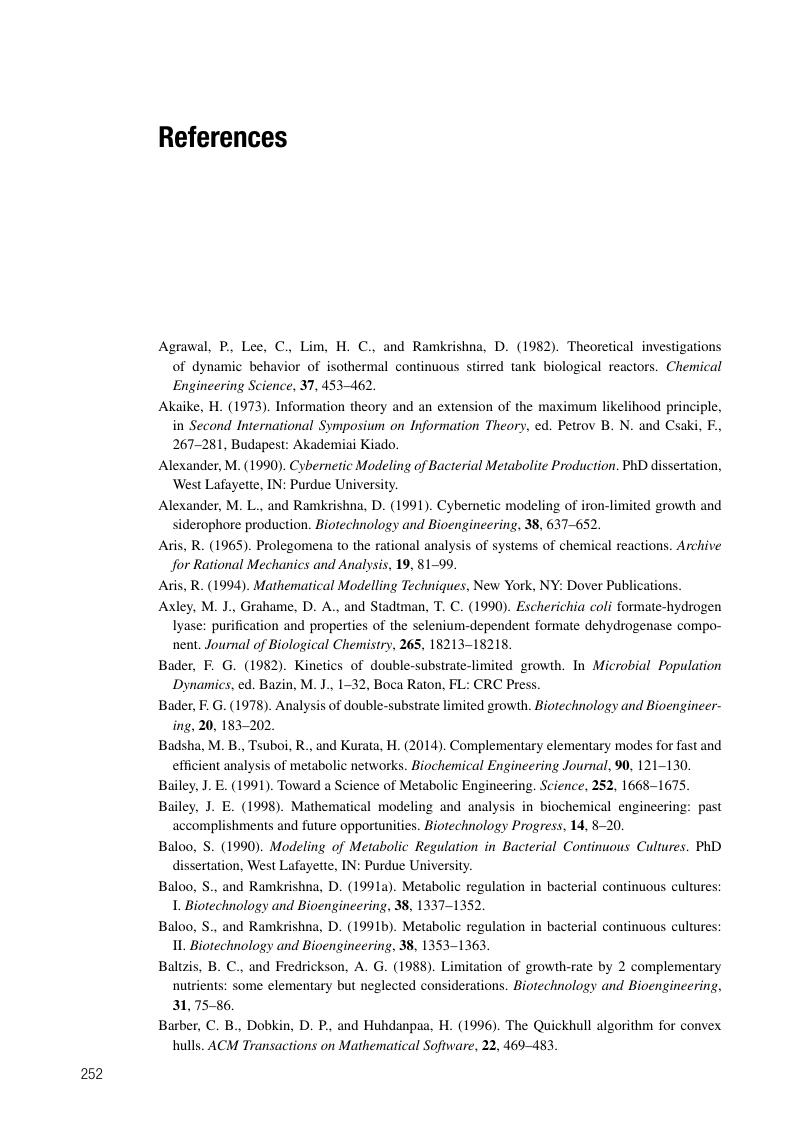
Agrawal, P., Lee, C., Lim, H. C., and Ramkrishna, D. (1982). Theoretical investigations of dynamic behavior of isothermal continuous stirred tank biological reactors. Chemical Engineering Science, 37, 453–462.CrossRefGoogle Scholar
Akaike, H. (1973). Information theory and an extension of the maximum likelihood principle, in Second International Symposium on Information Theory, ed. Petrov, B. N. and Csaki, F., 267–281, Budapest: Akademiai Kiado.Google Scholar
Alexander, M. (1990). Cybernetic Modeling of Bacterial Metabolite Production. PhD dissertation, West Lafayette, IN: Purdue University.Google Scholar
Alexander, M. L., and Ramkrishna, D. (1991). Cybernetic modeling of iron-limited growth and siderophore production. Biotechnology and Bioengineering, 38, 637–652.CrossRefGoogle ScholarPubMed
Aris, R. (1965). Prolegomena to the rational analysis of systems of chemical reactions. Archive for Rational Mechanics and Analysis, 19, 81–99.CrossRefGoogle Scholar
Axley, M. J., Grahame, D. A., and Stadtman, T. C. (1990). Escherichia coli formate-hydrogen lyase: purification and properties of the selenium-dependent formate dehydrogenase component. Journal of Biological Chemistry, 265, 18213–18218.CrossRefGoogle ScholarPubMed
Bader, F. G. (1982). Kinetics of double-substrate-limited growth. In Microbial Population Dynamics, ed. Bazin, M. J., 1–32, Boca Raton, FL: CRC Press.Google Scholar
Bader, F. G. (1978). Analysis of double-substrate limited growth. Biotechnology and Bioengineering, 20, 183–202.CrossRefGoogle ScholarPubMed
Badsha, M. B., Tsuboi, R., and Kurata, H. (2014). Complementary elementary modes for fast and efficient analysis of metabolic networks. Biochemical Engineering Journal, 90, 121–130.10.1016/j.bej.2014.05.022CrossRefGoogle Scholar
Bailey, J. E. (1991). Toward a Science of Metabolic Engineering. Science, 252, 1668–1675.CrossRefGoogle Scholar
Bailey, J. E. (1998). Mathematical modeling and analysis in biochemical engineering: past accomplishments and future opportunities. Biotechnology Progress, 14, 8–20.CrossRefGoogle ScholarPubMed
Baloo, S. (1990). Modeling of Metabolic Regulation in Bacterial Continuous Cultures. PhD dissertation, West Lafayette, IN: Purdue University.Google Scholar
Baloo, S., and Ramkrishna, D. (1991a). Metabolic regulation in bacterial continuous cultures: I. Biotechnology and Bioengineering, 38, 1337–1352.CrossRefGoogle ScholarPubMed
Baloo, S., and Ramkrishna, D. (1991b). Metabolic regulation in bacterial continuous cultures: II. Biotechnology and Bioengineering, 38, 1353–1363.CrossRefGoogle ScholarPubMed
Baltzis, B. C., and Fredrickson, A. G. (1988). Limitation of growth-rate by 2 complementary nutrients: some elementary but neglected considerations. Biotechnology and Bioengineering, 31, 75–86.10.1002/bit.260310112CrossRefGoogle Scholar
Barber, C. B., Dobkin, D. P., and Huhdanpaa, H. (1996). The Quickhull algorithm for convex hulls. ACM Transactions on Mathematical Software, 22, 469–483.CrossRefGoogle Scholar
Baroukh, C., Munoz-Tamayo, R., Bernard, O., and Steyer, J. P. (2015). Mathematical modeling of unicellular microalgae and cyanobacteria metabolism for biofuel production. Current Opinion in Biotechnology, 33, 198–205.CrossRefGoogle ScholarPubMed
Barron, A., Rissanen, J., and Yu, B. (1998). The minimum description length principle in coding and modeling. IEEE Transactions on Information Theory, 44, 2743–2760.CrossRefGoogle Scholar
Batt, B. C., and Kompala, D. S. (1989). A structured kinetic modeling framework for the dynamics of hybridoma growth and monoclonal antibody production in continuous suspension cultures. Biotechnology and Bioengineering, 34, 515–531.10.1002/bit.260340412CrossRefGoogle ScholarPubMed
Behre, J., Wilhelm, T., Von Kamp, A., Ruppin, E., and Schuster, S. (2008). Structural robustness of metabolic networks with respect to multiple knockouts. Journal of Theoretical Biology, 252, 433–441.CrossRefGoogle ScholarPubMed
Berrios-Rivera, S. J., Bennett, G. N., and San, K. Y. (2002). Metabolic engineering of Escherichia coli: increase of NADH availability by overexpressing an NAD+-dependent formate dehydrogenase. Metabolic Engineering, 4, 217–229.CrossRefGoogle ScholarPubMed
Bilous, O., and Amundson, N. R. (1955). Chemical reactor stability and sensitivity. AIChE Journal, 1, 513–521.CrossRefGoogle Scholar
Bohl, K., de Figueiredo, L. F., Hdicke, O., Klamt, S., Kost, C., Schuster, S., and Kaleta, C. (2010). CASOP GS: computing intervention strategies targeted at production improvement in genome-scale metabolic networks, in Proceedings of the 25th German Conference on Bioinformatics, ed. Schomburg, D. and, Grote, A., 71–80, Bonn: Gesellschaft für Informatik.Google Scholar
Burgard, A. P., Pharkya, P., and Maranas, C. D. (2003). OptKnock: a bilevel programming framework for identifying gene knockout strategies for microbial strain optimization. Biotechnology and Bioengineering, 84, 647–657.10.1002/bit.10803CrossRefGoogle ScholarPubMed
Çakir, T., Arga, K. Y., Altintas, M. M., and Ülgen, K. Ö. (2004a). Flux analysis of recombinant Saccharomyces cerevisiae YPB-G utilizing starch for optimal ethanol production. Process Biochemistry, 39, 2097–2108.10.1016/j.procbio.2003.10.010CrossRefGoogle Scholar
Çakir, T., Kirdar, B., and Ülgen, K. Ö. (2004b). Metabolic pathway analysis of yeast strengthens the bridge between transcriptornics and metabolic networks. Biotechnology and Bioengineering, 86, 251–260.10.1002/bit.20020CrossRefGoogle Scholar
Carlson, R., and Srienc, F. (2004). Fundamental Escherichia coli biochemical pathways for biomass and energy production: identification of reactions. Biotechnology and Bioengineering, 85, 1–19.CrossRefGoogle ScholarPubMed
Castaño-Cerezo, S., Pastor, J. M., Renilla, S., Bernal, V., Iborra, J. L., and Canovas, M. (2009). An insight into the role of phosphotransacetylase (pta) and the acetate/acetyl-CoA node in Escherichia coli. Microbial Cell Factories, 8, Article number 54.10.1186/1475-2859-8-54CrossRefGoogle ScholarPubMed
Chan, S. H. J., and Ji, P. (2011). Decomposing flux distributions into elementary flux modes in genome-scale metabolic networks. Bioinformatics, 27, 2256–2262.CrossRefGoogle ScholarPubMed
Chan, S. H. J., Solem, C., Jensen, P. R., and Ji, P. (2014). Estimating biological elementary flux modes that decompose a flux distribution by the minimal branching property. Bioinformatics, 30, 3232–3239.CrossRefGoogle ScholarPubMed
Chandrasekaran, S., and Price, N. D. (2010). Probabilistic integrative modeling of genome-scale metabolic and regulatory networks in Escherichia coli and Mycobacterium tuberculosis. Proceedings of the National Academy of Sciences of the United States of America, 107, 17845– 17850.Google ScholarPubMed
Charalampopoulos, D., Vazquez, J. A., and Pandiella, S. S. (2009). Modelling and validation of Lactobacillus plantarum fermentations in cereal-based media with different sugar concentrations and buffering capacities. Biochemical Engineering Journal, 44, 96–105.10.1016/j.bej.2008.11.004CrossRefGoogle Scholar
Chassagnole, C., Noisommit-Rizzi, N., Schmid, J. W., Mauch, K., and Reuss, M. (2002). Dynamic modeling of the central carbon metabolism of Escherichia coli. Biotechnology and Bioengineering, 79, 53–73.10.1002/bit.10288CrossRefGoogle ScholarPubMed
Choon, Y. W., Mohamad, M. S., Deris, S., Illias, R. M., Chong, C. K., and Chai, L. E. (2014). A hybrid of bees algorithm and flux balance analysis with OptKnock as a platform for in silico optimization of microbial strains. Bioprocess and Biosystems Engineering, 37, 521–532.CrossRefGoogle ScholarPubMed
Clarke, B. L. (1988). Stoichiometric network analysis. Cell Biophysics, 12, 237–253.10.1007/BF02918360CrossRefGoogle ScholarPubMed
Colijn, C., Brandes, A., Zucker, J., Lun, D. S., Weiner, B., Farhat, M. R., Cheng, T. Y., Moody, D. B., Murray, M., and Galagan, J. E. (2009). Interpreting expression data with metabolic flux models: predicting Mycobacterium tuberculosis mycolic acid production. PLOS Computational Biology, 5, Article number e1000489.CrossRefGoogle ScholarPubMed
Contiero, J., Beatty, C., Kumari, S., Desanti, C. L., Strohl, W. R., and Wolfe, A. (2000). Effects of mutations in acetate metabolism on high-cell-density growth of Escherichia coli. Journal of Industrial Microbiology & Biotechnology, 24, 421–430.CrossRefGoogle Scholar
Cortassa, S., Aon, J. C., and Aon, M. A. (1995). Fluxes of carbon, phosphorylation, and redox intermediates during growth of Saccharomyces cerevisiae on different carbon sources. Biotechnology and Bioengineering, 47, 193–208.10.1002/bit.260470211CrossRefGoogle ScholarPubMed
Covert, M. W., and Palsson, B. Ø. (2002). Transcriptional regulation in constraints-based metabolic models of Escherichia coli. Journal of Biological Chemistry, 277, 28058–28064.CrossRefGoogle ScholarPubMed
Covert, M. W., Xiao, N., Chen, T. J., and Karr, J. R. (2008). Integrating metabolic, transcriptional regulatory and signal transduction models in Escherichia coli. Bioinformatics, 24, 2044–2050.10.1093/bioinformatics/btn352CrossRefGoogle ScholarPubMed
Cruz, H. J., Moreira, J. L., and Carrondo, M. J. T. (1999). Metabolic shifts by nutrient manipulation in continuous cultures of BHK cells. Biotechnology and Bioengineering, 66, 104–113.3.0.CO;2-#>CrossRefGoogle ScholarPubMed
Davis, B. D., Dulbecco, R., Eisen, H. N., Ginsberg, H. S., and Wood, W. B. (1967). Microbiology: A Text Emphasizing Molecular and Genetic Aspects of Microbiology and Immunology, and the Relations of Bacteria, Fungi and Viruses to Human Diseases, New York: Harper and Row.Google Scholar
de Figueiredo, L. F., Podhorski, A., Rubio, A., Kaleta, C., Beasley, J. E., Schuster, S., and Planes, F. J. (2009). Computing the shortest elementary flux modes in genome-scale metabolic networks. Bioinformatics, 25, 3158–3165.10.1093/bioinformatics/btp564CrossRefGoogle ScholarPubMed
De Mey, M., De Maeseneire, S., Soetaert, W., and Vandamme, E. (2007). Minimizing acetate formation in E-coli fermentations. Journal of Industrial Microbiology & Biotechnology, 34, 689–700.CrossRefGoogle ScholarPubMed
Devilbiss, F. (2016). Is Metabolism Goal-Directed? Investigating the Validity of Modeling Biological Systems with Cybernetic Control Via Omic Data. PhD dissertation, West Lafayette, IN: Purdue University.Google Scholar
Dhurjati, P. (1982). Cybernetic Modeling of the Growth of Microorganisms in Multiple Substrate Environments. PhD dissertation, West Lafayette, IN: Purdue University.Google Scholar
Dhurjati, P., Ramkrishna, D., Flickinger, M. C., and Tsao, G. T. (1985). A cybernetic view of microbial-growth: modeling of cells as optimal strategists. Biotechnology and Bioengineering, 27, 1–9.CrossRefGoogle ScholarPubMed
Duarte, N. C., Herrgard, M. J., and Palsson, B. Ø. (2004). Reconstruction and validation of Saccharomyces cerevisiae iND750, a fully compartmentalized genome-scale metabolic model. Genome Research, 14, 1298–1309.10.1101/gr.2250904CrossRefGoogle ScholarPubMed
Edwards, J. S., Ramakrishna, R., and Palsson, B. Ø. (2002). Characterizing the metabolic phenotype: a phenotype phase plane analysis. Biotechnology and Bioengineering, 77, 27–36.10.1002/bit.10047CrossRefGoogle ScholarPubMed
Egli, T. (1995). The ecological and physiological significance of the growth of heterotrophic microorganisms with mixtures of substrates. Advances in Microbial Ecology, 14, 305–386.CrossRefGoogle Scholar
Europa, A. F., Gambhir, A., Fu, P. C., and Hu, W. S. (2000). Multiple steady states with distinct cellular metabolism in continuous culture of mammalian cells. Biotechnology and Bioengineering, 67, 25–34.3.0.CO;2-K>CrossRefGoogle ScholarPubMed
Feist, A. M., Henry, C. S., Reed, J. L., Krummenacker, M., Joyce, A. R., Karp, P. D., Broadbelt, L. J., Hatzimanikatis, V., and Palsson, B. Ø. (2007). A genome-scale metabolic reconstruction for Escherichia coli K-12 MG1655 that accounts for 1260 ORFs and thermodynamic information. Molecular Systems Biology, 3, Article number 121.CrossRefGoogle ScholarPubMed
Finn, R. K., and Wilson, R. E. (1954). Fermentation process control: population dynamics of a continuous propagator for microorganisms. Journal of Agricultural and Food Chemistry, 2, 66–69.CrossRefGoogle Scholar
Follstad, B. D., Balcarcel, R. R., Stephanopoulos, G., and Wang, D. I. C. (1999). Metabolic flux analysis of hybridoma continuous culture steady state multiplicity. Biotechnology and Bioengineering, 63, 675–683.10.1002/(SICI)1097-0290(19990620)63:6<675::AID-BIT5>3.0.CO;2-R3.0.CO;2-R>CrossRefGoogle ScholarPubMed
Franz, A., Song, H.-S., Ramkrishna, D., and Kienle, A. (2011). Experimental and theoretical analysis of poly(beta-hydroxybutyrate) formation and consumption in Ralstonia eutropha. Biochemical Engineering Journal, 55, 49–58.10.1016/j.bej.2011.03.006CrossRefGoogle Scholar
Fredrickson, A. G. (1976). Formulation of structured growth models. Biotechnology and Bioengineering, 18, 1481–1486.CrossRefGoogle ScholarPubMed
Fredrickson, A. G. (1991). Segregated, structured, distributed models and their role in microbial ecology: a case study based on work done on the filter-feeding ciliate Tetrahymena pyriformis. Microbial Ecology, 22, 139–159.10.1007/BF02540220CrossRefGoogle Scholar
Gadkar, K. G., Doyle, F. J., Crowley, T. J., and Varner, J. D. (2003). Cybernetic model predictive control of a continuous bioreactor with cell recycle. Biotechnology Progress, 19, 1487–1497.10.1021/bp025776dCrossRefGoogle ScholarPubMed
Gagneur, J., and Klamt, S. (2004). Computation of elementary modes: a unifying framework and the new binary approach. BMC Bioinformatics, 5, Article number 175.10.1186/1471-2105-5-175CrossRefGoogle Scholar
Gauch, H. G. (2003). Scientific Method in Practice, Cambridge, UK: Cambridge University Press.Google Scholar
Gayen, K., and Venkatesh, K. V. (2006). Analysis of optimal phenotypic space using elementary modes as applied to Corynebacterium glutamicum. BMC Bioinformatics, 7, Article number 445.CrossRefGoogle ScholarPubMed
Geng, J., Song, H.-S., Yuan, J. Q., and Ramkrishna, D. (2012). On enhancing productivity of bioethanol with multiple species. Biotechnology and Bioengineering, 109, 1508–1517.10.1002/bit.24419CrossRefGoogle ScholarPubMed
Gernaey, K. V., Lantz, A. E., Tufvesson, P., Woodley, J. M., and Sin, G. (2010). Application of mechanistic models to fermentation and biocatalysis for next-generation processes. Trends in Biotechnology, 28, 346–354.10.1016/j.tibtech.2010.03.006CrossRefGoogle ScholarPubMed
Gerstl, M. P., Jungreuthmayer, C., and Zanghellini, J. (2015). tEFMA: computing thermodynam-ically feasible elementary flux modes in metabolic networks. Bioinformatics, 31, 2232–2234.10.1093/bioinformatics/btv111CrossRefGoogle ScholarPubMed
Gupta, S., and Clark, D. P. (1989). Escherichia coli derivatives lacking both alcohol-dehydrogenase and phosphotransacetylase grow anaerobically by lactate fermentation. Journal of Bacteriology, 171, 3650–3655.10.1128/jb.171.7.3650-3655.1989CrossRefGoogle ScholarPubMed
Hädicke, O., and Klamt, S. (2010). CASOP: a computational approach for strain optimization aiming at high productivity. Journal of Biotechnology, 147, 88–101.CrossRefGoogle ScholarPubMed
Herbert, D., Elsworth, R., and Telling, R. C. (1956). The continuous culture of bacteria: a theoretical and experimental study. Journal of General Microbiology, 14, 601–622.CrossRefGoogle ScholarPubMed
Herbert, D., Phipps, P. J., and Tempest, D. W. (1965). The chemostat: design and instrumentation. Laboratory Practice, 14, 1150–1161.Google ScholarPubMed
Herrnstein, R. J. (1997). The Matching Law: Papers in Psychology and Economics, ed. Rachlin, H. and Laibson, D. I., Cambridge, MA: Harvard University Press.Google Scholar
Hjersted, J. L., Henson, M. A., and Mahadevan, R. (2007). Genome-scale analysis of Saccharomyces cerevisiae metabolism and ethanol production in fed-batch culture. Biotechnology and Bioengineering, 97, 1190–1204.CrossRefGoogle ScholarPubMed
Hoefnagel, M. H. N., Starrenburg, M. J. C., Martens, D. E., Hugenholtz, J., Kleerebezem, M., Van Swam, I. I., Bongers, R., Westerhoff, H. V., and Snoep, J. L. (2002). Metabolic engineering of lactic acid bacteria, the combined approach: kinetic modelling, metabolic control and experimental analysis. Microbiology-Sgm, 148, 1003–1013.10.1099/00221287-148-4-1003CrossRefGoogle ScholarPubMed
Holtzclaw, W. D., and Chapman, L. F. (1975). Degradative acetolactate synthase of Bacillus subtilis: purification and properties. Journal of Bacteriology, 121, 917–922.10.1128/jb.121.3.917-922.1975CrossRefGoogle Scholar
Hunt, K. A., Folsom, J. P., Taffs, R. L., and Carlson, R. P. (2014). Complete enumeration of elementary flux modes through scalable demand-based subnetwork definition. Bioinformatics, 30, 1569–1578.10.1093/bioinformatics/btu021CrossRefGoogle ScholarPubMed
Jones, K. D., and Kompala, D. S. (1999). Cybernetic model of the growth dynamics of Saccharomyces cerevisiae in batch and continuous cultures. Journal of Biotechnology, 71, 105–131.CrossRefGoogle ScholarPubMed
Jungers, R. M., Zamorano, F., Blondel, V. D., Vande Wouwer, A., and Bastin, G. (2011). Fast computation of minimal elementary decompositions of metabolic flux vectors. Automatica, 47, 1255–1259.10.1016/j.automatica.2011.01.011CrossRefGoogle Scholar
Jungreuthmayer, C., Ruckerbauer, D. E., and Zangnellini, J. (2013). regEfmtool: speeding up elementary flux mode calculation using transcriptional regulatory rules in the form of three-state logic. Biosystems, 113, 37–39.10.1016/j.biosystems.2013.04.002CrossRefGoogle ScholarPubMed
Kabir, M. M., Ho, P. Y., and Shimizu, K. (2005). Effect of ldhA gene deletion on the metabolism of Escherichia coli based on gene expression, enzyme activities, intracellular metabolite concentrations, and metabolic flux distribution. Biochemical Engineering Journal, 26, 1–11.CrossRefGoogle Scholar
Kaleta, C., de Figueiredo, L. F., Behre, J., and Schuster, S. (2009). EFMEvolver: computing elementary flux modes in genome-scale metabolic networks, in Lecture Notes in Informatics-Proceedings, 179–189.Google Scholar
Karr, J. R., Sanghvi, J. C., Macklin, D. N., Gutschow, M. V., Jacobs, J. M., Bolival, B., Assad-Garcia, N., Glass, J. I., and Covert, M. W. (2012). A whole-cell computational model predicts phenotype from genotype. Cell, 150, 389–401.CrossRefGoogle ScholarPubMed
Katoh, T., Yuguchi, D., Yoshii, H., Shi, H. D., and Shimizu, K. (1999). Dynamics and modeling on fermentative production of poly (β-hydroxybutyric acid) from sugars via lactate by a mixed culture of Lactobacillus delbrueckii and Alcaligenes eutrophus. Journal of Biotechnology, 67, 113–134.10.1016/S0168-1656(98)00177-1CrossRefGoogle ScholarPubMed
Khodayari, A., and Maranas, C. D. (2016). A genome-scale Escherichia coli kinetic metabolic model k-ecoli457 satisfying flux data for multiple mutant strains. Nature Communications, 7, Article number 13806.10.1038/ncomms13806CrossRefGoogle ScholarPubMed
Khodayari, A., Zomorrodi, A. R., Liao, J. C., and Maranas, C. D. (2014). A kinetic model of Escherichia coli core metabolism satisfying multiple sets of mutant flux data. Metabolic Engineering, 25, 50–62.10.1016/j.ymben.2014.05.014CrossRefGoogle ScholarPubMed
Kim, B. M., Kim, S. W., and Yang, D. R. (2003). Cybernetic modeling of the cephalosporin C fermentation process by Cephalosporium acremonium. Biotechnology Letters, 25, 611–616.10.1023/A:1023080027754CrossRefGoogle ScholarPubMed
Kim, J. I. (2008). A Hybrid Cybernetic Modeling for the Growth of Escherichia coli in Glucose-pyruvate Mixtures. PhD dissertation, West Lafayette, IN: Purdue University.Google Scholar
Kim, J. I., Song, H.-S., Sunkara, S. R., Lali, A., and Ramkrishna, D. (2012). Exacting predictions by cybernetic model confirmed experimentally: steady state multiplicity in the chemostat. Biotechnology Progress, 28, 1160–1166.CrossRefGoogle ScholarPubMed
Kim, J. I., Varner, J. D., and Ramkrishna, D. (2008). A hybrid model of anaerobic E. coli GJT001: combination of elementary flux modes and cybernetic variables. Biotechnology Progress, 24, 993–1006.10.1002/btpr.73CrossRefGoogle ScholarPubMed
Kim, J. I., Song, H.-S., Sunkara, S. R., Lali, A., and Ramkrishna, D. (2012). Exacting predictions by cybernetic model confirmed experimentally: steady state multiplicity in the chemostat. Biotechnology Progress, 28, 1160–1166.CrossRefGoogle ScholarPubMed
Kitano, H. (2004). Biological robustness. Nature Reviews Genetics, 5, 826–837.10.1038/nrg1471CrossRefGoogle ScholarPubMed
Kitano, H. (2007). Towards a theory of biological robustness. Molecular Systems Biology, 3, Article number 137.10.1038/msb4100179CrossRefGoogle ScholarPubMed
Klamt, S. (2006). Generalized concept of minimal cut sets in biochemical networks. Biosystems, 83, 233–247.CrossRefGoogle ScholarPubMed
Klamt, S., and Gilles, E. D. (2004). Minimal cut sets in biochemical reaction networks. Bioinformatics, 20, 226–234.10.1093/bioinformatics/btg395CrossRefGoogle ScholarPubMed
Klamt, S., Saez-Rodriguez, J., and Gilles, E. D. (2007). Structural and functional analysis of cellular networks with CellNetAnalyzer. BMC Systems Biology, 1, Article number 2.10.1186/1752-0509-1-2CrossRefGoogle ScholarPubMed
Klamt, S., and Stelling, J. (2002). Combinatorial complexity of pathway analysis in metabolic networks. Molecular Biology Reports, 29, 233–236.10.1023/A:1020390132244CrossRefGoogle ScholarPubMed
Klamt, S., and Stelling, J. (2003). Two approaches for metabolic pathway analysis? Trends in Biotechnology, 21, 64–69.10.1016/S0167-7799(02)00034-3CrossRefGoogle ScholarPubMed
Klamt, S., and Von Kamp, A. (2011). An application programming interface for CellNetAnalyzer. Biosystems, 105, 162–168.10.1016/j.biosystems.2011.02.002CrossRefGoogle ScholarPubMed
Kompala, D. (1984). Bacterial Growth on Multiple Substrates. Experimental Verification of Cybernetic Models. PhD dissertation, West Lafayette, IN: Purdue University.Google Scholar
Kompala, D. S., Ramkrishna, D., Jansen, N. B., and Tsao, G. T. (1986). Investigation of bacterial growth on mixed substrates: experimental evaluation of cybernetic models. Biotechnology and Bioengineering, 28, 1044–1055.10.1002/bit.260280715CrossRefGoogle ScholarPubMed
Kompala, D. S., Ramkrishna, D., and Tsao, G. T. (1984). Cybernetic modeling of microbial-growth on multiple substrates. Biotechnology and Bioengineering, 26, 1272–1281.CrossRefGoogle ScholarPubMed
Kotte, O., Zaugg, J. B., and Heinemann, M. (2010). Bacterial adaptation through distributed sensing of metabolic fluxes. Molecular Systems Biology, 6, Article number 355.10.1038/msb.2010.10CrossRefGoogle ScholarPubMed
Krishnan, M. S. (1996). Process Development of Fuel Ethanol Production from Lignocellulosic Sugars Using Genetically Engineered Yeasts. PhD dissertation, West Lafayette, IN: Purdue University.Google Scholar
Krishnan, M. S., Xia, Y., Ho, N. W. Y., and Tsao, G. T. (1997). Fuel ethanol production from lignocellulosic sugars: studies using a genetically engineered Saccharomyces yeast. Fuels and Chemicals from Biomass, 666, 74–92.10.1021/bk-1997-0666.ch004CrossRefGoogle Scholar
Kümmel, A., Panke, S., and Heinemann, M. (2006). Putative regulatory sites unraveled by network-embedded thermodynamic analysis of metabolome data. Molecular Systems Biology, 2, Article number 0034.10.1038/msb4100074CrossRefGoogle ScholarPubMed
Kurata, H., Zhao, Q. Y., Okuda, R., and Shimizu, K. (2007). Integration of enzyme activities into metabolic flux distributions by elementary mode analysis. BMC Systems Biology, 1, Article number 31.10.1186/1752-0509-1-31CrossRefGoogle ScholarPubMed
Lee, A. L., Ataai, M. M., and Shuler, M. L. (1984). Double-substrate-limited growth of Escherichia-coli. Biotechnology and Bioengineering, 26, 1398–1401.10.1002/bit.260261120CrossRefGoogle ScholarPubMed
Lee, S. B., and Bailey, J. E. (1984). Genetically structured models for lac promoter-operator Function in the Escherichia coli chromosome and in multicopy plasmids: Lac operator function. Biotechnology and Bioengineering, 26, 1372–1382.CrossRefGoogle ScholarPubMed
Lin, H., Bennett, G. N., and San, K. Y. (2005). Effect of carbon sources differing in oxidation state and transport route on succinate production in metabolically engineered Escherichia coli. Journal of Industrial Microbiology & Biotechnology, 32, 87–93.10.1007/s10295-005-0206-5CrossRefGoogle ScholarPubMed
Llaneras, F., and Pico, J. (2010). Which metabolic pathways generate and characterize the flux space? A comparison among elementary modes, extreme pathways and minimal generators. Journal of Biomedicine and Biotechnology, 2010, Article number 753904.10.1155/2010/753904CrossRefGoogle ScholarPubMed
Machado, D., Soons, Z., Patil, K. R., Ferreira, E. C., and Rocha, I. (2012). Random sampling of elementary flux modes in large-scale metabolic networks. Bioinformatics, 28, i515–i521.10.1093/bioinformatics/bts401CrossRefGoogle ScholarPubMed
Magasanik, B. (1982). Genetic control of nitrogen assimilation in bacteria. Annual Review of Genetics, 16, 135–168.10.1146/annurev.ge.16.120182.001031CrossRefGoogle ScholarPubMed
Mahadevan, R., Edwards, J. S., and Doyle, F. J. (2002). Dynamic flux balance analysis of diauxic growth in Escherichia coli. Biophysical Journal, 83, 1331–134010.1016/S0006-3495(02)73903-9CrossRefGoogle ScholarPubMed
Mandli, A. R., and Modak, J. M. (2014). Cybernetic modeling of adaptive prediction of environmental changes by microorganisms. Mathematical Biosciences, 248, 40–45CrossRefGoogle ScholarPubMed
Marashi, S. A., David, L., and Bockmayr, A. (2012). Analysis of metabolic subnetworks by flux cone projection. Algorithms for Molecular Biology, 7, Article number 17.10.1186/1748-7188-7-17CrossRefGoogle ScholarPubMed
Marr, A. G., Nilson, E. H., and Clark, D. J. (1963). The maintenance requirement of Escherichia coli. Annals of the New York Academy of Sciences, 102, 536–548.CrossRefGoogle Scholar
Mayr, E. (1961). Cause and effect in biology: kinds of causes, predictability, and teleology are viewed by a practicing biologist. Science, 134, 1501–1506.10.1126/science.134.3489.1501CrossRefGoogle Scholar
Mayr, E. (1982). The Growth of Biological Thought: Diversity, Evolution, and Inheritance, Cambridge, MA: Harvard University Press.Google Scholar
McDonald, C. P., and Urban, N. R. (2010). Using a model selection criterion to identify appropriate complexity in aquatic biogeochemical models. Ecological Modelling, 221, 428–432.10.1016/j.ecolmodel.2009.10.021CrossRefGoogle Scholar
Mitchell, A., Romano, G. H., Groisman, B., Yona, A., Dekel, E., Kupiec, M., Dahan, O., and Pilpel, Y. (2009). Adaptive prediction of environmental changes by microorganisms. Nature, 460, 220–224.10.1038/nature08112CrossRefGoogle ScholarPubMed
Monod, J. (1942). Recherches sur la Croissance des Cultures Bactériennes. Paris: Hermann.Google Scholar
Monod, J. (1949). The growth of bacterial cultures. Annual Review of Microbiology, 3, 371–394.CrossRefGoogle Scholar
Namjoshi, A. (2003). A Mathematical Investigation of the Consequences of Metabolic Regulation in Complex Pathways: The Cybernetic Approach. PhD dissertation, West Lafayette, IN: Purdue University.Google Scholar
Namjoshi, A. A., Hu, W. S., and Ramkrishna, D. (2003). Unveiling steady-state multiplicity in hybridoma cultures: the cybernetic approach. Biotechnology and Bioengineering, 81, 80–91.10.1002/bit.10447CrossRefGoogle ScholarPubMed
Namjoshi, A. A., and Ramkrishna, D. (2001). Multiplicity and stability of steady states in continuous bioreactors: dissection of cybernetic models. Chemical Engineering Science, 56, 5593–5607.10.1016/S0009-2509(01)00166-XCrossRefGoogle Scholar
Narang, A. (1994). The Dynamics of Microbial Growth on Mixtures of Substrates. PhD dissertation, West Lafayette, IN: Purdue University.Google Scholar
Narang, A., Konopka, A., and Ramkrishna, D. (1997a). Dynamic analysis of the cybernetic model for diauxic growth. Chemical Engineering Science, 52, 2567–2578.10.1016/S0009-2509(97)00073-0CrossRefGoogle Scholar
Narang, A., Konopka, A., and Ramkrishna, D. (1997b). New patterns of mixed-substrate utilization during batch growth of Escherichia coli K12. Biotechnology and Bioengineering, 55, 747–757.10.1002/(SICI)1097-0290(19970905)55:5<747::AID-BIT5>3.0.CO;2-B3.0.CO;2-B>CrossRefGoogle ScholarPubMed
Neidhardt, F. C., Ingraham, J. L., and Schaechter, M. (1990). Physiology of the Bacterial Cell: A Molecular Approach, Sunderland, MA: Sinauer Associates.Google Scholar
Neijssel, O. M., and Tempest, D. W. (1975). Regulation of carbohydrate metabolism in Klebsiella aerogenes NCTC 418 organisms, growing in chemostat culture. Archives of Microbiology, 106, 251–258.10.1007/BF00446531CrossRefGoogle ScholarPubMed
Nissen, T. L., Schulze, U., Nielsen, J., and Villadsen, J. (1997). Flux distributions in anaerobic, glucose-limited continuous cultures of Saccharomyces cerevisiae. Microbiology-Uk, 143, 203–218.10.1099/00221287-143-1-203CrossRefGoogle ScholarPubMed
Nizam, S. A., and Shimizu, K. (2008). Effects of arcA and arcB genes knockout on the metabolism in Escherichia coli under anaerobic and microaerobic conditions. Biochemical Engineering Journal, 42, 229–236.10.1016/j.bej.2008.06.021CrossRefGoogle Scholar
Oreilly, A. M., and Scott, J. A. (1995). Defined coimmobilization of mixed microorganism cultures. Enzyme and Microbial Technology, 17, 636–646.10.1016/0141-0229(94)00103-XCrossRefGoogle Scholar
Orth, J. D., Thiele, I., and Palsson, B. Ø. (2010). What is flux balance analysis? Nature Biotechnology, 28, 245–248.10.1038/nbt.1614CrossRefGoogle ScholarPubMed
Papin, J. A., Price, N. D., Wiback, S. J., Fell, D. A., and Palsson, B. Ø. (2003). Metabolic pathways in the post-genome era. Trends in Biochemical Sciences, 28, 250–258.CrossRefGoogle ScholarPubMed
Pavlou, S., and Fredrickson, A. G. (1989). Growth of microbial-populations in nonminimal media: some considerations for modeling. Biotechnology and Bioengineering, 34, 971–989.10.1002/bit.260340712CrossRefGoogle ScholarPubMed
Penny, W. D. (2012). Comparing dynamic causal models using AIC, BIC and free energy. Neuroimage, 59, 319–330.10.1016/j.neuroimage.2011.07.039CrossRefGoogle ScholarPubMed
Pey, J., Villar, J. A., Tobalina, L., Rezola, A., Garcia, J. M., Beasley, J. E., and Planes, F. J. (2015). TreeEFM: calculating elementary flux modes using linear optimization in a tree-based algorithm. Bioinformatics, 31, 897–904.10.1093/bioinformatics/btu733CrossRefGoogle Scholar
Pinchuk, G. E., Hill, E. A., Geydebrekht, O. V., De Ingeniis, J., Zhang, X. L., Osterman, A., Scott, J. H., Reed, S. B., Romine, M. F., Konopka, A. E., Beliaev, A. S., Fredrickson, J. K., and Reed, J. L. (2010). Constraint-based model of Shewanella oneidensis MR-1 metabolism: a Tool for data analysis and hypothesis generation. PLOS Computational Biology, 6, Article number e1000822.CrossRefGoogle ScholarPubMed
Pirt, S. J. (1965). The maintenance energy of bacteria in growing cultures. Proceedings of the Royal Society of London B: Biological Sciences, 163, 224–231.Google ScholarPubMed
Pirt, S. J. (1982). Maintenance energy: a general model for energy-limited and energy-sufficient growth. Archives of Microbiology, 133, 300–302.10.1007/BF00521294CrossRefGoogle ScholarPubMed
Pitkänen, J. P., Aristidou, A., Salusjarvi, L., Ruohonen, L., and Penttila, M. (2003). Metabolic flux analysis of xylose metabolism in recombinant Saccharomyces cerevisiae using continuous culture. Metabolic Engineering, 5, 16–31.10.1016/S1096-7176(02)00012-5CrossRefGoogle ScholarPubMed
Pittendrigh, C. S. (1958). Adaptation, natural selection and behavior. Behavior and Evolution, ed. Roe, A., Simpson, G. G., 390–416. New Haven: Yale.Google Scholar
Pontryagin, L. S., Boltyanskii, V. G., Gamkrelidze, R. V., and Mishchenko, E. F. (1962). The Mathematical Theory of Optimal Processes. New York: Interscience.Google Scholar
Preiss, J. (1989) Chemistry and metabolism of intracellular reserves, in Bacteria in Nature, ed. Leadbetter, E. R. 3, 189–258, New York: Plenum Press.10.1007/978-1-4613-0803-4_3CrossRefGoogle Scholar
Provost, A., and Bastin, G. (2004). Dynamic metabolic modelling under the balanced growth condition. Journal of Process Control, 14, 717–728.CrossRefGoogle Scholar
Provost, A., Bastin, G., Agathos, S. N., and Schneider, Y. J. (2006). Metabolic design of macroscopic bioreaction models: application to Chinese hamster ovary cells. Bioprocess and Biosystems Engineering, 29, 349–366.10.1007/s00449-006-0083-yCrossRefGoogle ScholarPubMed
Provost, A., Bastin, G., and Schneider, Y. J. (2007). From metabolic networks to minimal dynamic bioreaction models. IFAC Proceedings, 40, 1–6.Google Scholar
Quek, L. E., and Nielsen, L. K. (2014). A depth-first search algorithm to compute elementary flux modes by linear programming. BMC Systems Biology, 8, Article number 294.10.1186/s12918-014-0094-2CrossRefGoogle ScholarPubMed
Ramakrishna, R. (1996). Cybernetic Modeling of Microbial Growth on Substitutable Substrates: Applications in Bioremediation. PhD dissertation, West Lafayette, IN: Purdue University.Google Scholar
Ramakrishna, R., Ramkrishna, D., and Konopka, A. E. (1996). Cybernetic modeling of growth in mixed, substitutable substrate environments: preferential and simultaneous utilization. Biotechnology and Bioengineering, 52, 141–151.10.1002/(SICI)1097-0290(19961005)52:1<141::AID-BIT14>3.0.CO;2-R3.0.CO;2-R>CrossRefGoogle ScholarPubMed
Raman, K., and Chandra, N. (2009). Flux balance analysis of biological systems: applications and challenges. Briefings in Bioinformatics, 10, 435–449.10.1093/bib/bbp011CrossRefGoogle ScholarPubMed
Ramkrishna, D. (1979). Statistical models of cell populations. Advances in Biochemical Engineering, 11, 1–47.Google Scholar
Ramkrishna, D. (1983). A cybernetic perspective of microbial-growth. ACS Symposium Series, 207, 161–178.CrossRefGoogle Scholar
Ramkrishna, D. (2003). On modeling of bioreactors for control. Journal of Process Control, 13, 581–589.10.1016/S0959-1524(02)00092-6CrossRefGoogle Scholar
Ramkrishna, D., Frederickson, A. G., and Tsuchiya, H. M. (1966). Dynamics of microbial propagation models considering endogenous metabolism. Journal of General and Applied Microbiology, 12, 311–327.CrossRefGoogle Scholar
Ramkrishna, D., Frederickson, A. G., and Tsuchiya, H. M. (1967). Dynamics of microbial propagation: models considering inhibitors and variable cell composition. Biotechnology and Bioengineering, 9, 129–170.10.1002/bit.260090203CrossRefGoogle Scholar
Ramkrishna, D., and Song, H.-S. (2008). A rationale for Monod’s biochemical growth kinetics. Industrial & Engineering Chemistry Research, 47, 9090–9098.10.1021/ie800905dCrossRefGoogle Scholar
Ramkrishna, D., and Song, H.-S. (2012). Dynamic models of metabolism: review of the cybernetic approach. AIChE Journal, 58, 986–997.10.1002/aic.13734CrossRefGoogle Scholar
Rardin, R. L. (1998). Optimization in Operations Research, Upper Saddle River, NJ: Prentice Hall.Google Scholar
Rissanen, J. (2007). Information and Complexity in Statistical Modeling, NewYork, NY: Springer.10.1007/978-0-387-68812-1CrossRefGoogle Scholar
Roos, T. (2011). Short course: introduction to information-theoretic modeling, Fifth Brazilian Conference on Statistical Modelling in Insurance and Finance, Maresias, Brazil.Google Scholar
Saa, P. A., and Nielsen, L. K. (2017). Formulation, construction and analysis of kinetic models of metabolism: a review of modelling frameworks. Biotechnology Advances, 35, 981–1003.10.1016/j.biotechadv.2017.09.005CrossRefGoogle ScholarPubMed
Sánchez, A. M., Bennett, G. N., and San, K. Y. (2005). Efficient succinic acid production from glucose through overexpression of pyruvate carboxylase in an Escherichia coli alcohol dehydrogenase and lactate dehydrogenase mutant. Biotechnology Progress, 21, 358–365.10.1021/bp049676eCrossRefGoogle Scholar
Sauer, U., Lasko, D. R., Fiaux, J., Hochuli, M., Glaser, R., Szyperski, T., Wuthrich, K., and Bailey, J. E. (1999). Metabolic flux ratio analysis of genetic and environmental modulations of Escherichia coli central carbon metabolism. Journal of Bacteriology, 181, 6679–6688.CrossRefGoogle ScholarPubMed
Sawers, G., and Watson, G. (1998). A glycyl radical solution: oxygen-dependent interconversion of pyruvate formate-lyase. Molecular Microbiology, 29, 945–954.10.1046/j.1365-2958.1998.00941.xCrossRefGoogle ScholarPubMed
Schellenberger, J., Park, J. O., Conrad, T. M., and Palsson, B. Ø. (2010). BiGG: a Biochemical Genetic and Genomic knowledgebase of large scale metabolic reconstructions. BMC Bioinformatics, 11, Article number 213.10.1186/1471-2105-11-213CrossRefGoogle Scholar
Schilling, C. H., Letscher, D., and Palsson, B. Ø. (2000). Theory for the systemic definition of metabolic pathways and their use in interpreting metabolic function from a pathway-oriented perspective. Journal of Theoretical Biology, 203, 229–248.10.1006/jtbi.2000.1073CrossRefGoogle ScholarPubMed
Schuster, S., Fell, D. A., and Dandekar, T. (2000). A general definition of metabolic pathways useful for systematic organization and analysis of complex metabolic networks. Nature Biotechnology, 18, 326–332.10.1038/73786CrossRefGoogle ScholarPubMed
Schuster, S., and Hilgetag, C. (1994). On elementary flux modes in biochemical reaction systems at steady state. Journal of Biological Systems, 2, 165–182.10.1142/S0218339094000131CrossRefGoogle Scholar
Schuster, S., Hilgetag, C., Woods, J. H., and Fell, D. A. (2002). Reaction routes in biochemical reaction systems: algebraic properties, validated calculation procedure and example from nucleotide metabolism. Journal of Mathematical Biology, 45, 153–181.10.1007/s002850200143CrossRefGoogle ScholarPubMed
Schütte, H., Flossdorf, J., Sahm, H., and Kula, M. R. (1976). Purification and properties of formaldehyde dehydrogenase and formate dehydrogenase from Candida boidinii. European Journal of Biochemistry, 62, 151–160.10.1111/j.1432-1033.1976.tb10108.xCrossRefGoogle Scholar
Schwartz, J. M., and Kanehisa, M. (2005). A quadratic programming approach for decomposing steady-state metabolic flux distributions onto elementary modes. ACS Bioinformatics, 21, 204–205.10.1093/bioinformatics/bti1132CrossRefGoogle ScholarPubMed
Schwarz, G. (1978). Estimating the dimension of a model. The Annals of Statistics, 6, 461–464.CrossRefGoogle Scholar
Segre, D., Vitkup, D., and Church, G. M. (2002). Analysis of optimality in natural and perturbed metabolic networks. Proceedings of the National Academy of Sciences of the United States of America, 99, 15112–15117.10.1073/pnas.232349399CrossRefGoogle ScholarPubMed
Senior, P. J. (1975). Regulation of nitrogen metabolism in Escherichia coli and Klebsiella aerogenes: studies with the continuous-culture technique. Journal of Bacteriology, 123, 407–418.10.1128/jb.123.2.407-418.1975CrossRefGoogle ScholarPubMed
Serres, M. H., and Riley, M. (2006). Genomic analysis of carbon source metabolism of Shewanella oneidensis MR-1: predictions versus experiments. Journal of Bacteriology, 188, 4601–4609.10.1128/JB.01787-05CrossRefGoogle ScholarPubMed
Shlomi, T., Berkman, O., and Ruppin, E. (2005). Regulatory on/off minimization of metabolic flux changes after genetic perturbations. Proceedings of the National Academy of Sciences of the United States of America, 102, 7695–7700.10.1073/pnas.0406346102CrossRefGoogle ScholarPubMed
Sidoli, F. R., Mantalaris, A., and Asprey, S. P. (2005). Toward global parametric estimability of a large-scale kinetic single-cell model for mammalian cell cultures. Industrial & Engineering Chemistry Research, 44, 868–878.10.1021/ie0401556CrossRefGoogle Scholar
Song, H.-S., and Ramkrishna, D. (2013). Complex nonlinear behavior in metabolic processes: global bifurcation analysis of Escherichia coli growth on multiple substrates. Processes, 1, 263–278.10.3390/pr1030263CrossRefGoogle Scholar
Song, H.-S., Devilbiss, F., and Ramkrishna, D. (2013a). Modeling metabolic systems: the need for dynamics. Current Opinion in Chemical Engineering, 2, 373–382.10.1016/j.coche.2013.08.004CrossRefGoogle Scholar
Song, H.-S., Goldberg, N., Mahajan, A., and Ramkrishna, D. (2017). Sequential computation of elementary modes and minimal cut sets in genome-scale metabolic networks using alternate integer linear programming. Bioinformatics, 33, 2345–2353.10.1093/bioinformatics/btx171CrossRefGoogle ScholarPubMed
Song, H.-S., Kim, S. J., and Ramkrishna, D. (2012). Synergistic optimal integration of continuous and fed-batch reactors for enhanced productivity of lignocellulosic bioethanol. Industrial & Engineering Chemistry Research, 51, 1690–1696.10.1021/ie200879sCrossRefGoogle Scholar
Song, H.-S., and Liu, C. (2015). Dynamic metabolic modeling of denitrifying bacterial growth: the cybernetic approach. Industrial & Engineering Chemistry Research, 54, 10221–10227.10.1021/acs.iecr.5b01615CrossRefGoogle Scholar
Song, H.-S., Morgan, J. A., and Ramkrishna, D. (2009). Systematic development of hybrid cybernetic models: application to recombinant yeast co-consuming glucose and xylose. Biotechnology and Bioengineering, 103, 984–1002.10.1002/bit.22332CrossRefGoogle ScholarPubMed
Song, H.-S., and Ramkrishna, D. (2009a). Reduction of a set of elementary modes using yield analysis. Biotechnology and Bioengineering, 102, 554–568.10.1002/bit.22062CrossRefGoogle ScholarPubMed
Song, H.-S., and Ramkrishna, D. (2009b). When is the quasi-steady-state approximation admissible in metabolic modeling? When admissible, what models are desirable? Industrial & Engineering Chemistry Research, 48, 7976–7985.10.1021/ie900075fCrossRefGoogle Scholar
Song, H.-S., and Ramkrishna, D. (2010). Prediction of metabolic function from limited data: Lumped Hybrid Cybernetic Modeling (L-HCM). Biotechnology and Bioengineering, 106, 271–284.CrossRefGoogle ScholarPubMed
Song, H.-S., and Ramkrishna, D. (2011). Cybernetic models based on lumped elementary modes accurately predict strain-specific metabolic function. Biotechnology and Bioengineering, 108, 127–140.10.1002/bit.22922CrossRefGoogle ScholarPubMed
Song, H.-S., and Ramkrishna, D. (2012). Prediction of dynamic behavior of mutant strains from limited wild-type data. Metabolic Engineering, 14, 69–80.10.1016/j.ymben.2012.02.003CrossRefGoogle ScholarPubMed
Song, H.-S., and Ramkrishna, D. (2016). Comment on “Mathematical modeling of unicellular microalgae and cyanobacteria metabolism for biofuel production” by Baroukh et al. [Curr Opin Biotechnol. 2015, 33:198–205]. Current Opinion in Biotechnology, 38, 198–199.CrossRefGoogle ScholarPubMed
Song, H.-S., Ramkrishna, D., Pinchuk, G. E., Beliaev, A. S., Konopka, A. E., and Fredrickson, J. K. (2013b). Dynamic modeling of aerobic growth of Shewanella oneidensis. Predicting triauxic growth, flux distributions, and energy requirement for growth. Metabolic Engineering, 15, 25–33.10.1016/j.ymben.2012.08.004CrossRefGoogle ScholarPubMed
Song, H.-S., Reifman, J., and Wallqvist, A. (2014). Prediction of metabolic flux distribution from gene expression data based on the flux minimization principle. PLOS One, 9, Article number e112524.10.1371/journal.pone.0112524CrossRefGoogle ScholarPubMed
Song, H.-S., Renslow, R. S., Fredrickson, J. K., and Lindemann, S. R. (2015). Integrating ecological and engineering concepts of resilience in microbial communities. Frontiers in Microbiology, 6, Article number 1298.10.3389/fmicb.2015.01298CrossRefGoogle ScholarPubMed
Song, H.-S., Thomas, D. G., Stegen, J. C., Li, M. J., Liu, C. X., Song, X. H., Chen, X. Y., Fredrickson, J. K., Zachara, J. M., and Scheibe, T. D. (2017b). Regulation-structured dynamic metabolic model provides a potential mechanism for delayed enzyme response in denitrification Process. Frontiers in Microbiology, 8, Article number 1866.10.3389/fmicb.2017.01866CrossRefGoogle ScholarPubMed
Soons, Z. I., Ferreira, E. C., and Rocha, I. (2010). Selection of elementary modes for bioprocess control. IFAC Proceedings, 43, 156–161.Google Scholar
Stelling, J., Klamt, S., Bettenbrock, K., Schuster, S., and Gilles, E.D. (2002). Metabolic network structure determines key aspects of functionality and regulation. Nature, 420, 190–193.10.1038/nature01166CrossRefGoogle ScholarPubMed
Stephanopoulos, G., Aristidou, A. A., and Nielsen, J. (1998). Metabolic Engineering: Principles and Methodologies, San Diego: Academic press.Google Scholar
Steuer, R., Gross, T., Selbig, J., and Blasius, B. (2006). Structural kinetic modeling of metabolic networks. Proceedings of the National Academy of Sciences of the United States of America, 103, 11868–11873.CrossRefGoogle ScholarPubMed
Straight, J. (1991). Microbial Growth in Continuous Cultures subject to Single and Multiple Limitations Involving Carbon and/or Nitrogen. PhD dissertation, West Lafayette, IN: Purdue University.Google Scholar
Straight, J. V., and Ramkrishna, D. (1991) Complex growth dynamics in batch cultures: experiments and cybernetic models. Biotechnology and Bioengineering, 37, 895–909.10.1002/bit.260371002CrossRefGoogle ScholarPubMed
Straight, J. V., and Ramkrishna, D. (1994a) Cybernetic modeling and regulation of metabolic pathways. Growth on complementary nutrients. Biotechnology Progress, 10, 574–587.10.1021/bp00030a002CrossRefGoogle Scholar
Straight, J. V., and Ramkrishna, D. (1994b). Modeling of bacterial-growth under multiply-limiting conditions: experiments under carbon-limiting or/and nitrogen-limiting conditions. Biotechnology Progress, 10, 588–605.10.1021/bp00030a003CrossRefGoogle Scholar
Ström, T. (1975). On logarithmic norms. SIAM Journal on Numerical Analysis, 12, 741–753.10.1137/0712055CrossRefGoogle Scholar
Symonds, M. R. E., and Moussalli, A. (2011). A brief guide to model selection, multimodel inference and model averaging in behavioural ecology using Akaike’s information criterion. Behavioral Ecology and Sociobiology, 65, 13–21.10.1007/s00265-010-1037-6CrossRefGoogle Scholar
Szambelan, K., Nowak, J., and Czarnecki, Z. (2004). Use of Zymomonas mobilis and Saccharomyces cerevisiae mixed with Kluyveromyces fragilis for improved ethanol production from Jerusalem artichoke tubers. Biotechnology Letters, 26, 845–848.CrossRefGoogle ScholarPubMed
Tang, Y. J., Martin, H. G., Deutschbauer, A., Feng, X. Y., Huang, R., Llora, X., Arkin, A., and Keasling, J. D. (2009). Invariability of central metabolic flux distribution in Shewanella oneidensis MR-1 under environmental or genetic perturbations. Biotechnology Progress, 25, 1254–1259.10.1002/btpr.227CrossRefGoogle ScholarPubMed
Tang, Y. J., Meadows, A. L., and Keasling, J. D. (2007). A kinetic model describing Shewanella oneidensis MR-1 growth, substrate consumption, and product secretion. Biotechnology and Bioengineering, 96, 125–133.10.1002/bit.21101CrossRefGoogle ScholarPubMed
Tempest, D. W., Neijssel, O. M., and Zevenboom, W. (1983). Properties and performance of microorganisms in laboratory culture; their relevance to growth in natural ecosystems. Symposia of the Society for General Microbiology, 34, 119–152.Google Scholar
Terzer, M., Maynard, N. D., Covert, M. W., and Stelling, J. (2009). Genome-scale metabolic networks. Wiley Interdisciplinary Reviews-Systems Biology and Medicine, 1, 285–297.10.1002/wsbm.37CrossRefGoogle ScholarPubMed
Terzer, M., and Stelling, J. (2008). Large-scale computation of elementary flux modes with bit pattern trees. Bioinformatics, 24, 2229–2235.10.1093/bioinformatics/btn401CrossRefGoogle ScholarPubMed
Terzer, M., and Stelling, J. (2010). Parallel extreme ray and pathway computation. Parallel Processing and Applied Mathematics, Part II 6068, 300–309.CrossRefGoogle Scholar
Trinh, C. T., Carlson, R., Wlaschin, A., and Srienc, F. (2006). Design, construction and performance of the most efficient biomass producing E-coli bacterium. Metabolic Engineering, 8, 628–638.10.1016/j.ymben.2006.07.006CrossRefGoogle ScholarPubMed
Trinh, C. T., Unrean, P., and Srienc, F. (2008). Minimal Escherichia coli cell for the most efficient production of ethanol from hexoses and pentoses. Applied and Environmental Microbiology, 74, 3634–3643.10.1128/AEM.02708-07CrossRefGoogle ScholarPubMed
Trinh, C. T., Wlaschin, A., and Srienc, F. (2009). Elementary mode analysis: a useful metabolic pathway analysis tool for characterizing cellular metabolism. Applied Microbiology and Biotechnology, 81, 813–826.CrossRefGoogle ScholarPubMed
Tsuchiya, H. M., Fredrickson, A. G., and Aris, R. (1966). Dynamics of microbial cell populations. Advances in Chemical Engineering, 6, 125–206.10.1016/S0065-2377(08)60275-6CrossRefGoogle Scholar
Turner, B. (1986). Cybernetic Modeling of Bacterial Cultures at Low Growth Rates. PhD dissertation, West Lafayette, IN: Purdue University.Google Scholar
Turner, B. G., Ramkrishna, D., and Jansen, N. B. (1989). Cybernetic modeling of bacteriol cultures at low growth rates: single-substrate systems. Biotechnology and Bioengineering, 34, 252–261.10.1002/bit.260340214CrossRefGoogle Scholar
Tyler, B. (1978). Regulation of the assimilation of nitrogen compounds. Annual Review of Biochemistry, 47, 1127–1162.CrossRefGoogle ScholarPubMed
Uppal, A., Ray, W. H., and Poore, A. B. (1974). Dynamic behavior of continuous stirred tank reactors. Chemical Engineering Science, 29, 967–985.10.1016/0009-2509(74)80089-8CrossRefGoogle Scholar
Urbanczik, R., and Wagner, C. (2005a). Functional stoichiometric analysis of metabolic networks. Bioinformatics, 21, 4176–4180.10.1093/bioinformatics/bti674CrossRefGoogle ScholarPubMed
Urbanczik, R., and Wagner, C. (2005b). An improved algorithm for stoichiometric network analysis: theory and applications. Bioinformatics, 21, 1203–1210.10.1093/bioinformatics/bti127CrossRefGoogle ScholarPubMed
Varner, J. (1997). Metabolic Engineering from a Cybernetic Perspective. A Conceptual Framework. PhD dissertation, West Lafayette, IN: Purdue University.Google Scholar
Varner, J., and Ramkrishna, D. (1998). Application of cybernetic models to metabolic engineering: investigation of storage pathways. Biotechnology and Bioengineering, 58, 282–291.3.0.CO;2-D>CrossRefGoogle ScholarPubMed
Varner, J., and Ramkrishna, D. (1999a). Metabolic engineering from a cybernetic perspective. 1. Theoretical preliminaries. Biotechnology Progress, 15, 407–425.10.1021/bp990017pCrossRefGoogle ScholarPubMed
Varner, J., and Ramkrishna, D. (1999b). Metabolic engineering from a cybernetic perspective. 2. Qualitative investigation of nodal architectures and their response to genetic perturbation. Biotechnology Progress, 15, 426–438.CrossRefGoogle ScholarPubMed
Varner, J., and Ramkrishna, D. (1999c). Metabolic engineering from a cybernetic perspective: aspartate family of amino acids. Metabolic Engineering, 1, 88–116.10.1006/mben.1998.0104CrossRefGoogle ScholarPubMed
Vazquez, J. A., and Murado, M. A. (2008). Unstructured mathematical model for biomass, lactic acid and bacteriocin production by lactic acid bacteria in batch fermentation. Journal of Chemical Technology and Biotechnology, 83, 91–96.10.1002/jctb.1789CrossRefGoogle Scholar
Verduyn, C. (1991). Physiology of yeasts in relation to biomass yields. Antonie Van Leeuwenhoek International Journal of General and Molecular Microbiology, 60, 325–353.10.1007/BF00430373CrossRefGoogle ScholarPubMed
Verduyn, C., Postma, E., Scheffers, W. A., and Vandijken, J. P. (1990). Energetics of Saccharomyces cerevisiae in anaerobic glucose-limited chemostat cultures. Journal of General Microbiology, 136, 405–412.10.1099/00221287-136-3-405CrossRefGoogle ScholarPubMed
Villadsen, J., Nielsen, J., and Lidn, G. (2011). Bioreaction Engineering Principles, 29, 3rd edition, New York: Springer.CrossRefGoogle Scholar
von Kamp, A., and Schuster, S. (2006). Metatool 5.0: fast and flexible elementary modes analysis. Bioinformatics, 22, 1930–1931.10.1093/bioinformatics/btl267CrossRefGoogle ScholarPubMed
von Meyenburg, H. K. (1969). Katabolit-Repression under Sprossungszklus von Saccharomyces cerevisiae. PhD dissertation, Zurich: ETH.Google Scholar
Wagner, C. (2004). Nullspace approach to determine the elementary modes of chemical reaction systems. Journal of Physical Chemistry B, 108, 2425–2431.CrossRefGoogle Scholar
Wagner, C., and Urbanczik, R. (2005). The geometry of the flux cone of a metabolic network. Biophysical Journal, 89, 3837–3845.10.1529/biophysj.104.055129CrossRefGoogle ScholarPubMed
Wang, L. P., Ridgway, D., Gu, T. Y., and Moo-Young, M. (2009). Kinetic modeling of cell growth and product formation in submerged culture of recombinant Aspergillus niger. Chemical Engineering Communications, 196, 481–490.10.1080/00986440802483947CrossRefGoogle Scholar
Wang, L. Q., Birol, I., and Hatzimanikatis, V. (2004). Metabolic control analysis under uncertainty: framework development and case studies. Biophysical Journal, 87, 3750–3763.10.1529/biophysj.104.048090CrossRefGoogle ScholarPubMed
Wiback, S. J., Mahadevan, R., and Palsson, B. Ø. (2004). Using metabolic flux data to further constrain the metabolic solution space and predict internal flux patterns: the Escherichia coli spectrum. Biotechnology and Bioengineering, 86, 317–331.10.1002/bit.20011CrossRefGoogle ScholarPubMed
Wiener, N. (1948) Cybernetics: Or Control and Communication in the Animal and the Machine. Paris: Hermann et Cie, Cambridge Mass.: MIT Press (2nd revised ed. 1961).Google Scholar
Wilhelm, T., Behre, J., and Schuster, S. (2004). Analysis of structural robustness of metabolic networks. Systems Biology, 1, 114–120.CrossRefGoogle ScholarPubMed
Yang, Y. T., Aristidou, A. A., San, K. Y., and Bennett, G. N. (1999a). Metabolic flux analysis of Escherichia coli deficient in the acetate production pathway and expressing the Bacillus subtilis acetolactate synthase. Metabolic Engineering, 1, 26–34.10.1006/mben.1998.0103CrossRefGoogle ScholarPubMed
Yang, Y. T., San, K. Y., and Bennett, G. N. (1999b). Redistribution of metabolic fluxes in Escherichia coli with fermentative lactate dehydrogenase overexpression and deletion. Metabolic Engineering, 1, 141–152.10.1006/mben.1998.0111CrossRefGoogle ScholarPubMed
Yang, Y. T., Bennett, G. N., and San, K. Y. (2001). The effects of feed and intracellular pyruvate levels on the redistribution of metabolic fluxes in Escherichia coli. Metabolic Engineering, 3, 115–123.10.1006/mben.2000.0166CrossRefGoogle ScholarPubMed
Yoo, S., and Kim, W. S. (1994). Cybernetic model for synthesis of poly-β-hydroxybutyric acid in Alcaligenes eutrophus. Biotechnology and Bioengineering, 43, 1043–1051.CrossRefGoogle ScholarPubMed
Young, J. D. (2005). A System-Level Mathematical Description of Metabolic Regulation Combining Aspects of Elementary Mode Analysis with Cybernetic Control Laws. PhD dissertation, West Lafayette, IN: Purdue University.Google Scholar
Young, J. D. (2015). Learning from the steersman: a natural history of cybernetic models. Industrial & Engineering Chemistry Research, 54, 10162–10169.10.1021/acs.iecr.5b01315CrossRefGoogle Scholar
Young, J. D., Henne, K. L., Morgan, J. A., Konopka, A. E., and Ramkrishna, D. (2008). Integrating cybernetic modeling with pathway analysis provides a dynamic, systems-level description of metabolic control. Biotechnology and Bioengineering, 100, 542–559.CrossRefGoogle ScholarPubMed
Young, J. D., and Ramkrishna, D. (2007). On the matching and proportional laws of cybernetic models. Biotechnology Progress, 23, 83–99.10.1021/bp060176qCrossRefGoogle ScholarPubMed
Yun, N. R., San, K. Y., and Bennett, G. N. (2005). Enhancement of lactate and succinate formation in adhE or pta-ackA mutants of NADH dehydrogenase-deficient Escherichia coli. Journal of Applied Microbiology, 99, 1404–1412.10.1111/j.1365-2672.2005.02724.xCrossRefGoogle ScholarPubMed
Zhu, J. F., and Shimizu, K. (2005). Effect of a single-gene knockout on the metabolic regulation in Escherichia coli for D-lactate production under microaerobic condition. Metabolic Engineering, 7, 104–115.10.1016/j.ymben.2004.10.004CrossRefGoogle ScholarPubMed
Accessibility standard: Unknown
Why this information is here
This section outlines the accessibility features of this content - including support for screen readers, full keyboard navigation and high-contrast display options. This may not be relevant for you.Accessibility Information
Accessibility compliance for the PDF of this book is currently unknown
and may be updated in the future.