To save content items to your account,
please confirm that you agree to abide by our usage policies.
If this is the first time you use this feature, you will be asked to authorise Cambridge Core to connect with your account.
Find out more about saving content to .
To save content items to your Kindle, first ensure no-reply@cambridge.org
is added to your Approved Personal Document E-mail List under your Personal Document Settings
on the Manage Your Content and Devices page of your Amazon account. Then enter the ‘name’ part
of your Kindle email address below.
Find out more about saving to your Kindle.
Note you can select to save to either the @free.kindle.com or @kindle.com variations.
‘@free.kindle.com’ emails are free but can only be saved to your device when it is connected to wi-fi.
‘@kindle.com’ emails can be delivered even when you are not connected to wi-fi, but note that service fees apply.
Andrews ” Reath offers a new interpretation of the doctrine, set forth in the Critique of Practical Reason, that the moral law is given to us as a “fact of reason.” Reath proposes that we understand this doctrine through the idea that what is given in this fact is the reality of a basic rational power. He argues that Kant accepts a generally ‘Aristotelian’ conception of a rational power, so that pure practical reason is a rational power with its own formal end and its own formal principle, which we know to be the moral law. Exercises of this power are (in some sense) guided by a subject’s consciousness of its formal principle, and therein lies its spontaneity and self-activity.
Alexandra Newton discusses the relation between virtue and habit in Kant’s moral philosophy. While commentators frequently claim that Kant rejects Aristotle’s definition of virtue as a type of habit, Newton argues that this overlooks the fact that Kant distinguishes different kinds of habit. While he rejects the idea that virtue is a habit of action or desire, like Aristotle he allows virtue to be a habit of choice (hexis prohairetike), understood as an exercise of practical reason. Carefully distinguishing the different notions of habit Kant delineates thus allows us to see that his conception of virtue is more Aristotelian than commonly assumed. At the same time, Newton notes, there remain important points on which Kant’s conception diverges from Aristotle’s, having to do specifically with the temporal character of virtue
Hume argues that there cannot be any act of the mind by means of which we create a moral obligation at will. I argue that nonetheless, on Hume’s view, to promise is, fundamentally, to obligate myself intentionally by my utterance (though not merely by an act of mind). The convention of promises, as he constructs it, gives an individual the power to change the sentiments of the community (regarding a certain action) by speaking. Given his account of obligation, that change makes the described action obligatory. This explains why Hume initially found promises mysterious and how the convention removes the mystery. It also reveals a sharp difference between Hume’s explanation of promissory obligation and that found in present-day assurance theories, according to which the obligation cannot be created merely by an intentional act of self-obligation but depends crucially on the mental states of the promisor and the promise’s recipient.
This chapter considers how, between the mid twelfth and the mid thirteenth century, the theme of free will was addressed according to two major lines of investigation: on the one hand, that of the relationship between free will and the different powers of the soul; and on the other hand, the idea that free will should be understood as a process divided into several steps.
Final causation is a keenly discussed topic in early modern philosophy, and one of the most controversial quaestiones concerns the end’s causality, i.e., the way in which an end really causes. The question brought into play the status of the end as a cause and required coming to terms with an increasingly efficiency-based view of general causation. Suarez holds that the end’s causality is a metaphorical motion, as many Aristotelians before him did; however, how this motion had to be understood was open to discussion, as Suarez shows by considering several alternatives before settling on his own view of metaphorical motion as the end’s drawing of the will to itself concomitantly to the will exercising a physical motion. Aside from allowing a glimpse on Suarez’s way of navigating the philosophical landscape, Suarez’s account of the end’s causality connects to several other key features of his metaphysics.
Kierkegaard’s book Repetition, along with his descriptions of the book in Concluding Unscientific Postscript, offer a more positive characterization of thought experiments than we find in earlier works. This chapter argues that imaginary construction has a positive aim of identifying underlying continuities. I identify some similarities between Ørsted’s pursuit of invariants and Kierkegaard’s. One new addition in Kierkegaard’s discussions is the role of exceptions. An exception is a case that falls outside a rule without breaking it. Exceptions can neither establish a rule nor refute its necessity, but they can turn attention to the principles and their limits as well as further determine their scope and content. A further similarity between Kierkegaard’s work and Ørsted’s is the fact that variation must be active and free.
Douglas Clark reveals how moments of willing and will-making pervade English Renaissance drama and play a crucial role in the depiction of selfhood, sin, sociality, and succession. This wide-ranging study synthesizes concepts from historical, legal, philosophical, and theological studies to examine the dramatic performance of the will as both an internal faculty and a legal document. Clark establishes the diverse connections that Shakespeare, Jonson, Middleton, and a range of overlooked playwrights of the early Elizabethan era made between different types and understandings of the will. By doing so, he reveals the little-understood ethical issues to which they gave rise in relation to the mind, emotions, and soul. Understanding the purpose of the will in its multiple forms was a central concern for writers of the time, and Clark shows how this concern profoundly shaped the depiction of life and death in both Elizabethan and Jacobean drama. This title is part of the Flip It Open programme and may also be available as open access. Check our website Cambridge Core for details.
In his sermons, Augustine applies his more theoretical considerations of God’s impact on human willing to the concrete, day-to-day challenges of his flock. As he seeks to spur his congregation on in its mundane struggles of will, Augustine develops an account of God’s grace and our willing that is at once starkly realistic about human limitations and hopeful about what God can do in and for the faithful, even in this life. While Augustine frankly forecasts that ongoing wrongful desires, painful curative procedures, and inner turmoil will be the norm, he also emphasizes that love eases these burdens, enabling genuine progress and human contributions. The resulting vision carries, rather than dissipates, the energy generated by the biblical friction between such realistic and optimistic assessments of God’s mercy at work in human life. In this sense, Augustine’s preaching on God’s grace and our willing is charged, never neutral.
This paper considers Hans Boersma’s analysis of Bonaventure’s account of the beatific vision in his book Seeing God: The Beatific Vision in Christian Tradition. Boersma disputes Bonaventure’s claim in his Itinerarium Mentis in Deum that mystical union with God in this life takes place via the will and not the intellect, arguing that union with God must always produce union of the intellect and will. However, Boersma’s consideration of the Itinerarium fails to take into account Bonaventure’s other works, particularly his Commentary on the Gospel of John, in which he states that the beatific vision does unify the intellect and will, but that sin’s effect on the faculties makes the intellect unable to experience union with God in this life. This closer look at Bonaventure’s thought shows that Boersma needs a stronger account of the intellect and will to critique Bonaventure effectively.
In this text, James deals with the question of whether the will moves itself. In order to examine this question, he thinks it necessary to first develop a theory of the soul’s powers in general. At the heart of this general theory is a (then) unorthodox view about the granularity of the powers of the soul. James thinks that there are, in addition to our generic powers to think and see, a myriad of fine-grained powers in the soul, such as the power to think about cathood or the power to see red. James does not venture to say just how fine-grained these powers are, claiming that only God knows this. Drawing on terminology due to Simplicius, he calls a generic or coarse-grained power of the soul a “general aptitude” (idoneitas generalis), while he calls a fine-grained power a “special aptitude” (idoneitas specialis). James also argues in this text that an aptitude, whether general or special, is an “incomplete act”. By characterizing a power as an incomplete act, James is claiming that it is an incomplete version of the operation that it can bring about. So, for example, Socrates’ aptitude to think about cathood is an imperfect version of his act of thinking about cathood.
The Introduction reviews the widely shared understanding of Schopenhauer as an apolitical thinker. It then articulates the challenge to this view. Schopenhauer, this book argues, defined politics as the rational management of perpetual human strife. The Introduction lays out the two main steps for recovering the full scope of Schopenhauer’s political thought. First, his attitude to politics must be historically contextualized. Against the backdrop of his era and the political ideas of other thinkers, the individual profile and polemical significance of Schopenhauer’s conception of politics come into view more clearly. Second, his textually dispersed political ideas must be assembled into a recognizable whole. Many of Schopenhauer’s reflections on political skills, values, ideologies, and regimes can be found in sections that do not explicitly deal with politics, and his core conception of politics becomes visible through a series of contrasts between politics and religion, politics and morality, and politics and sociability.
This chapter examines how poet, orator, and early speech therapist John Thelwall engages with embodied materialist models of involuntary, yet autonomous, utterance to support his lifelong belief in the necessity of free and active speech. It investigates how Thelwall’s work presents both politicised notions of the speaking body and a physiological and sometimes pathologised understanding of political silencing and argues that Thelwall’s later elocutionary work develops a concern with embodied speech already fundamental to his more overtly political writing, resulting in a theory of speech production and impediment which remains suggestive of a radical politics in its materialist conception of the human body’s operation and agency. Drawing on his unpublished ‘Derby Manuscript’, the chapter considers how Thelwall’s cross-disciplinary theory of ‘rhythmus’, which positions the elements of elocution as fundamental physical laws, rather than practical or cultural rules, gives credence to the notion of speech as a materially potent force.
This chapter explores Schopenhauer’s views of the political systems in North America, Europe, and China. Schopenhauer understood the United States as a modern republic geared toward maximum individual freedom. He also took note of its high levels of interpersonal violence. Importantly, he repeatedly returned to US slavery as the most egregious example of institutionalized exploitation and brutality. In his treatment of the United States, he then connected republicanism to slavery and concluded that they were tightly associated. Schopenhauer’s argument against American republicanism does not, however, suggest that he endorsed traditional European monarchies. Against both North America and Europe, Schopenhauer instead held up the example of China as an advanced state that was hierarchical and imperial and yet resolutely nontheist. For Schopenhauer, China combined political stability and peacefulness with a philosophically sound atheism and thus demonstrated the realization of his political and his philosophical ideals.
This chapter recovers Schopenhauer’s previously neglected account of prudent political action. It points out the connections between the skilled governance of society and the savvy self-control of the individual in Schopenhauer’s works and argues that a full analysis of his conception of politics must include a treatment of prudence in world affairs as well as in interpersonal encounters. In fact, Schopenhauer supplemented his account of the modern state as an instrument of society-wide pacification with an account of prudent self-governance as an obligation for the modern subject. He believed that the state must impose constraints on disruptive egoism from the top, but that individuals should also prudently mask their egoism and in this way soften antagonisms. In Schopenhauer’s view, Hobbes’ theory of statehood could be constructively linked to Baltasar Gracián’s account of prudence; implemented together, they could strengthen the prospects of peace.
Scholars have observed that Schopenhauer did not develop much of a political philosophy but have failed to recognize that this is a deliberate deflationary strategy. Schopenhauer’s aim was to circumscribe the function of politics narrowly and assign it a place in a broader range of human responses to the agony of existence. However, his attempt to differentiate politics from religion and the state from the church led to contradictions. One the one hand, Schopenhauer favored a strong state that could control social strife and noted that political leadership can rely on religious justifications to ensure stability. On the other hand, he observed that state-affiliated religious institutions often eliminate critical perspectives on their doctrines by silencing philosophical reflection, an attitude he could not accept. Schopenhauer thus ended up with an ambivalent conception of statehood as simultaneously protective of life and property and damaging to free inquiry.
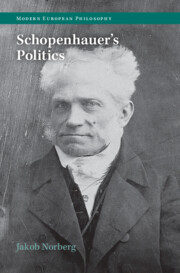
Arthur Schopenhauer (1788–1860) lived through an era of great political turmoil, but previous assessments of his political thought have portrayed him as a pessimistic observer with no constructive solutions to offer. By assembling and contextualizing Schopenhauer's dispersed comments on political matters, this book reveals that he developed a distinct conception of politics. In opposition to rising ideological movements such as nationalism or socialism, Schopenhauer denied that politics can ever bring about universal emancipation or fraternal unity. Instead, he viewed politics as a tool for mitigating rather than resolving the conflicts of a fundamentally imperfect world. Jakob Norberg's fascinating book reconstructs Schopenhauer's political ideas and shows how they relate to the dominant debates and trends during the period in which he lived. This title is also available as Open Access on Cambridge Core.
The national populism of the Brexit movement builds up its political worldview on the basis of an ethnocentric myth of continuous homogeneous British nationhood. This was a construct of the imagination that included nostalgia for lost British empire. It was tightly bound up with the Brexiters’ concept of ‘the people’, which brought into their campaign rhetoric the idea of ‘the will of the people’ and ‘the mandate of the people’, as well as ideas from social contract theory. ‘The will of the people’ was a phrase that ran throughout Brexitspeak, deployed by the ex-Remainer Theresa May and ardent Leavers alike, and backed up by the populist press. Brexitspeakers knew what the people’s will was, by implication at least. And the claim that this ‘will’ gave the government an unquestionable mandate followed automatically, despite the narrow margin by which the Leavers had won, and despite the fact that before it the result had been defined as ‘advisory’ only. There was also the question of who precisely constituted ‘the people’ at the referendum, for there were important groups of potential voters who were excluded by the Brexiter-influenced Referendum Act.
In Kant’s Groundwork II, the Formula of Universal Law (FUL) seems to be the argumentative link between the notion of a categorical imperative and later formulae (e.g. of humanity), its function as this link dependent on its equivalence to both. Some commentators have denied this equivalence and read the section as a failure. Others have abandoned its expository development by reading later formulae into the FUL. I argue that we need do neither if we distinguish the universality of the FUL from that of the will of all and read Groundwork II as extracting the latter from common moral cognition.
Nietzsche’s late text, Thus Spoke Zarathustra, has an important formal aim: to release images from the demands of reason. It also has a moral aim – to release the human will from its enslavement to preordained images, including from the image of itself. What would an image be for which its viewer still had to be invented? for which its viewer was being invented – in the image itself? This is the adventure of Nietzsche’s major work, which, like some literary works, is drunk with images, but they take a certain path of development, from knowing images to willing images. Instead of an image that presents knowledge for a knower, Nietzsche, through trial and error, develops a “willing image,” which first has a negative task, to liberate the will from its tie to established knowledge. But across the momentous book he also gradually sets aside images that stimulate an already existing will. The aim of Thus Spoke Zarathustra is thus like the aim of some literature, to give desire, wishing, wanting, hoping, and loving a new landscape in which it can change its genre and its objects, where it can learn to self-determine.