Refine search
Actions for selected content:
22 results
6 - What Is Democracy?
- from Part III - Democracy, Liberty, and Judicial Review
-
- Book:
- Democracy, Liberty, and Judicial Review
- Published online:
- 05 December 2025
- Print publication:
- 08 January 2026, pp 177-207
-
- Chapter
- Export citation
7 - Representation and Democracy
- from Part III - Democracy, Liberty, and Judicial Review
-
- Book:
- Democracy, Liberty, and Judicial Review
- Published online:
- 05 December 2025
- Print publication:
- 08 January 2026, pp 208-236
-
- Chapter
- Export citation
1 - Majoritarian Arguments
- from Part I - The Majoritarian Critique and the Constitutionalist Response
-
- Book:
- Democracy, Liberty, and Judicial Review
- Published online:
- 05 December 2025
- Print publication:
- 08 January 2026, pp 19-56
-
- Chapter
- Export citation

Democracy, Liberty, and Judicial Review
-
- Published online:
- 05 December 2025
- Print publication:
- 08 January 2026
Chapter 2 - Representation, Choice, and Rule
-
- Book:
- Time and Governance in Fifteenth-Century Perpignan
- Published online:
- 26 July 2025
- Print publication:
- 14 August 2025, pp 39-93
-
- Chapter
- Export citation
Constituency Juries: Holding Elected Representatives Accountable through Sortition
-
- Journal:
- Perspectives on Politics , First View
- Published online by Cambridge University Press:
- 30 July 2025, pp. 1-19
-
- Article
-
- You have access
- Open access
- HTML
- Export citation
Representation vs. Democracy?: Presbyterianism in the Age of the French Revolution
-
- Journal:
- Church History / Volume 94 / Issue 2 / June 2025
- Published online by Cambridge University Press:
- 01 September 2025, pp. 244-270
- Print publication:
- June 2025
-
- Article
-
- You have access
- Open access
- HTML
- Export citation
4 - Misreading Conservative Nationalism (1920–1945)
-
- Book:
- Cosmopolitan Nationalism in Ghana
- Published online:
- 12 December 2024
- Print publication:
- 19 December 2024, pp 158-201
-
- Chapter
- Export citation
1 - The Balance of Classes (1867)
- from Political Writings
-
- Book:
- Albert Venn Dicey: Writings on Democracy and the Referendum
- Published online:
- 10 February 2023
- Print publication:
- 16 February 2023, pp 3-15
-
- Chapter
- Export citation
7 - The Referendum and Its Critics (1910)
- from Political Writings
-
- Book:
- Albert Venn Dicey: Writings on Democracy and the Referendum
- Published online:
- 10 February 2023
- Print publication:
- 16 February 2023, pp 127-151
-
- Chapter
- Export citation
5 - The Referendum (1894)
- from Political Writings
-
- Book:
- Albert Venn Dicey: Writings on Democracy and the Referendum
- Published online:
- 10 February 2023
- Print publication:
- 16 February 2023, pp 103-111
-
- Chapter
- Export citation
3 - Ought the Referendum to Be Introduced into England? (1890)
- from Political Writings
-
- Book:
- Albert Venn Dicey: Writings on Democracy and the Referendum
- Published online:
- 10 February 2023
- Print publication:
- 16 February 2023, pp 53-80
-
- Chapter
- Export citation
4 - The Defence of the Union (1892)
- from Political Writings
-
- Book:
- Albert Venn Dicey: Writings on Democracy and the Referendum
- Published online:
- 10 February 2023
- Print publication:
- 16 February 2023, pp 81-102
-
- Chapter
- Export citation
9 - Development during the Last Thirty Years of New Constitutional Ideas (Extract from the Introduction to the Eighth Edition of Introduction to the Study of the Law of the Constitution, 1915)
- from Political Writings
-
- Book:
- Albert Venn Dicey: Writings on Democracy and the Referendum
- Published online:
- 10 February 2023
- Print publication:
- 16 February 2023, pp 171-209
-
- Chapter
- Export citation
8 - The Parliament Act, 1911, and the Destruction of All Constitutional Safeguards (1912)
- from Political Writings
-
- Book:
- Albert Venn Dicey: Writings on Democracy and the Referendum
- Published online:
- 10 February 2023
- Print publication:
- 16 February 2023, pp 152-170
-
- Chapter
- Export citation
2 - Democracy in Switzerland (1890)
- from Political Writings
-
- Book:
- Albert Venn Dicey: Writings on Democracy and the Referendum
- Published online:
- 10 February 2023
- Print publication:
- 16 February 2023, pp 16-52
-
- Chapter
- Export citation
Introduction
-
- Book:
- Albert Venn Dicey: Writings on Democracy and the Referendum
- Published online:
- 10 February 2023
- Print publication:
- 16 February 2023, pp viii-xxxix
-
- Chapter
- Export citation
6 - Will the Form of Parliamentary Government Be Permanent? (1899)
- from Political Writings
-
- Book:
- Albert Venn Dicey: Writings on Democracy and the Referendum
- Published online:
- 10 February 2023
- Print publication:
- 16 February 2023, pp 112-126
-
- Chapter
- Export citation
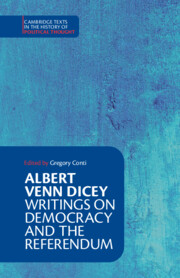
Albert Venn Dicey: Writings on Democracy and the Referendum
-
- Published online:
- 10 February 2023
- Print publication:
- 16 February 2023
7 - Democracy in the (Other) America
- from Part II - Receptions and Applications
-
-
- Book:
- The Cambridge Companion to <I>Democracy in America</I>
- Published online:
- 23 March 2022
- Print publication:
- 24 March 2022, pp 204-229
-
- Chapter
- Export citation
