To save content items to your account,
please confirm that you agree to abide by our usage policies.
If this is the first time you use this feature, you will be asked to authorise Cambridge Core to connect with your account.
Find out more about saving content to .
To save content items to your Kindle, first ensure no-reply@cambridge.org
is added to your Approved Personal Document E-mail List under your Personal Document Settings
on the Manage Your Content and Devices page of your Amazon account. Then enter the ‘name’ part
of your Kindle email address below.
Find out more about saving to your Kindle.
Note you can select to save to either the @free.kindle.com or @kindle.com variations.
‘@free.kindle.com’ emails are free but can only be saved to your device when it is connected to wi-fi.
‘@kindle.com’ emails can be delivered even when you are not connected to wi-fi, but note that service fees apply.
Aristotle defines hybris as a way of mistreating (dishonouring) others. But he also emphasises its psychology, in ways that chime very well with the understanding of the concept in earlier literary sources. As well as indicating a failure to show other people the respect they deserve, hybris is a way of thinking too much of oneself. This affects one’s estimation of the role that luck plays in all human endeavour: the classic Aristotelian case is that of the rich, ‘lucky fools’ who think that their material good fortune is a sign that they excel in all respects; but ancient hybristai in general tend to develop the belief that they are invulnerable to the vagaries of fortune. In this way, hybris regularly entails a failure to deal adequately with risk. At the same time, it bears a relation to the myth of meritocracy, by which the fortunate convince themselves that their success is deserved.
The notion of making it big has different meanings for different people. Sometimes it is a precise moment in time when everything clicks. Other times, it can be a slow process. And sometimes, a big break that took many years can look like an overnight sensation to the outside world. People in this chapter talk about how the creative life isn’t always about fame and acclaim.
This chapter develops a view that casts moral heroism as a specific kind of moral achievement and argues it is superior to the virtue approach to moral heroism. I begin the discussion with J. O. Urmson’s account of moral heroism as overcoming fear, registering the limitations of that account before moving on to Gwen Bradford’s account of achievement as such, which centers on overcoming difficulty. She defends a view of difficulty that consists in the expending of effort, rather than in the surmounting of complexity. Her highly developed account is a good model for analyzing moral achievement, yet it is in need of significant modification in order to function in a specifically moral context. In order to give an account of moral achievement, I argue that Bradford’s key notion of difficulty should be replaced by sacrifice. Moral heroism consists in making high-stakes sacrifices. I develop an account of what sacrificing consists in, identifying features of actions that constitute sacrifices. I show how this concept offers us an account of moral heroism as a kind of moral achievement. I then argue that it significantly outperforms the virtue approach according to the desiderata from Chapter 2: accuracy, related phenomenon, and fitting responses.
Over the past decade, ethnographers have increasingly paid attention to the ways in which practices and principles of financial speculation have been adopted in the governance of public and private resources. Those interested in matters of tax and taxation have typically associated speculation with tax evasion and fraud, paying less attention to other ways in which speculative thinking has entered the relationship between the taxpayer and the state. In this chapter, I examine the design and public reception of the Slovak National Receipt Lottery, one example of the way speculative logic has become part of governing the fiscal subject. I show how the Lottery both reflected and challenged established ideas of fiscal citizenship and redistributive justice, triggering novel anxieties about fraud, disclosure, and privacy amongst citizens and policymakers alike. It revealed a profound disconnect between the way policymakers imagined taxpayer behaviour and motivation, and citizens’ own perception of themselves as morally and socially embedded subjects. Finally, I suggest that the National Receipt Lottery is an example of speculative governance: a particular way of administering public life which combines elements of audit culture, behavioural policy, and gamification to generate social goods and shape citizen subjectivities.
The Romans had to cope with uncertainty and, in part, did so through a shared set of knowledge and practices, which this chapter calls a risk culture. These ways of coping contained a lower level of individuality, consciousness or reflexivity than Beck’s modern Risk Society. There was also no simple divide between lay and expert knowledge. The Roman world exposed its inhabitants to a variety of risks but the accumulated experience of coping with these represented a mutual way of mitigating the dangers.
Modern theorists have seen the development of the concept of risk as reflecting a profound shift away from a belief in the divine determination of human fate. Modernity, it is also argued, has seen the introduction of new mega-risks, which are far larger than those before. The chapter challenges these views and argues both that the Romans were not simply fatalistic about the future, and also that it is impossible to quantify whether the ancients faced less risk.
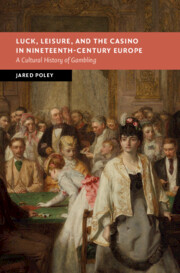
The casino provided a unique location to probe the logic of chance for those seeking to understand fortune and misfortune, causation and correlation. Chance helped generate predictability. When we shift to consider the picture of luck that emerges, we see that it is exhibited in various systems designed to generate wins at the gambling table, lured to a person to through any number of bizarre superstitions, and made the object of social scientific inquiry. Luck was something that people could generate, manufacture, cultivate, or capture. This element of human agency speaks to a vision of the world that promoted the basic idea of human agency while also acknowledging its limits. Gambling systems and superstitions, especially when they did not rest on the foundation of the “maturity of chances,” were at their heart modern attempts to bend luck to one’s side.
The introduction sets out the intent of the book, an overview of the major works in the field, and a view of the arguments appearing in each chapter. Gambling is central to the cultural, social, and intellectual history of the nineteenth century. Studying casino gambling provides a way to see how nineteenth-century Europeans understood their changing world, even as it also reflected those changes itself. In this way gambling was used in an explanatory capacity, one that let contemporaries probe the inner workings of the machine and the creation of knowledge. If we want to understand the intricate dance of society, culture, politics, and ideas, then gambling is a useful tool to pry open these different stories, allowing us to see better large historical transformations.
Gambling was central to the cultural, social, and intellectual history of nineteenth-century Europe. By tracing the evolution of gambling and investigating the spatial qualities of the casino, this book reveals how Europeans used gambling to understand their changing world. The development of resorts and the architectural qualities of casinos demonstrate how new leisure practices, combined with revolutions in transportation and communication, fashioned resort gambling in the Rhineland and Riviera. Jared Poley explores the importance of casino gambling in people's lives, probing how gambling and fate intersected. The casino impacted understandings of the body, excited emotions, and drove the 'psychology' of the gambler, as well as affecting ideas about probability, chance, and luck. Ultimately, this book addresses the fundamental question of what gambling was for, and how it opened up opportunities to understand theories about aggression, play, and human development.
Kenneth I. Kellermann, National Radio Astronomy Observatory, Charlottesville, Virginia,Ellen N. Bouton, National Radio Astronomy Observatory, Charlottesville, Virginia
The history of radio astronomy has been a series of discoveries, mostly serendipitous, using a new instrument, or using an old instrument in a new unintended way. Theoretical predictions have had little influence, and in some cases actually delayed the discovery by discouraging observers. Many of the key transformational discoveries were made while investigating other areas of astronomy; others came as a result of commercial and military pursuits unrelated to astronomy. We discuss how the transformational serendipitous discoveries in radio astronomy depended on luck, age, education, and the institutional affiliation of the scientists involved, and we comment on the effect of peer review in the selection of research grants, observing time, and the funding of new telescopes, and speculate on its constraint to new discoveries. We discuss the decrease in the rate of new discoveries since the Golden Years of the 1960s and 1970s and the evolution of radio astronomy to a big science user oriented discipline. We conclude with a discussion of the impact of computers in radio astronomy and speculations on the potential for future discoveries in radio astronomy – the unknown unknowns.
Understanding serendipity from a trajectory perspective is crucial because serendipitous findings bend the arc of progress, leading us down unexpected paths - in the process changing the direction and rate of research pursuits. Many imagine the classic "Eureka!" moments being a demonstration of such serendipity in real life, although this might be overly simplistic. There are many processes that occur before and after making an unexpected observation that, in hindsight, set the stage for these observations to become discoveries of use. Chapter 18 explores how the serendipitous discoveries of Helicobacter pylori and many modern psychotherapeutic drugs came to be, and discusses how we can more systematically cultivate conditions that allow serendipitous findings to occur.
We report a series of experiments investigating the influence of feeling lucky or unlucky on people’s choice of known-risk or ambiguous options using the traditional Ellsberg Urns decision-making task. We induced a state of feeling lucky or unlucky in subjects by using a rigged wheel-of-fortune game, which just missed either the bankrupt or the jackpot outcome. In the first experiment a large reversal of the usual ambiguity aversion effect was shown, indicating that feeling lucky made subjects significantly more ambiguity seeking than usual. However, this effect failed to replicate in five refined and larger follow-up experiments. Thus we conclude that there is no evidence that feeling lucky reliably influences ambiguity aversion. Men were less ambiguity averse than women when there were potential gains to be had, but there were no gender differences when the task was negatively framed in terms of losses.
A valid explanation may not be based on any theory, and luck can be a valid explanation of certain business events. Regression to the mean suggests that good performance (probably due to good luck) is likely to be followed by decline whereas poor performance (probably due to bad luck) is likely to be followed by improvement. When theory is used, there is a risk of theory-ladenness of observation, which challenges the traditional empiricist account of scientific observation as the passive reception of sense-data. The theory-laden view implies that different paradigms or theories may be incommensurable in the sense that their proponents may not be able to communicate with and understand each other meaningfully. However, both theory-ladenness and incommensurability are exaggerations and can be overcome. The example of yin-yang theory shows that it is important to distinguish between substantive theory (or theory in the usual meaning of the term) and metatheory. The former is used to explain empirical phenomena whereas the latter serves as the philosophical foundation for the former.
This “guided tour” of the Lives of the Poets explores Johnson’s criteria for poetry, starting from his discussion of the metaphysical poets. What Johnson says about Gray’s Elegy is related to the commemorative impulse in the Lives. The ironic vision of the Life of Savage is argued to underlie that comedic understanding of the complex relation between writing and life that frequently surfaces elsewhere. Four major writers then get special attention, in which literary appreciation and quasi-personal relationship go hand in hand. Johnson’s intensely held ambivalence about Paradise Lost pays reluctant tribute to Milton’s own capaciousness of mind. Swift’s rigor toward himself and others is met by Johnson’s correspondingly acerbic, unforgiving account. Dryden’s roving, fluid, omni-curious intelligence, his hospitality to the occasional and contingent, is matched by the relaxed generosity and miscellaneousness of Johnson’s Life of Dryden, as contrasted with the careful scrutiny afforded to the life and work of the self-aware, self-critical, aspiring Pope.
In this paper, I reflect on the implications that ultimatum and dictator game experiments might have for public policy and for the debates over egalitarianism. Experiments suggest that people are more inclined to redistribute when outcomes are influenced by luck than effort. This can create difficulties for public policy when people hold contrasting views over whether luck or effort determine outcomes. The results also appear to play into forms of luck egalitarianism. However, they may also be consistent with an alternative understanding of egalitarianism as the impulse to have rules that treat people equally.
Scholars have debated the various texts in which Socrates seems to indicate an extremely close – perhaps even logical or analytic – connection between virtue and happiness. Is virtue simply identical to happiness? Is virtue all that is needed – is it sufficient – for happiness? Some texts seem to indicate such a logical connection, but attributing the sufficiency thesis to Socrates also commits him to the view that even the worst disasters cannot make a good person unhappy or spoil a virtuous agent’s life. Other texts, however, seem to show that Socrates clearly did recognize our vulnerability to conditions that are beyond human control. Provides an interpretation of the Socratic view on this issue that denies the sufficiency thesis while maintaining a strong nomological connection between virtue and happiness. Greater virtue will always improve a human life, even if such improvement falls short of achieving positive happiness. Success comes in degrees, even in the most important pursuits.
This contribution argues that the concept of protean power opens a space to think about the limits of control and knowledge about catastrophic possibilities such as nuclear war. To do so, it offers the first distinctive definition of nuclear luck, which has long been acknowledged by policy and military leaders but remains unaccounted for in scholarship. It further shows that the nuclear realm is defined by two key unknowables. However, it argues that protean power perpetuates a survivability bias which has characterized scholarship so far, before suggesting ways to overcome that bias and modify scholarly ethos to acknowledge such catastrophic possibilities.
Support is canvassed for a new way of approaching some core epistemic issues: anti-risk epistemology. It is explained how anti-risk epistemology differs from anti-luck epistemology by examining some of the subtle (but epistemologically significant) differences between the notions of luck and risk. It is argued that anti-risk epistemology, while essentially an adaption of anti-luck epistemology, can nonetheless resolve some motivational issues that face the latter proposal. In the process, it can provide other important benefits, such as enabling a broader range of epistemic assessments, including capturing the complexity of some important epistemic assessments involving collaborative inquiry. Our ultimate concern, however, is to examine how anti-risk epistemology fits into a wider virtue-theoretic account of knowledge, one that replaces anti-luck virtue epistemology with anti-risk virtue epistemology. As we will see, the latter proposal inherits all the strengths of the former but none of its flaws. It is also better placed to explain why knowledge is never compatible with unsafe belief, and to provide us with a diagnostic handle on the path taken by post-Gettier epistemology.
Some philosophers have recently argued that luck at the time of decision is a problem for compatibilists and libertarians alike. But conceptual ambiguity regarding deterministic luck at the time of decision – henceforth C-luck – has obscured recognition of the problem C-luck poses to compatibilism. This paper clarifies C-luck and distinguishes it from present luck, showing that the former arises from contingent factors at the time of decision instead of presupposed free will requirements. We then argue that empirical findings confirm the existence of C-luck thereby raising a fundamental challenge to compatibilist accounts of moral responsibility.
Achievements are among the things that make a life good. Assessing the plausibility of this intuitive claim requires an account of the nature of achievements. One necessary condition for achievement appears to be that the achieving agent acted competently, i.e. was not just lucky. I begin by critically assessing existing accounts of anti-luck conditions for achievements in both the ethics and epistemology literature. My own proposal is that a goal is reached competently (and thus an achievement), only if the actions of the would-be-achiever make success likely, and that this is the reason why she acts that way.