To save content items to your account,
please confirm that you agree to abide by our usage policies.
If this is the first time you use this feature, you will be asked to authorise Cambridge Core to connect with your account.
Find out more about saving content to .
To save content items to your Kindle, first ensure no-reply@cambridge.org
is added to your Approved Personal Document E-mail List under your Personal Document Settings
on the Manage Your Content and Devices page of your Amazon account. Then enter the ‘name’ part
of your Kindle email address below.
Find out more about saving to your Kindle.
Note you can select to save to either the @free.kindle.com or @kindle.com variations.
‘@free.kindle.com’ emails are free but can only be saved to your device when it is connected to wi-fi.
‘@kindle.com’ emails can be delivered even when you are not connected to wi-fi, but note that service fees apply.
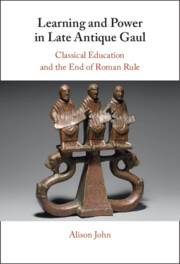
This chapter situates classical education in late antique Gaul in its historical context, positioning the work within the current scholarly debates, and building on recent scholarship on late antique Gaul. Arranged thematically, Chapter 2 considers key developments in the political and military relationships between the western Roman empire, Gallo-Romans and barbarian groups, the prospects and prosperity of Gallo-Roman aristocrats, the increasing dominance of the Church and bishops in daily life, and the vitality and continuity of Gallo-Roman cities. It considers the conditions necessary for classical education to thrive and function and discusses how the structures that fostered education were affected by the political, military, religious, and cultural transformations of fifth-century Gaul.
The concluding chapter reflects upon how the themes and questions explored in the book speak to familiar concerns of families, communities, and societies across time. What is the purpose of education? What do we expect of our education, and in what ways does our pursuit of knowledge and our learning define who we are? The conclusion draws together the arguments from the preceding chapters, considering in what ways the ‘fall’ of Rome meant the end of the schools of grammar and rhetoric in Gaul. Without the superstructure of the Roman empire, the socio-political culture that valued literary education disappeared, and the schools soon followed suit; it was not primarily material changes caused by the political, cultural, and religious upheavals of the fifth century that led to the decline of the schools, but rather marked changes in the attitudes and mindset towards education and learning of the emerging power brokers of post-imperial Gaul – the barbarian kingdoms and the Church.
The introduction sets out the approaches, sources, and scope of the book. It acquaints the reader with the main features of classical education and places the book within the modern historiography.
This book traces the changing political and social roles of classical education in late antique Gaul. It argues that the collapse of Roman political power in Gaul changed the way education was practiced and perceived by Gallo-Romans. Neither the barbarian kingdoms nor the Church directly caused the decline of classical schools, but these new structures of power did not encourage or support a cultural and political climate in which classical education mattered; while Latin remained the language of the Church, and literacy and knowledge of law were valued by barbarian courts, training in classical grammar and rhetoric was no longer seen as a prerequisite for political power and cultural prestige. This study demonstrates that these fundamental shifts in what education meant to individuals and power brokers resulted in the eventual end of the classical schools of grammar and rhetoric that had once defined Roman aristocratic public and private life.
A range of sciences was taught in the Platonist schools of late antiquity (third to sixth centuries) with the purpose of leading the human soul up to a divine life. This curriculum constituted so to speak a ladder of the sciences. The ways in which these sciences were newly interpreted in this context have not, however, been fully appreciated. This volume brings together selected essays, some translated into English for the first time, which show how a new vision of these disciplines and sciences was reached as part of a Platonist philosophical education. They cover a wide range of topics, from rhetoric, ethics and politics to mathematics, music and metaphysics, and discuss the work of various philosophers. Dominic O'Meara is considered one of the foremost scholars of Platonism and this book provides readers with an indispensable tool for accessing his most important scholarship in this area.
Veiling meant many things to the ancients. On women, veils could signify virtue, beauty, piety, self-control, and status. On men, covering the head could signify piety or an emotion such as grief. Late Roman mosaics show people covering their hands with veils when receiving or giving something precious. They covered their altars, doorways, shrines, and temples; and many covered their heads when sacrificing to their gods. Early Christian intellectuals such as Origen and Gregory of Nyssa used these everyday practices of veiling to interpret sacred texts. These writers understood the divine as veiled, and the notion of a veiled spiritual truth informed their interpretation of the bible. Veiling in the Late Antique World provides the first assessment of textual and material evidence for veiling in the late antique Mediterranean world. Susannah Drake here explores the relation between the social history of the veil and the intellectual history of the concept of truth as veiled/revealed.
The proliferation of fortification in north-western Europe during Late Antiquity marks an important shift from the first to early third centuries. The fortified cities and military installations were joined by new fortified towns and rural and hilltop defences. While these defences have been extensively studied, there has been little engagement with this transformation at a statistical level. This article provides an overview of defence in the region using data collected across northeastern Gaul and the provinces of Germania Secunda and Germania Prima. It will highlight biases, distributions and key variations in the dataset and demonstrate regional variations in defence on a large scale.
The author provides an account of the cultural evolution of a new concept of leadership for both emperors and the church in the Christianising society based in the eastern Roman capital of Constantinople. The focus is the pivotal period from the establishment of Constantine the Great’s one-man rule through Byzantine rule over the eastern and western empires in the sixth and seventh centuries, ending with the rule of Irene as sole empress (797–802) and Charlemagne’s coronation in 800. Letters exemplify the late Roman transformation from a model of one-man (or one-family) rule to a more complex system of power sharing between religious authorities, which was under constant renegotiation, from the highest levels of governance under emperors and bishops to the lowest level of the parish led by local clergy. Increasing opportunities for women to exercise power, hand in hand with the episcopal leaders of the new church, also shaped imperial leadership ideals in new ways.
The introduction sets the scene at the catacombs of San Gennaro in Naples, where our only early Christian fresco from the Shepherd of Hermas is painted on a tomb wall. I lay out the thesis and roadmap for the book, namely, that the Shepherd crafts obedient early Christian subjects within the ancient Mediterranean discourse of enslavement. A brief overview of the Shepherd’s content is provided, as well as regarding its popularity and transmission history across the ancient, late ancient, and medieval worlds. I especially note how the Shepherd became a pedagogical tool in late antiquity, and that the Shepherd’s teachings are even placed in Jesus’s own mouth by some late ancient writers, heightening the stakes for understanding how enslavement is utilized in a text used to shape Christian thought and practice for centuries after its composition. Also provided is a brief introduction to slavery in antiquity to situate the reader, as well as outline some of the major influences on my approach to reading the text, especially womanist translational theory and Chris de Wet’s concept of doulology.
The last decades have seen great scholarly interest in the fate of Roman temples and cult statues during the Christianisation of the Roman Empire. The surge of studies on spatiality and lived religion in Roman studies have demonstrated that ancient religious practice was not confined to sanctuaries but rather infused into all spheres of everyday life. Informed by these studies, I argue that the Christianisation effort was not confined to temples and cult statues in sanctuaries, despite the narrow focus on these monuments in legal and patristic sources. The spaces where people most frequently moved, lived, and practised religion in their everyday lives were equally important religious arenas. In this article I venture out of the temples and into the streets of late antique Ephesus to the Triodos intersection to highlight an array of subtle transformations that are unassuming in isolation, but together effectively Christianised the streetscape. I demonstrate that streetscapes were arenas of material Christianisation alongside monumental sanctuaries. The Triodos is used as a point of departure to show how the Roman streetscapes functioned as more-than-material religious assemblages. Human–material interaction in ritual and everyday movement and practices made the streetscapes active participants in the Christianisation process.
The study of travel in Late Antiquity is complicated by a specific set of factors that will appear throughout this volume and in every period: namely, the motivations and goals of the travellers. This is especially true in Late Antiquity because the mental shape of the world was changing quickly and dramatically from what came before. The imperial reign of Constantine (306−337) ushered in for Christian writers a long-expected saeculum of imperial peace and the triumph of the Christian message. The motivations for travel in Late Antiquity very often can only be read on the background of that paradigm shift. The triumph of the Church was inextricably linked to the shape of the empire, notionally and geographically. That same empire in which Christians formerly had moved quietly and in secret was now an open space for travel and expansive thinking. Thus, travel in Late Antiquity went hand-in-hand with new geographical horizons: not primarily a physical expansion of “the known world” (the oikoumenē in Greek), though that came too, but a freedom of expression through movement within the Roman Empire they already knew.
This article explores literary records of the fourth-century senatorial dedications that illustrate the perception of inscribed monuments in variegated spatial contexts. It offers considerations about literary reflections of material conditions in which late antique statues were set, staged, and perceived, their interaction with urban and domestic contexts, accessibility, and ways in which their mise-en-scène had an impact on an onlooker. Late antique and middle Byzantine patrographic attestations highlight the pleasure experienced by viewing inscribed monuments in city fora. I argue that literary accounts of statue and epigraphic representations of the senatorial aristocracy mediate the phenomenon of the expansion of new, spatially mobile elites. I examine literary descriptions of (1) statuary set up for senatorial office-holders; (2) dedications for emperors and other recipients awarded by senatorial officials; (3) statue monuments erected by senates. I conclude with an elaboration on what different media genres, as mediating structures by which aristocracy and rulers articulated their interaction, reveal about members of the senatorial order fashioning their relationship with the imperial court and the broader public. The elusive traces in late antique and medieval literary reports furnish fragments of historical evidence of how the memory of individual senators was constructed, reshaped, and perceived.
In 2022–2023, fragments of figurative wall paintings were discovered in the Royal Palace at Sanjar-Shah, a Sogdian site near Panjikent in Tajikistan. The paintings depict a procession of priests approaching a large fire altar—this offers a rare insight into religious imagery and a representation of fire worship in Sogdian murals.
In 1926, Roberto Bartoccini excavated a late-antique tomb at Sirte, Libya. Fifty-three inscriptions in Latin, Greek and Latino-Punic have been recorded and used as evidence of a thriving Christian community. This article reassesses these inscriptions, paying particular attention to the Latino-Punic texts, and discusses the persistence of a Punic identity that can be placed in the context of the wider archaeological landscape.
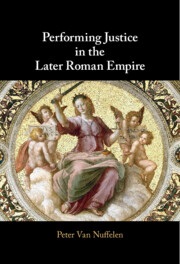
In the Later Roman Empire (AD 300–650), power seems to manifest itself mostly through legislation, bureaucracy, and an increasingly distant emperor. This book focuses instead on personal interaction as crucial to the exercise of power. It studies four social practices (petitions, parrhesia, intercession, and collective action) to show how they are much more dynamic than often assumed. These practices were guided by strong expectations of justice, which constrained the actions of superiors. They therefore allowed the socially inferior to develop strategies of conduct that could force the hand of the superior and, in extreme cases, lead to overturning hierarchical relations. Building on the analysis of these specific forms of interaction, the book argues for an understanding of late antique power rooted in the character and virtue of those invested with it.
The Encyclopaedia of Late Antique Art and Archaeology seeks to fill a significant gap in historical research by placing art and archaeology at the forefront of late Roman and late antique studies. Recognising the need for a comprehensive and accessible reference, this work moves beyond the traditional focus on ‘early Christian archaeology’ to adopt a broader perspective. It highlights the dynamic interplay of Christianity, Judaism and Islam, challenging outdated notions of a fully Christianised Late Antiquity. Organised into six sections – architecture and iconography, artefacts and material evidence, urbanism and rural landscapes, regional and ethnic diversity, and key issues and debates – the encyclopaedia offers a structured, in-depth exploration of the field. With contributions from leading scholars, it synthesises archaeological discoveries to challenge narratives of decline, instead presenting Late Antiquity as an era of transformation and cultural fusion.
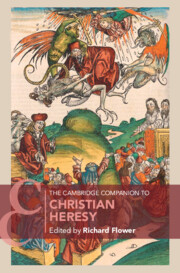
This chapter introduces the main themes and scope of the volume, including discussing the origin of the concept of ‘heresy’, as well as outlining what aspects of it will and will not form the focus of the following chapters. It then provides a summary of the division of the volume into two parts and the particular topics and case studies contained in each.
The concept of heresy has played a major role across Christian history. Traditionally, heretical sects have been regarded as distinct, real-life groups of people who had departed from the stable orthodox traditions of Christianity and who posed a threat that needed to be addressed, sometimes through violent repression. More recently, scholarship has focused on the notion of heresy as discourse, placing particular emphasis on its literary construction and the social and cultural contexts in which it was deployed. This literature has generated significant debates about the nature and historicity of many heresies. The Cambridge Companion to Christian Heresy provides a systematic and up-to-date guide to the study of this topic and its methodological challenges. The opening chapters explore different forms of written material that have played vital roles in historical disputes and in modern scholarly accounts. These are followed by case studies of thirteen notable heresies, ranging from the Gnostics through to the Hussites at the dawn of the Reformation.
Magic and Heresy in Ancient Christian Literature is a genealogical study of two parallel but not coequal discursive trajectories: of 'magic' and of 'heresy.' This longue durée analysis charts how these two discursive streams intersect in myriad ways, for myriad ends, across the first four centuries of selected Christian literature. Magic and Heresy attempts to answer in part the question: When and how did early Christian authors start thinking of magic as heresy – that is, as a religious and epistemic system wholly external to their own orthodoxies? Prompted by metacritical concerns about the relationship between magic and heresy, as well as these categories' roles in erecting and maintaining Christian empire, this Element seeks to disrupt tidy conceptual conflations of magic-heresy constructed by ancient authors and replicated in some modern scholarship. Magic and Heresy excavates the cycles of discursive disciplining that eventually resulted in these very conflations.
Scholars, beginning with Hippolyte Delehaye, have long claimed a distinction between eastern and western customs of relic veneration in late antiquity: westerners left martyrial corpses intact and did not translate them, using contact relics instead, while easterners readily moved and divided these relics. They base this distinction on two papal letters from Pope Hormisdas’s legates and from Gregory the Great that distinguish between Roman and Greek customs of relics veneration. Yet scholars have almost totally neglected one piece of late antique evidence highly instructive for this topic: a letter from Eusebios of Thessaloniki, a contemporary of Gregory the Great, responding to a request from the emperor Maurice to send a corporeal relic of the Thessalonian martyr Demetrios. I argue that Eusebios’s letter demonstrates that the distinction between Roman and Greek customs of relic veneration proposed by the papal letters does not hold in late sixth-/early seventh-century Thessaloniki; furthermore, rather than giving evidence for sweeping, regional patterns, these letters all offer reflections on local, municipal customs of relic veneration in Rome and Thessaloniki in response to local imperial customs in Constantinople.