To save content items to your account,
please confirm that you agree to abide by our usage policies.
If this is the first time you use this feature, you will be asked to authorise Cambridge Core to connect with your account.
Find out more about saving content to .
To save content items to your Kindle, first ensure no-reply@cambridge.org
is added to your Approved Personal Document E-mail List under your Personal Document Settings
on the Manage Your Content and Devices page of your Amazon account. Then enter the ‘name’ part
of your Kindle email address below.
Find out more about saving to your Kindle.
Note you can select to save to either the @free.kindle.com or @kindle.com variations.
‘@free.kindle.com’ emails are free but can only be saved to your device when it is connected to wi-fi.
‘@kindle.com’ emails can be delivered even when you are not connected to wi-fi, but note that service fees apply.
This chapter explores the development of debates on the moral among theologians from the mid twelfth century to the first half of the thirteenth century. It identifies a crucial turning point in the early decades of the thirteenth century, when interest in understanding the very nature of the human being and its faculties paved the way for a general reassessment of the issue of the different kinds of law.
David Hume's A Treatise of Human Nature, published anonymously in 1739–40, was his first major work of philosophy, and his only systematic, scientific analysis of human nature. It is now regarded as a classic text in the history of Western thought and a key text in philosophical empiricism, scepticism, and naturalism. This Critical Guide offers fourteen new essays on the work by established and emerging Hume scholars, ranging over Hume's epistemology and philosophy of mind, the passions and ethics, and the early reception of the Treatise. Topics include the significance of Hume's treatment of the passion of curiosity, the critical responses to Hume's account of how we acquire belief in external objects, and Hume's depiction of the human tendency to view the world in inegalitarian ways and its impact on our view of virtue. The volume will be valuable for scholars and students of Hume studies and in eighteenth-century philosophy more generally.
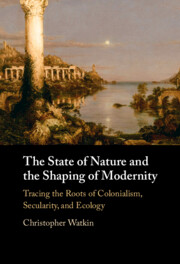
The state of nature is a powerful idea at the heart of the fragmented and sometimes conflicting stories the modern West tells about itself. It also makes sense of foundational Western commitments to equality and accumulation, freedom and property, universality and the individual. By exploring the social and cultural imaginaries that emerge from the distinct and often contradictory accounts of the state of nature in the writing of Hobbes, Locke and Rousseau, The State of Nature and the Shaping of Modernity offers a fresh perspective on some of the most pressing debates of our time, showing how the state of nature idea provides a powerful lens through which to focus the complex forces shaping today's political and cultural landscape. It also explores how ideas about human nature and origins drive today's debates about colonialism, secularism, and the environment, and how they can shed new light on some of society's most heated debates.
The Origins of Scholasticism provides the first systematic account of the theological and philosophical ideas that were debated and developed by the scholars who flourished during the years immediately before and after the founding of the first official university at Paris. The period from 1150-1250 has traditionally been neglected in favor of the next century (1250-1350) which witnessed the rise of intellectual giants like Thomas Aquinas, Albert the Great, and John Duns Scotus, who famously popularized the major works of Aristotle. As this volume demonstrates, however, earlier scholastic thinkers laid the groundwork for the emergence of theology as a discipline with which such later thinkers actively engaged. Although they relied heavily on traditional theological sources, this volume highlights the extent to which they also made use of philosophy not only from the Greek but also the Arabic traditions in ways that defined the role it would play in theological contexts for generations to follow.
The goal of this chapter is to introduce dehumanization and humanness. It begins with the story of Carmelita Torres, a seventeen-year-old adolescent girl from Juárez, Mexico. In January 1917, she was asked to get naked, shave her hair, and take a kerosene bath by US immigration authorities when she was coming to work as a maid in El Paso, Texas. The story of Carmelita illustrates dehumanization, the denial of people’s full humanity. This chapter examines popular myths and different forms of dehumanization, such as treating people like animals (animalistic dehumanization), objects (mechanistic dehumanization), and supernatural beings (mystic dehumanization). To confront dehumanization, we need to affirm our humanness, the dignity and wholeness of all human beings that makes them unique, free, and entitled to rights. Carmelita and others affirmed their humanness by protesting in the 1917 Bath Riots. The chapter includes a Food for Thought section on Halloween, blackface, and redface. It ends with a discussion of Carmelita Torres and the affirmation of our humanity.
The concern of this chapter is with varieties of philosophical humanism and their own conceptions of the nature and significance of science. After an initial characterization of major themes in Renaissance humanism, it describes three main varieties that are evident in twentieth-century European philosophy – humanism as essentialism, humanism as rational subjectivity, and existential humanism. Different varieties of humanism are associated with different conceptions of science, some allied to the sciences, others antipathetic to them, while yet others offer subtler positions. The upshot is that there are different tales to tell about the relationship of (varieties of) philosophical humanism to (conceptions of) science, only some of which fit popular modern celebratory claims about a necessary alliance of humanism and science. If we take a wider look at the history of philosophy, we find ongoing experimentation with forms of humanism and explorations of diverse ways of understanding and evaluating scientific knowledge and ambitions. What we find is what we ought to expect of social, creative, epistemically sophisticated, self-expressive creatures: endless variety.
The final chapter entitled Conclusions contains a summary of the findings of the study, explaining the key motivations and claims behind the Galenic understanding of bodily unity.
In acts that are properly acts of justice (rather than, say, compassion or generosity), what is good for people is sought under the mediating description what is due them. The virtue of justice is the generalized concern that people get what is due them. Objective justice is the property of states of affairs, actions, institutions, and personal relationships in which people tend to get what is due them. So the virtue of justice is the concern that such objects have that property. When is some good or evil due a person? It is due on at least eight kinds of basis: desert, status, need, current possession, agreement, legality, parity, and freedom. We appeal to these conditions in justifying justice claims. The person who has the virtue of justice is one who is consistently and intelligently concerned that states of affairs, actions, institutions, and personal relationships be objectively just.
In Attention to Virtues, Robert C. Roberts offers a view of moral philosophical inquiry reminiscent of the ancient Greek concern that philosophy improve a practitioner's life by improving her character. The book divides human virtues into three groups: virtues of caring (generosity and truthfulness, for example, are direct, while justice and the sense of duty are indirect), enkratic virtues (courage, self-control), and humility, which is in a class by itself. The virtues are individuated by their conceptual structure, which Roberts calls their 'grammar.' Well-illustrated accounts of generosity, gratitude, compassion, forgivingness, truthfulness, patience, courage, justice, and a sense of duty relate such traits to human concerns and the emotions that express them in the circumstances of life. The book provides a comprehensive account of excellent moral character, and yet treats each virtue in enough detail to bring it to life.
This chapter considers the presentation of virtue and happiness in the Meditations and asks how far this matches the distinctive features of Stoic thinking on these topics. The main topics considered are (1) the virtue–indifferents distinction, (2) the presentation of the virtues as forming groups or as unified in some way, (3) the virtue-happiness relationship and the idea of happiness as ‘the life according to nature’, meaning according to human or universal nature (or both). Overall, it is suggested that, although Marcus’s focus in the work is on the contribution of these ideas to his overall project of ethical self-improvement, his presentation largely reflects the ideas and connections between them that we find in the standard ancient accounts of Stoic ethics.
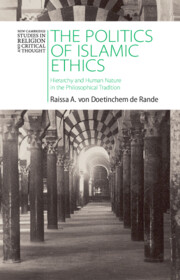
Most scholars assume that the Islamic concept of created human nature (fiṭra) indicates the natural religiosity of all human beings as created by God, and that, therefore, provides the basis for a kind of equality among humans – whether religious in nature or about gender and sexuality. While this is one interpretation of fiṭra, primarily found among scriptural commentators and theologians, this book highlights a far more diverse and contested tradition of interpretation and use of this concept. To demonstrate fiṭra’s rich use as a hierarchical, political, and ethical concept, the author introduces different philosophical engagements with the concept by al-Fārābī (d. 339/950); Ibn Bājja (d. 533/1139) and Ibn Ṭufayl (d. 581/1185); and Ibn Rushd (d. 595/1198). In the Introduction, she sheds light not only on the contemporary literature on created human nature and its roots in the scriptural sources but above all the importance of approaches to Islamic ethics that highlight the richness of the Islamic intellectual tradition and the complexity of its fundamental ethical concepts.
The book has shown that, like any other concept, fiṭra has a complex history. And like any concept with a lively history, fiṭra needs to be interpreted. The philosophers’ ethics and politics, and particularly their commitment to intellectual, social, and political hierarchies, do not map onto our ethics or politics. However, that does not mean that their engagement with fiṭra is not crucial in the current moment. Working through fiṭra among the philosophers creates tensions – among them, and between them and other Islamic interpreters such as the scriptural commentators. In these tensions the ethical work lies, opening space for both a more robust conception of Islamic intellectual history and more informed debates in the present. The possibilities of what it means to be human in Islamic thought are so much more diverse and contextual and signal that if one of our most foundational concepts, human nature, is under contestation, then so is our moral life. In fact, this contestation is necessary, deeply human, and traditional.
Fundamental to Islamic thought is the idea that there is a way that human beings simply are, by nature or creation. This concept is called fiṭra. Rooting her investigation in the two central passages in the Qur'an and Hadith literature, where it is asserted that God created human beings in a certain way, the author moves beyond discussion of the usual figures who have commented on those texts to look instead at a group of classical Islamic philosophers rarely discussed in conjunction with ethical matters. Tracing the development of fiṭra through this overlooked strand of medieval thinking, von Doetinchem de Rande uses fiṭra as an entrée to wider topics in Islamic ethics. She shows that the notion of fiṭra articulated by al-Farabi, Ibn Bajja, Ibn Tufayl and Ibn Rushd highlights important issues about organizational hierachies of human nature. This, she argues, has major implications for contemporary political and legal debates.
A textbook objection to consequentialism is that it is too demanding—on the assumption that a moral theory which is excessively demanding thereby loses plausibility. In this paper, I assess whether the mechanisms employed by two versions of rule consequentialism, those of Brad Hooker and Tim Mulgan, adequately meet the requirement of not being too demanding. I also examine whether the concept of human nature might help determine what should count as demanding for a moral theory. While this suggestion also faces significant challenges, I contend that prescribing less partiality towards the present generation may not be a drawback for the consequentialist frameworks under consideration.
In his paper “Moral Permissibility and Desert in the Therapy-Enhancement Distinction,” Ozan Gurcan takes a fresh look at the therapy-enhancement distinction and argues that, while the distinction does not establish rigid moral boundaries, it nevertheless serves an important purpose because it differentiates between interventions that are, generally speaking, owed to individuals as a matter of justice (i.e., therapies) and those that are not (i.e., enhancements). Because therapies help to promote justice in society, therapies are always permitted and, in many cases required, whereas enhancements may be, at best, permitted. In this commentary, I argue that we would be concerned about the morality of genetic enhancements even if they did not raise issues of social justice and I propose that other key moral ideas, such as the concept of human nature, may also be important in establishing the boundary between therapy and enhancement.
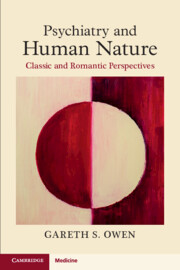
Urges psychiatry to get back to human nature because the concept, together with the idea of human freedom and classic and romantic perspectives, is required to calibrate the normal and the pathological in psychiatry. Highlights balance by showing how ‘sickly’ (Goethe) pictures of human nature and human freedom have adverse effects on psychiatry, including its interface with political life. Revisits the classicl and romantic perspectives, considering them in and out of balance in different ways. Distils a tripartite picture of the relationship between human nature, human freedom and mental disorder relevant to future research and teaching on psychiatric formulation and psychiatric ethics.
This chapter is partly about how actions are executed and how the details of people’s behavioral performance should be explained. But it also introduces some classes of action that find no place within the standard belief-desire model. These include habitual actions as well as speeded skilled actions, including many speech actions. To the extent that philosophers have addressed these kinds of action at all, their theories have run the gamut from complete mindlessness to full-blown intellectualism. The chapter critiques some influential accounts of the latter sort, after emphasizing that skilled actions are as distinctively human as are our rational capacities.
Psychiatry is medicine's most multi-disciplinary specialty and arguably its most intellectually and emotionally demanding. It has long attracted dual interpretations from cool, detached perspectives valuing objectivity (classic) to hotter, embodied and more political perspectives valuing subjectivity (romantic). Professor Owen argues that psychiatry should become more aware of classic and romantic threads that run through it. He approaches core topics in psychiatry and throughout the book both research and case material are used to animate the concepts. The author relates psychiatry to questions in philosophical anthropology and ethics. He presents human nature, mental disorder, and human freedom as inherently inter-related. This is a book of broad appeal to anyone interested in psychiatry and why this branch of medicine has ethical, legal and political significance.