To save content items to your account,
please confirm that you agree to abide by our usage policies.
If this is the first time you use this feature, you will be asked to authorise Cambridge Core to connect with your account.
Find out more about saving content to .
To save content items to your Kindle, first ensure no-reply@cambridge.org
is added to your Approved Personal Document E-mail List under your Personal Document Settings
on the Manage Your Content and Devices page of your Amazon account. Then enter the ‘name’ part
of your Kindle email address below.
Find out more about saving to your Kindle.
Note you can select to save to either the @free.kindle.com or @kindle.com variations.
‘@free.kindle.com’ emails are free but can only be saved to your device when it is connected to wi-fi.
‘@kindle.com’ emails can be delivered even when you are not connected to wi-fi, but note that service fees apply.
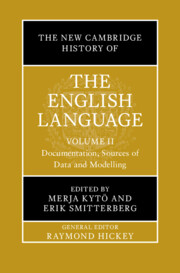
This volume considers the various kinds of text which document the history of the English language. It looks closely at vernacular speech in writing and the broader context of orality along with issues of literacy and manuscripts. The value of text corpora in the collection and analysis of historical data is demonstrated in a number of chapters. A special focus of the volume is seen in the chapters on genre and medium in the textual record. Various types of evidence are considered, for instance, journalistic work, medical writings, historiography, grammatical treatises and ego documents, especially emigrant letters. A dedicated section examines the theories, models and methods which have been applied to the textual record of historical English, including generative and functionalist approaches as well as grammaticalisation and construction grammar. In addition, a group of chapters consider the English language as found in Beowulf and the writings of Chaucer and Shakespeare.
Chapter 8 is concerned with the use of historical corpora in the study of language relating to health. We present two case studies – one where an issue is well understood and discussed publicly, the other where there was a clear issue with the framing of a discussion. For the former study we explore the VicVaDis corpus, first introduced in chapter 1. We combine different corpus techniques to show the main anti-vaccination arguments in the corpus and to point out parallels with present-day anti-vaccination discourse. The second case study looks at the emergence of venereal disease in the seventeenth century using the Early English Books Online corpus. By examining collocates of the word pox, we are able to weed out relevant uses of the word (e.g., those which referred to venereal disease) as opposed to those which do not. Additionally, we show that through the investigation of one type of collocate (words referring to geographical locations) the analysis was taken in an unexpected but rewarding direction.
Every reputable new English dictionary, or new edition, published since 1987 has made use of a large collection of text, or ‘corpus’, for evidence of a word’s usage. In this chapter, one of the most eminent names in lexicography, Patrick Hanks, takes the reader on a journey to discover more about different kinds of dictionaries and corpora, and basic principles of corpus linguistics and lexicography. He outlines how dictionaries have made use of corpus evidence in the past, and proposes how they might make better use of them in the future.
This paper presents a diachronic account for the emergence of the expletive það in Icelandic impersonal constructions. Using data from the IcePaHC corpus (Wallenberg et al. 2011), I show that a cataphorically referential það functions as a topic position placeholder in Old Icelandic (1150-1350) in impersonals with a clausal argument. The corpus findings indicate that það spread from this early cataphoric context to impersonals which lack the clausal argument, with ‘say-type predicates’ acting as a bridging context. Strikingly, this coincides with another change whereby cataphoric það becomes increasingly restricted to the topic position in constructions with a clausal subject. I interpret this as evidence that cataphoric það is losing its subject status in such contexts and becoming a topic position placeholder, in line with its function in impersonals. This sheds light on the mixed status of cataphoric það in modern Icelandic and challenges the ‘Prefinite First Hypothesis’ for the diachrony of Germanic expletives (e.g. Faarlund 1990).
Recommend this
Email your librarian or administrator to recommend adding this to your organisation's collection.