To save content items to your account,
please confirm that you agree to abide by our usage policies.
If this is the first time you use this feature, you will be asked to authorise Cambridge Core to connect with your account.
Find out more about saving content to .
To save content items to your Kindle, first ensure no-reply@cambridge.org
is added to your Approved Personal Document E-mail List under your Personal Document Settings
on the Manage Your Content and Devices page of your Amazon account. Then enter the ‘name’ part
of your Kindle email address below.
Find out more about saving to your Kindle.
Note you can select to save to either the @free.kindle.com or @kindle.com variations.
‘@free.kindle.com’ emails are free but can only be saved to your device when it is connected to wi-fi.
‘@kindle.com’ emails can be delivered even when you are not connected to wi-fi, but note that service fees apply.
In the nave of Sant’Apollinare in Classe stands what, by the time it was constructed, had come to be called an altar (Figures 13 and 14). By the sixteenth century, not only the name but also the matter, the form, and the composition had come to provoke thousands of Christians, some to call for their replacement with wooden tables, some to singular physical violence, bringing sledgehammers to smash into rubble what had, for generations, stood in choirs, apses, and chapels and against columns. Even those who left them in place no longer accorded them the same role in the Mass. For Lutherans, they were the surface for the celebration of the Eucharist. For Catholics, they were more, but no longer what they had been. Even the great Jesuit scholar Joseph Braun, whose study of altars remains foundational, defined the altar as “that liturgical instrument [Gerät] on and at which the Eucharist was celebrated.” It was for him a thing. He accorded some six pages in a 756-page volume to the “symbolism” of the altar. For him, meaning was given to the altar by texts: commentators, liturgists including Durand, canon lawyers, popes, and theologians. The altar itself was mute.
This chapter gives fruitful attention to the role of the sacraments in the Confessions. It delineates the ways in which the sacrament of baptism structures the autobiographical books, with baptism foregrounded in the first book (Augustine’s baptism postponed), the central or hinge book (Book 5, in which Augustine’s baptism is again deferred), and the climactic book (Book 9, in which Augustine’s baptism is recounted, along with many other baptisms, quite a few of which did not take place within the chronological scope of Book 9). The Eucharist, which was for Augustine the other sacrament of initiation and for which baptism itself was a prerequisite, comes into clear view at the end of Book 9 and in Book 10. The exegetical books then treat Genesis as “a model for all of Christian life, and especially that of the church,” a life inaugurated in baptism and sustained by the Eucharist. Contrary to the view of some scholars, who see very few Eucharistic allusions in the Confessions, the chapter shows that many of Augustine’s images – especially of food and of milk – have Eucharistic overtones.
The chapter discusses the development of sacramental doctrine during a period of lively debate on the subject around the year 1200, with a focus on the relevance of the Fourth Lateran Council as a continuation of the eleventh-century ecclesiastical reform movement, and with stress on the unique relevance of Paris as the key centre of intellectual production.
Chapter 4, on David Jones’ The Anathemata (1952), considers the poem in terms of the author’s own aspiration to preserve the past. Jones considers art to be a way of making its object present and active, as the Roman Catholic Mass is believed to make Christ’s body and blood present. This form of “re-presentation” (anamnēsis) makes the past actively present without literally reconstructing it, offering a middle way between Boym’s restorative and reflective nostalgia. In Jones’ view, poets in the twentieth century must assemble the fragments of the cultural past as a means of resisting the increasingly utilitarian nature of modern culture. Ultimately, Jones’ densely allusive poetry forces us to consider the limits of nostalgia. If art inevitably makes past present, is it always in some sense nostalgic?
The Spanish Inquisition developed the heresy known as alumbradismo out of disparate evidence: the heresy existed only in documents by, for, or about the Inquisition. Defendants charged as alumbrados were often acted in ways incommensurate with orthodox Spanish Catholicism; their defining characteristic across time was an emphasis on interior religious experience, especially mental prayer, which would lead toward the abandonment of one’s soul in God. However, the idea that they were members of an organized group—despite lacking any self-formulated doctrine or teachings, much less a means for global communication or dissemination of their ideas—was a stretch of logic that validated inquisitorial persecution but fails to adhere to modern historians’ concepts of proof. It was the Inquisition’s persecutorial discourse and bureaucracy that provided the connective threads for this “sect” when the alumbrados themselves failed to do so.
Part I, ‘The Dispensary’, focuses on the consumables on Sturmy’s ship – sweet wines and spices – reflecting on their medicinal, spiritual and commercial value. Chapter 1 analyses Eucharistic images which presented sweet wine as the Christian blood of the Holy Land, providing an ethnonationalist rationale for the essentialised Christianity of the lost crusader territories. Sweet wine was revered and regulated as a category distinct from ‘ordinary’ wines. Archaeological evidence of excavated Frankish winepresses shows that winemaking in the crusader kingdom was a major, organised industry. Sweet wines were first imported to England from these settlements, and subsequently were traded by Italian merchants.
Harald Buchinger sketches the origins and complex evolutions of liturgies in Christian Antiquity. He focuses on patterns of worship and celebration developed in those times, underscoring how difficult it is to draw straightforward conclusions, mainly because of a paucity of sources.
This chapter explores christological underpinnings to eucharistic theology. It delineates transubstantiation, consubstantiation, and three versions of impanation in the effort to offer an incarnational model of Christ’s presence in the Eucharist.
This chapter focuses on the companion volumes Mystic Trees and Poems of Adoration to explore the ways Michael Field’s poetry changed following Katharine Bradley and Edith Cooper’s 1907 conversion to Roman Catholicism. This chapter reviews prior scholarship on Field’s devotional poetry, which has often emphasised the continuity between Field’s pre- and post- conversion work. The chapter builds on this scholarship by arguing that Field’s devotional poetry, informed by their newfound faith, explores new ways of thinking about time, suffering, and the purpose of art. Furthermore, this chapter explores the significance of studying Victorian devotional and religious verse, and the ways women and queer people were able to use the genre to engage with and build upon theological concepts, outside the bounds of ecclesiastical authority.
Throughout the long history of Christianity, Christians have celebrated their faith in a myriad of ways. This Companion offers new insights into the theological depths of the liturgical mysteries that are the essence of Christian worship services, rituals, and sacraments. It investigates how these mysteries order time and space, and how they permeate the life of the Churches. The volume explores how Christian liturgy, as a corporeal and communal set of activities, has had a profound impact on spiritualities, preaching, pastoral engagement, and ecumenical relations, as well as encounters with religious others. Written by an international team of scholars, it also explores the intrinsic connections between liturgy and the arts, and why liturgy matters theologically. Ultimately, The Cambridge Companion to Christian Liturgy demonstrates the inextricable link between theology and liturgy and provides incentives for critical and constructive reflections about the relevance of liturgy in today's world.
The argument of this chapter is that the instrument doctrine, if held, sharpens our understanding of other mysteries of the Christian faith, including the hypostatic union, the Church, and the sacrament of the Eucharist. One reason that Aquinas held to the doctrine was the clarity it brought to these other mysteries. With Christology, the benefits are grammatical and speculative. Calling Christ’s humanity an instrument leads us to think of the one who possesses it, namely, the Logos, and so it can render single-subject Christology clearer to the intellect. If Christ’s humanity is held to be an instrument, it also implicates in our understanding the divine power through which the Logos works. With the theology of the Church, the instrument doctrine supports the biblical idea that Christ sends the Holy Spirit on the Church as a human being, and not only as God. And with the theology of the Eucharist, the instrument doctrine assists Catholic faith in perceiving how Jesus gives us a share of the divine life through sacramental communion.
Leviticus has shaped both Jewish and Christian theology and practice over the centuries. The final chapter examines its influence in the rest of the Old Testament and into the Second Temple period and the New Testament. Levitical theology also influenced a Christian understanding of sacred space in church architecture as well as helping shape the Christian liturgical year.
Leviticus is often considered to be one of the most challenging books of the Bible because of its focus on blood sacrifice, infectious diseases, and complicated dietary restrictions. Moreover, scholarly approaches have focused primarily on divisions in the text without considering its overarching theological message. In this volume, Mark W. Scarlata analyses Leviticus' theology, establishing the connection between God's divine presence and Israel's life. Exploring the symbols and rituals of ancient Israel, he traces how Leviticus develops a theology of holiness in space and time, one that weaves together the homes of the Israelites with the home of God. Seen through this theological lens, Leviticus' text demonstrates how to live in the fullness of God's holy presence and in harmony with one another and the land. Its theological vision also offers insights into how we might live today in a re-sacralized world that cherishes human dignity and cares for creation.
Cyprian of Carthage’s On the Lapsed, written in the aftermath of the third-century Decian persecution, contains several stories of the eucharist attacking apostate Christians. These Christians claimed they had been admitted to the eucharist by local, highly esteemed martyrs and confessors. Cyprian, who had fled during the persecution and been unpopular since the day of his election, could not afford to confront this group directly. Instead, he crafted a text that conjured up an autonomous eucharist that policed itself against unworthy intruders. Moreover, he used the graphic language of bodily suffering and dismemberment to scramble the boundaries between lapsed Christian, bishop, and martyr, essentially reconfiguring himself as a martyr.
Augustine’s liturgical preaching is integral to his conception of the liturgical celebration as rendering present the unrepeatable saving acts of Christ. During the liturgical season from Lent to Easter, the north African bishop is consistently preoccupied with the present effectiveness of the mysteries of Christ’s death and Resurrection. During Lent, he invites his congregation to fashion a cross for themselves – through prayer, fasting, and alms – for the sake of communion in Christ’s crucifixion. On Good Friday, he invites his listeners to contemplate the suffering of the impassible God and to safeguard the integrity of the Church that is the fruit of his suffering. In the Easter celebrations, he instructs his flock to be strengthened in their Easter faith through participation in the Eucharist and through performance of works of mercy, and to hold fast to the objective content of their faith in the genuine corporeality of the Risen Lord. He guides them into an experience of Easter joy as a proleptic participation in the eternal joy of the Church’s communion in the body of the Risen Lord, which can only be attained through a sharing in his Crucifixion.
Augustine’s preaching touches numerous aspects of his theology which are predominantly present in his most important treatises. The sacraments of the Church are treated in his controversies with heretics but they are also very much present in his sermons, where he teaches the sound doctrine of the Church and performs the Christian rites for the edification of the faithful. This chapter examines Augustine’s teaching on baptism and the Eucharist in his preaching. Having considered his definition of the sacraments in general in his preached works, it presents his teaching on the sacraments in his catechesis to the baptism candidates and to the newly baptised Christians of his congregation. The study further takes into consideration what Augustine says on baptism and the Eucharist in his sermons while addressing the problems of the Donatists and Pelagians. Augustine makes difficult theological concepts understandable to his flock by adapting his language to them.
Bishop Augustine probably preached countless sermons on the New Testament, but less than three hundred remain extant. Most of his New Testament preaching is found in his 124 Homilies on the Gospel of John, his ten Homilies on the First Epistle of John, and his Sermons 51–183. The richness of these sermons is astounding. This chapter samples them, offering a starting point for further analysis. The first section focuses on the pastoral goals that stand behind Augustine’s preaching on the Gospel of Matthew. Second, the chapter turns to his anti-Donatist Homilies on the First Epistle of John, where he intersperses his commentary on 1 John with extensive citations of the Psalms and the Gospels. Third, with respect to his Homilies on the Gospel of John, the chapter shows that Augustine preaches on John with a strong eye to his central theological interests, including his well-known arguments regarding grace and predestination.
Thomas Cranmer appropriated the eucharistic theology of Cyril of Alexandria for the purposes of constructing a Reformed eucharistic theology and in a way that did not do justice to Cyril’s eucharistic theology. Cyril argued for a mingling of both the corporal and spiritual presence of Christ in both the incarnation and the Eucharist, whereas Cranmer affirms such a mingling in the incarnation alone but not in the Eucharist. Ashley Null has recently defended Cranmer’s appropriation of Cyril for the construction of Reformed eucharistic theology. This article concludes that both Thomas Cranmer’s appropriation and Null’s defence of Cranmer are not viable interpretations of Cyril’s eucharistic theology.
Numerous unpublished Greek manuscripts contain the rituals of marriage as performed in diverse regions of the Byzantine world. This chapter both discusses the universal practices of weddings known across Christian communities of the Eastern Mediterranean and discerns unique traditions local to specific regions, like Byzantine Southern Italy or Palestine. The prayers of the marriage rite are analyzed, and attention is given to such gestures as crowning and veiling couples and to traditions previously unknown to Byzantinists, like the practice of breaking a glass at weddings, popularly understood today as a Jewish custom, as well as specific aspects of ritualized bridal costume and the roles of witnesses, or paranymphs.
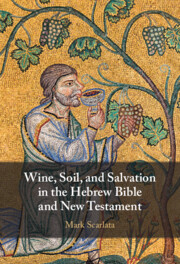
Biblical authors used wine as a potent symbol and metaphor of material blessing and salvation, as well as a sign of judgement. In this volume, Mark Scarlata provides a biblical theology of wine through exploration of texts in the Hebrew Bible, later Jewish writings, and the New Testament. He shows how, from the beginnings of creation and the story of Noah, wine is intimately connected to soil, humanity, and harmony between humans and the natural world. In the Prophets, wine functions both as a symbol of blessing and judgement through the metaphor of the cup of salvation and the cup of wrath. In other scriptures, wine is associated with wisdom, joy, love, celebration, and the expectations of the coming Messiah. In the New Testament wine becomes a critical sign for the presence of God's kingdom on earth and a symbol of Christian unity and life through the eucharistic cup. Scarlata's study also explores the connections between the biblical and modern worlds regarding ecology and technology, and why wine remains an important sign of salvation for humanity today.