To save content items to your account,
please confirm that you agree to abide by our usage policies.
If this is the first time you use this feature, you will be asked to authorise Cambridge Core to connect with your account.
Find out more about saving content to .
To save content items to your Kindle, first ensure no-reply@cambridge.org
is added to your Approved Personal Document E-mail List under your Personal Document Settings
on the Manage Your Content and Devices page of your Amazon account. Then enter the ‘name’ part
of your Kindle email address below.
Find out more about saving to your Kindle.
Note you can select to save to either the @free.kindle.com or @kindle.com variations.
‘@free.kindle.com’ emails are free but can only be saved to your device when it is connected to wi-fi.
‘@kindle.com’ emails can be delivered even when you are not connected to wi-fi, but note that service fees apply.
Chapter 1 investigates how naval reforms in the late 18th century aimed at rationalizing production, marked by standardizing, centralizing, and concentrating the shipbuilding process in the context of provisioning crisis and market relations. It gives a brief overview of shipbuilding and its transformation in the late eighteenth century, both in the Ottoman Empire and in Europe. It highlights the increasing dependence of the navy on market relations and dynamics in the late eighteenth century, catalyzed by the provisioning crisis emanating from technological transformations, naval competition and military pressures, environmental restrictions, and political-economic challenges, as illustrated by the example of provisioning timber. Against this crisis, naval administrations introduced substantial changes in the production process under the supervision of French naval engineers, whose policies centered on professionalization and the use of “scientific” principles in shipbuilding. The chapter concludes with a discussion on the spatial concentration of capital in the Arsenal, by renewing and expanding its production capacity and exerting centralized control over the production process.
A framing case study describes the Paris Climate Agreement and the worldwide movement to combat climate change. The chapter then discusses international environmental law. The chapter first discusses important concepts from environmental law, its historical evolution, and major principles. It then describes how states have attempted to protect the environment in the realm of the atmosphere, water, and living resources. Finally, the chapter examines how international environmental law interacts with topics discussed earlier in the book, including: trade, investment, human rights, and armed conflict.
How were England’s wetland margins imagined at a new scale, as a site of reform and profit at the heart of a thriving polity? This chapter traces the iterative rewriting of wetlands in histories, geographies, agricultural books, and pro-drainage pamphlets at the turn of the seventeenth century. Driven by desires to unify England and amplify national wealth, these improving authors reconceived the meanings and management of wetlands and common lands. Scholars have often identified this period as a hinge between long-standing beliefs that topography and climate shaped human bodies and societies and a new conviction that soil, water, and air could and should be altered through human intervention. This chapter suggests that environmental determinism and environmental reform were not antithetical impulses but instead two sides of the same coin. Improving authors interlaced older humoral theories with new ideas about political economy to articulate fen futures. In recasting wetlands as unruly, unhealthy, and unproductive, ambitious wetland projects became a ‘cure’ for the nation’s most pressing maladies, promising to produce productive land and industrious subjects.
How did ambitious projects of wetland improvement give rise to a new kind of environmental politics in early modern England? This chapter first asks how such projects reconfigure understandings of when, where, and how environmental change took place in this period. Environmental acts were political, it argues, because they relied on and engendered relationships of power: decision-making institutions, laws, legitimacy, and – above all – negotiation and conflict. It next explores what kind of politics were at work in imagining, implementing, and contesting wetland improvement. In emphasising material and institutional progress, studies of ‘improvement’ and ‘the state’ have often overlooked the contingent processes through which productivity and power were made and disputed on the ground. Mobilising custom as a practice and right, wetland communities played a vital role in the trajectory of improvement. Conflict over improvement exposed the contested nature of political authority in seventeenth-century England and generated material landscapes of flux. Finally, this chapter examines how speech acted and actions spoke to remake wetlands via print, maps, institutions, and environments.
How were seventeenth-century projects of wetland improvement remembered and revived in the centuries that followed? What remnants of wetlands past persist in popular memory, troublesome spirits, floodwaters, and nature reserves? This chapter traces afterlives of the turbulence and tumult generated by fen projects. In doing so, it weaves together the key strands of this book. First, new intellectual and political tools were needed to define and implement wetland improvement, reconceiving the scale of environmental thought and action in early modern England. Second, customary politics proved a powerful force in the negotiation of improvement as commoners intervened in the flow of water, the exercise of property rights, and the practice of sovereignty. Finally, coercive projects of environmental change expanded cracks in the exercise of central authority, becoming entangled in civil war conflict and imperilling the stability of improvement. It concludes by asking what conflict over early modern wetlands can tell us about the environmental politics of the Anthropocene.
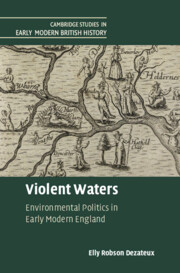
At the time and since, early modern wetlands have been subject to double vision: told as a tale of degradation and disaster or celebrated as a site of biodiversity and collective access. Violent Waters is a book about the politics of rapid, anthropogenic, environmental change in early modern England: a politics in which narratives about scarcity and abundance, the past and the future, justice and value became vital to struggles over wetlands. During projects of wetland improvement, environments were forged at the intersection between material conflicts over the distribution of resources and risk and political conflicts about flows of power.
If drainage aimed to free land from the vagaries of floodwater, then enclosure was necessary exclude commoners and transfer management of land to improving landlords and tenants. The development of ‘absolute’ private property in early modern England has often been analysed via legal categories or socio-economic outcomes. Resituating property-making as an environmental act, this chapter argues that the contested exercise of land rights in Hatfield Level relied on the ability to determine how water moved, where cattle could graze, and what kind of plants grew. It traces the words and practices through which commoners and improvers defined their rights, often hinging on disputes about the just distribution of resources. This chapter explores a spectrum of local responses to improvement, including complaints of scarcity, socially fraught adaptation, and action to reinforce customary rights. As disputes over enclosure escalated, physical acts of cultivation and grazing became means by rival groups asserted ‘right’ as jurisdiction and legitimacy. In doing so, they created contrasting environments, generative of different social, economic, and political relations.
From the late sixteenth century, foreign engineers promoted new hydraulic technologies in England. Yet, their techniques were not alone sufficient to implement wetland improvement at a grand scale. Drainage projects generated local controversy almost everywhere they were proposed. Disputes pivoted on thorny questions about who was empowered make decisions about the management of water and land, and by what means. Under the early Stuarts, the crown and its ministers began to act as instigators and facilitators driving forward fen projects. The use of increasingly coercive methods to suppress and circumvent local opposition became entangled in wider constitutional controversies about the limits of royal authority and definitions of the public good. Wetland communities were active participants in debates about the economy and morality, environments and justice, consent and legitimate authority. Customary politics proved a powerful force, unravelling a litany of proposed projects in the early seventeenth century. This impasse was broken when Charles I launched the first state-led drainage project in Hatfield Level in 1626, yoking coercive authority to transnational expertise.
The Sandtoft settlement in Hatfield Level is the best-documented of several refugee communities established on improved wetlands. Described via the resonant language of ‘plantation’, the settlement connects agricultural improvement in England to imperial expansion in the British Atlantic, acting in the service of empire and state while forging transnational Protestant networks. As improvers, the Sandtoft settlers were fastened to the crown’s agenda to produce profit, subdue commoners, and integrate marginal localities into the nation. As Calvinists and cultivators, however, they met with hostility in England: at odds with Archbishop Laud’s repressive efforts to demarcate a distinctively English Protestantism, while facing a violent campaign of expulsion by fen commoners opposing improvement. Interpreting these experiences through the transnational lens of Protestant adversity, the settler community entangled their quest for religious freedoms with their remit as fen improvers. Moving beyond dichotomous arguments about xenophobia in early modern England, this chapter traces how engineered environmental change forged lines of solidarity and separation.
How were environments and politics remade by sovereigns, floods, mapmakers, migrants, rioters, and writers during wetland improvement projects in early modern England? Violent Waters examines flagship ventures which promised to transform unruly fenland fringes into orderly terrain at the heart of national power and productivity. In practice, these projects sparked constitutional controversy, new floods, and huge riots. The first state-led project in Hatfield Level brought local, national, and transnational interests into contact and conflict for almost a century. Elly Robson Dezateux traces the environmental politics that emerged as water and land were constructed and contested, both mentally and materially. These disputes pivoted on urgent questions about risk and justice, which became entangled in civil war conflict and exposed the limits of central authority and technology. Ultimately, improvement was destabilised by a lack of legitimacy and the dynamism of local custom as a method of environmental management and collective action. Wetland communities, as much as improvers and sovereigns, remade the terrain of politics and the future of the fens.
What role did nomadic and non-settled societies play in the early twentieth-century world economy? Exploring a remote mountain valley close to the border between the Russian and Qing empires, this article investigates the multiscalar history of the Karkara trade fair and its Kazakh and Kyrgyz pastoralist communities. Although at first sight incongruous given its remote location, this market was in fact one of the most significant fairs in the entire Russian empire. Tracing dynamic circuits of exchange on local, regional, and trans-imperial scales across northern Eurasia and beyond from the 1890s to 1916, the article argues that ecological perspectives are essential if we are to understand the anatomy of global capitalism in the valley, and that the shifting relationship between environment, economy, and political power as the Russian imperial state sought to use the fair as a site of control and regulation created frictions that proved deeply corrosive. Throughout, the article underscores the need to re-evaluate the often overlooked importance of pastoralist societies and seemingly remote rural places in the early twentieth-century global economy and in modern Eurasian history.
Indigenous activists have increasingly asserted claims of ecocide in various international legal venues. While acting separately from each other, they reflect common concerns regarding destruction of the environment, particularly with respect to the impacts of environmental damage upon Indigenous communities. In doing so, they connect Indigenous interests in the environment to discourses over ecocide. The present analysis considers the appropriateness of ecocide discourse for Indigenous peoples in the light of the latter’s diverse interests in the environment. Specifically, the analysis seeks to explore the bases for Indigenous normative concerns regarding ecocide, both with respect to its meaning and its inclusion in international criminal law. The analysis draws upon Indigenous studies literature to develop a heuristic framework for organizing Indigenous perspectives, through which it is possible to clarify Indigenous arguments on ecocide. In doing so, the analysis furthers engagement with Indigenous approaches to ecocide in ways that assist descriptive understanding and prescriptive reflections addressing Indigenous concerns.
What it means to create a world in which “many worlds fit,” as the Zapatistas declared, has increasingly been taken up across the humanities and social sciences, introduced by decolonial theorists. This article focuses on some of the practices that allow for the enaction of the pluriverse: prayer and attachments to sacred space. I focus on a prayer camp organized by the Coalition to Save the Lemay Forest to the south of Winnipeg, showing that broadly construed notions of prayer can be understood as a pluriversal methodology wherein worlds are navigated through shared—yet still positionally aware—attachments to place. In the prayer camp, prayer—as plea/appeal, practice, action, communication, or commitment—is comfortable with divergent cosmological perspectives, rooted in (un)common attachments to sacred space: both in shared goals of protecting the space and honoring its legacy but also through an engagement with an “uncommon commoning” of that which is sacred and/or otherworldly. I argue that the sacred is an integral part of coalition building within the space; in turn, coalition building can also serve to reinvigorate connections to sacred space and worlds.
Global biodiversity is decreasing at an alarming rate, and Britain is now one of the most nature-depleted countries on the planet. This matters to archaeologists as it places limitations on our personal experience of ‘nature’ and damages the collective archaeological imagination, diluting our capacity to envisage the richness and diversity of the past worlds we seek to understand. Here, the author argues that we must learn, from contemporary biodiversity projects, animate Indigenous worldviews and enmeshed human-nonhuman ecosystems, to rewild our minds—for the sake of the past worlds we study and the future worlds that our narratives help shape.
What does 'Irish romanticism' mean and when did Ireland become romantic? How does Irish romanticism differ from the literary culture of late eighteenth- and nineteenth-century Britain, and what qualities do they share? Claire Connolly proposes an understanding of romanticism as a temporally and aesthetically distinct period in Irish culture, during which literature flourished in new forms and styles, evidenced in the lives and writings of such authors as Thomas Dermody, Mary Tighe, Maria Edgeworth, Lady Morgan, Thomas Moore, Charles Maturin, John Banim, Gerald Griffin, William Carleton and James Clarence Mangan. Their books were written, sold, circulated and read in Ireland, Britain and America and as such were caught up in the shifting dramas of a changing print culture, itself shaped by asymmetries of language, power and population. Connolly meets that culture on its own terms and charts its history.
The epilogue considers one possible future incarnation of the idea of progress in medicine, namely progress as achieving sustainability. Despite the fact that environmental concerns have long been associated with reimagined ideas of progress, aspirations for sustainability remain underdeveloped in medicine. Nevertheless, this epilogue discusses the cases in which the concept of medical progress has been coupled with “sustainable” or “green” medicine. Visions of sustainable medical progress tend to presuppose a multidimensional concept of medical progress, call for expanding the time frame in which progress is assessed, and posit environmental limits as constraints on open-ended progress. At the same time, few of these visions engage with the pluralistic nature of medical progress, preferring to understand measures that support a robust natural environment as intrinsically good for the health of individuals and societies, and broadly aligned with the goals of conventional medicine.
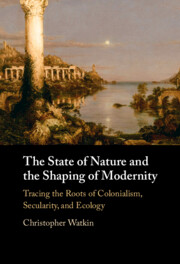
The state of nature is a powerful idea at the heart of the fragmented and sometimes conflicting stories the modern West tells about itself. It also makes sense of foundational Western commitments to equality and accumulation, freedom and property, universality and the individual. By exploring the social and cultural imaginaries that emerge from the distinct and often contradictory accounts of the state of nature in the writing of Hobbes, Locke and Rousseau, The State of Nature and the Shaping of Modernity offers a fresh perspective on some of the most pressing debates of our time, showing how the state of nature idea provides a powerful lens through which to focus the complex forces shaping today's political and cultural landscape. It also explores how ideas about human nature and origins drive today's debates about colonialism, secularism, and the environment, and how they can shed new light on some of society's most heated debates.
What should mostly matter is how successful environmental policies are at satisfying citizens’ policy preferences (e.g., reducing carbon emissions), relative to the policies’ cost. Yet, across 6 studies (N = 2759, 2 pre-registered), we found that French citizens tended to be rather insensitive to policy efficiency. In Experiments 1a–d (N = 854), citizens regarded an environmental policy driven by an altruistic intention that turned out to be inefficient as being more commendable than a policy motivated by selfishness that dramatically reduced carbon emissions. In Experiment 2 (N = 1105), altruistic but low efficiency policies were supported only slightly less than selfish but highly efficient policies. Independent manipulation of intent and efficiency indicated low sensitivity to large differences in efficiency expressed numerically, and substantial sensitivity to actors’ intentions. Moreover, moral commitment predicted stronger support for any environmental policy addressing the issue, regardless of its efficiency. Finally, Experiment 3 (N = 800) found that introducing reference points and qualitative appraisals of a policy’s impact and financial cost can nudge participants towards greater attention to its efficiency. Our paper highlights the importance of using contextual and qualitative (vs. numeric) descriptions of policies to make citizens more focused on their efficiency.
In the global waste trade, importers buy containers of waste and scrap to meet demand for raw materials, especially in the Global South. But post-processing leftovers generate localized negative externalities. I use the waste trade as a setting to establish that low-capacity states can and do use tariffs as a tool in their environmental policy repertoire. Product-level tariffs can serve as Pigouvian ’sin’ taxes that incentivize private market actors to limit transactions and/or increase state revenue, both channels that can result in improved environmental outcomes. For evidence, I leverage the ‘China garbage shock’: in 2017 China banned imports of twenty-six waste products (HS six-digit), which disrupted economic–environmental trade-offs in other, newly competitive markets awash in diverted imports. Using novel data on 179 traded waste products and product-level tariffs (1996–2020), I demonstrate that those that received the shock raised tariffs in ways consistent with environmental protection.