To save content items to your account,
please confirm that you agree to abide by our usage policies.
If this is the first time you use this feature, you will be asked to authorise Cambridge Core to connect with your account.
Find out more about saving content to .
To save content items to your Kindle, first ensure no-reply@cambridge.org
is added to your Approved Personal Document E-mail List under your Personal Document Settings
on the Manage Your Content and Devices page of your Amazon account. Then enter the ‘name’ part
of your Kindle email address below.
Find out more about saving to your Kindle.
Note you can select to save to either the @free.kindle.com or @kindle.com variations.
‘@free.kindle.com’ emails are free but can only be saved to your device when it is connected to wi-fi.
‘@kindle.com’ emails can be delivered even when you are not connected to wi-fi, but note that service fees apply.
The Revolution is often remembered in the public consciousness for doing away with censorship, yet the reality was somewhat different, especially when it came to remembering the decade of 1789–99. This chapter analyses how such representations across genres from ballet to fait historique were censored both laterally and bureaucratically from the calling of the Estates General in 1788 through to the coup of 18 Brumaire in November 1799, passing through cities like Nîmes, Brussels, Dijon, Tours, and Bordeaux, alongside Paris. After the initial relaxation of censorship in the early 1790s, it soon returned and there was a stark rise in bureaucratic censorship during the Directory. However, audiences, playwrights, and theatres throughout the Revolution were prepared to use the stage to reject the official view of political progress, at times leading to an overt rejection of the regime in place and bringing major cities to the brink of rebellion.
Instead of ushering in an era of enduring peace and partnership, the end of the Cold War was followed by a decade of turmoil, with wars in the Persian Gulf, the Balkans, and Chechnya, political violence in Moscow, and controversy over the eastward expansion of NATO. The disappointments and turbulence stemmed in part from the personalities and political choices of top leaders, including the erratic and increasingly autocratic Boris Yeltsin, the skeptical and stingy responses of George H. W. Bush to the reform and collapse of the Soviet Union, and the way Bill Clinton unreservedly embraced Yeltsin while also antagonizing him by deciding to enlarge NATO and wage war against Serbia. As this chapter shows, though, American–Russian relations in the 1990s were also roiled by widely shared popular attitudes, including American triumphalist mythology about how the Cold War ended, unrealistic Russian expectations of massive US aid and respect despite Russian corruption, mismanagement, and weakness. The bright promise of the end of the Cold War was marred both by arrogant American unilateralism and by a Russian slide into depression and authoritarianism.
Throughout much of the twentieth century, Japan maintained a “special relationship” with Myanmar, often bucking the policy approach of Western countries to provide financial and political support to the country’s military leaders. Following the February 2021 coup d’état in Myanmar, however, Japan’s policy approach toward the country notably shifted in response to domestic and international pressures. Utilizing declassified documents from Japan’s Ministry of Foreign Affairs (MOFA) and other Japanese-language sources, this study examines how Japanese diplomacy toward Myanmar evolved in response to the coup. Through a structured assessment of Japan’s geopolitical strategy, bureaucratic politics, and the influence of informal actors, the study demonstrates how these interconnected factors prompted Tokyo to “rethink” certain aspects of its relationship with Myanmar while maintaining distinctive elements of its previous approach.
This chapter traces trajectories of counterrevolutions following six revolutions, which exhibit the full range of counterrevolutionary outcomes and offer useful comparisons to Egypt. First, it examines two revolutions that never experienced counterrevolutions: Tunisia’s and Libya’s 2011 revolutions. Both occurred in the same Arab Spring wave as Egypt’s revolution, but in Tunisia the new government faced a military whose interests were not deeply threatened by civilian rule and in Libya the coercive capacity of the former regime was largely destroyed in the brief civil war. Next, it examines two Latin American revolutions that demonstrate the two ways in which revolutionaries can maintain their capacity and defeat counterrevolutionary threats. Following Cuba’s 1959 revolution, Fidel Castro’s regime put down multiple counterrevolutions using its loyal revolutionary army. In Venezuela, following the 1958 democratic revolution, the government enjoyed none of these coercive resources, yet managed to thwart multiple counterrevolutionary coup attempts through a preservation of revolutionary unity and a return to mass mobilization. Finally, in two cases that are otherwise quite different to Egypt – Thailand’s 1973 democratic uprising and Hungary’s 1919 communist revolution – a very similar set of mechanisms undermined the capacity of the new governments and created opportunities for counterrevolutionaries to return to power.
This chapter analyzes Egypt’s 2011 revolution and 2013 coup, one of the most prominent counterrevolutions of the 21st century. Drawing on approximately 100 original interviews with Egyptian politicians and activists, it argues that Egypt’s counterrevolution only became possible when revolutionaries squandered their initial capacity to hold the old regime’s military in check and presented them with an opportunity to rebuild their popular support. Specifically, the chapter makes the following claims: (1) revolutionary forces began the transition with considerable leverage over the former regime, grounded in their ability to threaten a return to mass mobilization and their backing from the United States; (2) after Mohamed Morsi was elected president, his administration’s poor management of the post-revolutionary governance trilemma, particularly its decision to prioritize the concerns of old regime elements over those of his secularist allies, caused the revolutionary coalition to fracture and Washington to begin questioning its support; and (3) these developments created opportunities for the military to bolster its domestic and foreign support and sapped revolutionaries’ capacity to resist a counterrevolutionary coup. Ultimately, the chapter concludes that, though the task facing Egypt’s revolutionary leaders was not easy, a counterrevolutionary end to the transition was far from a foregone conclusion.
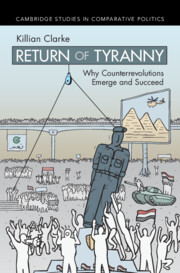
Why do some revolutions fail and succumb to counterrevolutions, whereas others go on to establish durable rule? Marshalling original data on counterrevolutions worldwide since 1900 and new evidence from the reversal of Egypt's 2011 revolution, Killian Clarke explains both why counterrevolutions emerge and when they are likely to succeed. He forwards a movement-centric argument that emphasizes the strategies revolutionary leaders embrace both during their opposition campaigns and after they seize power. Movements that wage violent resistance and espouse radical ideologies establish regimes that are very difficult to overthrow. By contrast, democratic revolutions like Egypt's are more vulnerable, though Clarke also identifies a path by which they too can avoid counterrevolution. By preserving their elite coalitions and broad popular support, these movements can return to mass mobilization to thwart counterrevolutionary threats. In an era of resurgent authoritarianism worldwide, Return of Tyranny sheds light on one particularly violent form of reactionary politics.
Both Saigon and Washington have Catholic presidents from 1961 to 1963. American Catholic support for the Diem regime remains strong, but the Kennedy administration begins to have serious doubts about its ally. As relations between the Saigon government and political Buddhists worsen, those doubts intensify. The administration approves a coup that topples and kills Diem. Meanwhile, the Second Vatican Council begins its historic work in Rome.
This chapter explains the tendency of revolutions to produce new forms of oppression rather than genuine liberation. It distinguished between Lockean and Hobbesian revolutionary conditions. In the former, the aspiring revolutionary leadership has institutional resources for solving the participation problem (how to get enough people to join the revolution) and the coordination problem (how to organize participation). Because they have access to relevant institutions and experience in operating within them, the aspiring revolutionary leadership can solve the participation and coordination problems in a relatively peaceful, noncoercive, consensual manner. In contrast, in Hobbesian conditions, where they lack access to institutions, the aspiring revolutionary leadership will typically have to resort to coercion to solve the participation and coordination problems. A particular kind of revolutionary ideology can help them achieve coercive solutions to those two problems. The features of this type of ideology that encourage coercive solutions to the participation and coordination problems are (1) framing the struggle against the regime as a Manichean contest between good and evil, a zero-sum, winner-take-all battle where the only options are victory or annihilation, (2) extreme deference to those the ideology identifies as the true leaders of the revolution, and (3) reliance on conspiracy theories that explain away failures of the leadership or other setbacks to the revolution. I then go on to identify the factors which, combined with reliance on this type of revolutionary ideology, make it highly likely that the new regime will be authoritarian, violent, and oppressive.
This Element aims to provide an overview of Thai politics with an up-to-date discussion of the characteristics of political regimes, political economy, and identity and mobilization that are grounded in historical analysis stretching back to the formation of the modern nation state. The thematic topics will focus on a) the chronic instability and ever-changing nature of political regimes resulting in the failure of democratic consolidation, b) the nexus of business and politics sustained by a patrimonial state structure, patronage politics and political corruption, and c) the contestation of identity and the causes and consequences of mass mobilization in the civic space and street politics.
In Bolivia, expectations for a decolonised society turned into a political crisis in the autumn of 2019. Discussing the limitations of progressive politics in cultivating democracy, this article identifies three narratives of authoritarianism – liberal democratic, developmentalist and colonial – which the opponents of Evo Morales use to frame their disillusionment with his rule. It argues that these multiple narratives lend meaning to contradictory experiences in a context in which hopes for a major decolonising state-transformation process have devolved into a deep polarisation of Bolivian society. The events in Bolivia are discussed in the context of rising authoritarianism throughout Latin America.
This chapter demonstrates the entrenchment of the dominant image of France as weak and poised to tip into revolution. Tensions with the State Department and between Secretary of State James Byrnes and President Harry Truman, the influence of Admiral William Leahy over the intelligence process, and Truman’s preference for military and current intelligence over more comprehensive analyses served to buttress alarmist assessments and legitimized a harder line, even as analysts in the nascent Central Intelligence Group began to question some of the more ominous reporting. In France, anti-communist elements encouraged American attention and aid by warning of secret communist plots involving weapons drops, arms caches, and covert preparations for insurrection, and they themselves as the resistance to these communist plots, willing to act once they received American assistance. Surprisingly, they also advocated for direct American intervention in French affairs, not only in shaping the electoral landscape but also in reestablishing military bases inside France. Meanwhile, other national intelligence services, in their exchanges with US intelligence, also sounded the alarm about communist activity in southern France and questioned the legitimacy and efficacy of the French government. These contacts only reinforced the American belief that France was a weak and unreliable ally.
This chapter details the cracks in the consensus that began to emerge as tension boiled over in France with the expulsion of the PCF from the governing coalition and the communist-directed strikes that paralyzed the nation at the end of the year. Italian, Spanish and French intelligence, US embassy officials in Paris, U.S. military intelligence, and Central Intelligence Group current intelligence reports kept up the drumbeat, warning of growing anti-Americanism, communist power grabs and the PCF’s role in a larger, global communist conspiracy. Their analysis formed the core of the intelligence sent to President Truman and his senior advisors. However darkly uniform the analysis of the preceding year had been, some French officials, experts in the Office of Intelligence and Research (OIR) and a few mid-level analysts in the CIA expressed growing concern about the type and quality of intelligence. OIR analysts who complained that some CIA officials failed to account for French agency raised one of the most serious shortcomings of American analysis. Beyond their entreaties for American aid, French sources also played a role in the development of U.S. interference in France and its pro-colonial turn.
This chapter focuses on Bolaño’s writings that confront the dictatorship of Augusto Pinochet Ugarte (1973–1990) and the complicity of intellectuals with Pinochet’s dictatorial state. Prior to Bolaño, few if any Chilean writers had reflected on complicity at such length or with such scathing intentionality. His works illuminate the moral gray zones to which the dictatorship gave rise and the myriad ways civilians and intellectuals became implicated in the regime’s reign of terror. Focusing especially on Bolaño’s 1996 novel Estrella distante (Distant Star, 2004) and his 2000 novel Nocturno de Chile (By Night in Chile, 2003), the chapter evokes several scenes from Bolaño’s two “dictatorship” novels to illustrate a wide spectrum of characters that range from fully complicit subjects to “implicated subjects” (Michael Rothberg). If the poet-killer Carlos Wieder, also known as Alberto Ruíz-Tagle, is clearly an accomplice to the Pinochet regime in Distant Star, figures such as the Opus Dei priest Sebastián Urrutia Lacroix or the belle of the literary salons María Canales in By Night in Chile, might be more aptly characterized as implicated subjects whose example brings into relief the ways a “civilized” culture inhabited by barbarism becomes part and parcel of dictatorial rule.
In June 1776, a group of Company officials conspired to overthrow the governor of the Madras Presidency, George Pigot. Both sides borrowed rhetoric from the more famous revolution then underway in America to frame the conflict as an issue of liberty and tyranny, but many in Britain saw the coup as little more than a cash grab in a settlement that had become synonymous with greed. This chapter revisits Pigot’s overthrow to show how this story of avarice was shaped by political conflict between two Indian rulers, Muhammad Ali Khan Wallajah of Arcot and Tuljaji Bhonsle of Thanjavur. Both rulers had shored up their positions by offering patronage to various Company officials: Pigot had ties to Thanjavur, while his opponents had been courted by Arcot. Their competing interests fueled fierce debates in Madras about how the Company should intervene in Indian affairs – and who should direct that intervention. The Company’s European officers used the crisis to claim new authority over their civilian counterparts and led the coup against Pigot. In Britain, officials condemned the coup, but in Madras, it established a powerful precedent used by politically ambitious officers for decades to come.
This chapter examines the consolidation of Pahlavi rule after the removal of Reza Shah from power, especially after 1953, when the reign of Mohammad Reza Pahlavi was reestablished following a CIA-sponsored coup. The chapter explores the tenuous beginnings of the reign of the new Shah, the increasing legislative and policy-making significance of the Majles in the 1940s, and the era of oil nationalization, from 1951 to 1953. Prime Minister Mohammad Mosaddeq was successful in getting the powers of the monarchy to be significantly reduced, but his overthrow was followed by the restoration of absolute monarchy built on a massive army and a feared secret service called SAVAK. Ultimately, however, the Pahlavi state failed to incorporate within its orbit and its social base remained weak. As the oil revenues began to lag, and the state was forced into making “housecleaning” concessions, it began to crumble under the weight of the gathering storm.
Understanding the determinants of support for democracy remains at the heart of many puzzles in international and comparative political economy. A central but still unresolved topic in this literature is the conditions under which such support dissipates. To answer this question, this article focuses on distributional politics: since democratic leaders possess limited budgets but need to win elections, they often skew resources toward one politically influential sector, leading to more negative attitudes toward democracy among electorally ignored populations. In particular, we argue that governments often face a key political trade-off: whether to direct resources to the agricultural sector or to encourage urban development. After developing this argument in a formal model, we detail historical accounts that substantiate the mechanisms identified in the model. Finally, we provide cross-national quantitative evidence that discontent with democracy increases among geographic populations when governments disproportionately distribute resources toward other sectors.
In Chapter 6, we find evidence that opposition successor parties from more closed opportunity structures experience centrifugal strains caused by the amalgamation of ideological orientations and perspectives that they represent. These strains lead to elite polarization that cause movement fracture and collapse. Conversely, opposition successor parties from more open opportunity structures are ideologically more coherent and thus do not suffer the same centrifugal tensions. Second, we see that nearly all opposition successor parties experience a dramatic decline in popularity after founding elections, due the ephemerality of symbolic resources in general (oppositional credibility, in this context). The positive reputations that helped opposition groups persuade citizens to vote for them in founding elections break down under economic strain and political disfunction that so frequently plague new democracies. Finally, we see that in contexts in which authoritarian state institutions persist beyond the transition, the resurgence of state repression against opposition successor parties becomes more likely, while authoritarian successor parties, in contrast, can integrate former regime members into the new democratic political system.
This chapter discusses Iranian nationalism during the years of Reza Khan’s rise as a nationalism rooted in territorial concepts. It describes how the emerging military rule of Reza Khan coalesced with the foreign policy efforts of the Iranian statesmen until parliamentary politics were overshadowed by the military’s arbitrary rule. Against this backdrop, the greater part of the chapter is devoted to depicting Iran's policy toward the Persian Gulf and toward the Arab shaykhdoms in the Gulf during the period of Reza Khan's rise, and the rhetoric and conduct of Iranian officials in the port towns and islands where the paths of Arabs and Iranians from different walks of life intersected. The assertion of central authority over Arabistan (renamed Khuzestan) is viewed as a decisive step in Iran’s more ambitious goal of reducing British influence in the Persian Gulf waterway, islands, and littoral.
This article is an historical analysis of West Africa’s first coup. Starting from contemporary accounts of the 1963 assassination of president Sylvanus Olympio of the Republic of Togo, and the overthrow of his government, the article identifies three competing explanations of events. It follows these three explanations through Togo’s “shadow archives,” asking how and why each of them was taken up or disregarded by particular people at particular moments in time. The article develops a new interpretation of West Africa’s first coup, and outlines its implications for the study of national sovereignty, neo-colonialism, and pan-African solidarity in postcolonial Africa.