To save content items to your account,
please confirm that you agree to abide by our usage policies.
If this is the first time you use this feature, you will be asked to authorise Cambridge Core to connect with your account.
Find out more about saving content to .
To save content items to your Kindle, first ensure no-reply@cambridge.org
is added to your Approved Personal Document E-mail List under your Personal Document Settings
on the Manage Your Content and Devices page of your Amazon account. Then enter the ‘name’ part
of your Kindle email address below.
Find out more about saving to your Kindle.
Note you can select to save to either the @free.kindle.com or @kindle.com variations.
‘@free.kindle.com’ emails are free but can only be saved to your device when it is connected to wi-fi.
‘@kindle.com’ emails can be delivered even when you are not connected to wi-fi, but note that service fees apply.
This chapter reappraises Debussy’s Piano Trio of 1880 and his two substantial cello pieces of 1882, in the light of having edited them for the Œuvres complètes de Claude Debussy. Surviving documentation suggests that Debussy, while working for Nadezhda von Meck in summer 1880, aimed at producing a Trio in Russian character, one that may even have played a part in prompting Tchaikovsky’s Trio of two years later. The structural cohesion and character of the work are also reassessed, including the editorial challenge of completing a passage for which only a cello part survives. Similar reappraisal is applied to Debussy’s two cello pieces of 1882, and clarification offered of the titling of one of the pieces, which has long been labelled Nocturne et Scherzo (despite being neither): that title appears to have been mistakenly carried over from a pair of entirely different violin pieces now lost.
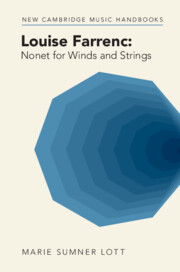
As well as being a virtuoso pianist, Louise Farrenc became the first woman to hold a permanent position as Professor at the Paris Conservatoire while continuing to compose symphonic and chamber music. This handbook introduces readers to Farrenc and her contemporaries with a focus on professional women musicians in nineteenth-century Paris. Farrenc's music was much admired by her contemporaries including Robert Schumann and Hector Berlioz. The acclaimed Nonet (1849) incorporated playful dialogue within the ensemble, virtuosic display, and an artful balance of newer and older compositional methods, garnering critical and artistic success and official recognition for the composer. Its performance history shows how musicians managed the logistics of professional life: forming and sustaining relationships, organizing concerts and tours, and promoting their work in the musical press. The book's nuanced analytical approach and historical insights will allow students, performers and listeners a fresh appreciation of Farrenc's work.
Farrenc worked within a network of musicians devoted to chamber music, including a dozen or more women pianists who specialized in the Classical repertoire. In the early decades of the nineteenth century, violinists like Pierre Baillot and Jean-Delphin Alard established chamber music concerts that created a culture of enthusiasm for string quartets and quintets, piano trios, and large ensemble music. Pianists like Farrenc, Thérèse Wartel, Sophie Pierson-Bodin, and Clara Loveday specialized in the performance of chamber music in the 1830s–50s, which allowed them to establish professional careers within a social environment that placed strict limits on “respectable” women and their activities in public spaces. Wartel established the Society for Classical Music, which presented septets, octets, and nonets for winds and strings to the Paris public for the first time. Farrenc composed her Nonet for the members of this group of virtuoso wind and string players, who performed it together in her solo concert in 1850.
A stylistic shibboleth of musical romanticism and early modernism, the breakthrough figures as a salient expressive device in many of Webern’s tonal compositions. This chapter sheds light on the aesthetic function that energetic thresholds fulfil in Webern’s early work, through a close analysis of the Piano Quintet (1907). Described by Theodor W. Adorno as an ‘amalgamation of Brahmsian with Wagnerian elements’, the quintet engages a complex dialectic between ‘formal’ and ‘material’ meaning strata. Linking this dialectic to what is termed the ‘agitating impulse’, a motivic idea set up in the opening bars that adamantly strives towards its resolution yet which is consistently frustrated, this chapter construes the various waves pervading the work not as emancipatory gestures but corporeal manifestations of a subcutaneous anxiety. As such, it is suggested that the quintet offers an original contribution to ‘Romantic’ sonata form practices, and a novel interpretation of the breakthrough.
Although the guitar was primarily used to accompany singing in Victorian England sophisticated chamber arrangements of music by Beethoven and Mozart were circulating in manuscript during the first decades of Victoria’s reign. This repertoire is almost entirely unknown and is discussed here for the first time. Duets for guitar and pianoforte were also fairly abundant into the 1840s. There was also a clear sense, especially among music publishers with a vested interest in the notion, that a ‘classical’ solo repertoire of guitar music had emerged during the first third of the century when the instrument was in fashion. Yet although there were still notable solo players towards mid-century, such as Joseph Anelli, making a career as a ‘serious’ guitar player, which had always been a precarious business was by 1850 virtually impossible, at least in Britain. Even Anelli’s concert programmes started to show the influence of the many popular entertainers who had begun to use the guitar, explored in the next chapter.
More than half of Schubert’s chamber works from 1824 to 1828 feature his preferred instrument, the piano. Yet in none of them does it function as an instrumental accompaniment, being instead an equal participant in a duo or trio chamber format. Especially in solo chamber works written for performance in recitals by befriended virtuoso instrumentalists, Schubert was perfectly willing to adapt the style brillant that flourished between 1820 and 1830. Based on the assumption that Schubert applied the style brillant solely for reasons of economy, his virtuoso chamber music has previously been considered to be of lesser value, mentioned only in passing. More recently, however, his turn to extroverted forms of expression has been described as a deliberate counterfoil to the introverted sublimation of his other ‘late’ works. This chapter considers the Fantasy in C Major (D934) and Variations in E Minor on ‘Trockne Blumen’ (D802) to show how Schubert discovered the sophisticated and outgoing mannerisms of the style brillant; it also discusses the development of ornamented variation techniques as an alternative to thematic development, and how this shift of emphasis between musical substance and figuration seems to anticipate the aesthetics of the Romantic arabesque.
This chapter gives a practical overview of writing for a variety of chamber music scenarios, from the traditional (e.g. string quartet) to the unusual (e.g. tuba trio). It describes how to respond to the existing canon of music for ensemble, as well as being creatively inspired by performers in rehearsal situations.
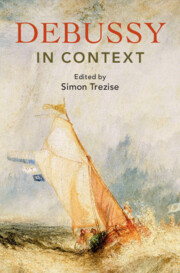
Exploring the many dimensions of Debussy's historical significance, this volume provides new perspectives on the life and work of a much-loved composer and considers how social and political contexts shape the way we approach and perform his works today. In short, focused chapters building on recent research, contributors chart the influences, relationships and performances that shaped Debussy's creativity, and the ways he negotiated the complex social and professional networks of music, literature, art, and performance (on and off the stage) in Belle Époque Paris. It probes Debussy's relationship with some of the most influential '-isms' of his time, including his fascination with early music and with the 'exotic', and assesses his status as a pioneer of musical modernism and his continuing popularity with performers and listeners alike.
Unlike operatic and orchestral music, chamber music, in common with song, thrived in the salons and the Société nationale. It was a rich period for chamber-music composition, with many works establishing a distinctively French style for genres like the string quartet (just as the French symphony came to distinguish itself from German models). Debussy was at his least idiosyncratic in his one published string quartet, which may be seen as an attempt to conform to expectations, at least in some aspects of the genre. Late in life he chose to distil the most personal features of his style in six chamber works, which pay tribute to remote French traditions, even though only three of these works were completed. The chapter concludes with a consideration of some of the attempts to complete Debussy’s incomplete set of six sonatas, of which he lived to complete only three.
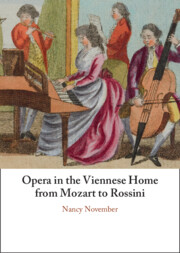
Domestic musical arrangements of opera provide a unique window on the world of nineteenth-century amateur music-making. These arrangements flourished in especially rich variety in early nineteenth-century Vienna. This study reveals ways in which the Viennese culture of musical arrangements opened up opportunities, especially for women, for connoisseurship, education, and sociability in the home, and extended the meanings and reach of public concert life. It takes a novel stance for musicology, prioritising musical arrangements over original compositions, and female amateurs' perspectives over those of composers, and asks: what cultural, musical, and social functions did opera arrangements serve in Vienna c.1790–1830? Multivalent musical analyses explore ways Viennese arrangers tailored large-scale operatic works to the demands and values of domestic consumers. Documentary analysis, using little-studied evidence of private and semi-private music-making, investigates the agency of musical amateurs and reinstates the central importance of women's roles.
The brief introduction situates Hensel’s String Quartet within the course of her compositional development, showing its significance here and its implications for understanding her modern reception. The string quartet genre held an enormous prestige in Hensel’s time, and the creation of this composition was implicitly a gesture showcasing her worth outside the ‘feminine’ sphere of solo lied and piano miniature. I also explain the position of this book within current, developing positions in the discussion of the music of female composers. This issue is especially pointed in this instance given the intimate relation and two-way interaction between the music of Fanny Hensel and her younger brother, Felix Mendelssohn. Hensel’s quartet makes an intriguing case study: its absence of significant reception history forces us to concentrate more on the actual music rather than what has been said about it.
If relatively modest in quantity, the chamber music of Amy Beach comprises a significant body of work that confronts meaningfully the churning countercurrents of her musical style. Chronologically, this repertoire falls into three groups, of which the first concentrates on works for violin and piano, culminating in the Violin Sonata, while in the second Beach explores a variety of other genres, including the piano quintet. The third and final group adds two late works, for piano trio and wind quintet. If this repertoire betrays clear enough references to Austro-Germanic traditions of chamber music, in particular to the music of Brahms (for example, Beach’s piano quintet exhibits examples of modeling from Brahms’s op. 34), it also reflects Beach’s ongoing efforts to expand the idea of American music, in part in answer to Dvorák’s “challenge” laid down in the “New World” Symphony. For Beach, the diversity of American music encouraged her to incorporate various popular sources, including Irish folk music and native Inuit music, into her own eclectic stylistic mixtures.
This Element considers the art and culture of arranging music in Europe in the period 1780–1830, using Haydn's London symphonies and Mozart's operas as its principal examples. The degree to which musical arrangements shaped the social, musical, and ideological landscape in this era deserves further attention. This Element focuses on Vienna, and an important era in the culture of arrangements in which they were widely and variously cultivated, and in which canon formation and the conception of musical works underwent crucial development. Piano transcriptions (for two hands, four hands, and two pianos) became ever more prominent, completely taking over the field after 1850. For various reasons, principal composers of the era under consideration, including Haydn, Mozart, and Beethoven, participated directly in the practice of arrangement. Motivations to produce arrangements included learning the art of composition, getting one's name known more widely, financial gain, and pedagogical aims.
Chapter 2 focuses on Hans Pfitzner’s Symphony in C♯ minor, a reworking of his 1925 String Quartet Op. 25, at its Berlin premiere in March 1933. This case study illuminates how National Socialist values, particularly to do with monumentality, gained traction within symphonic aesthetics. Liberal sociological theorisations of the symphony such as Paul Bekker’s (1918) seemed increasingly absurd as politics shifted and Enlightenment narratives about sovereignty reached breaking point. For instance, due to Nazi threats of violence, just days before the Berlin performance of Pfitzner’s new symphony the Philharmonie had seen the cancellation of Walter’s regular concert, precipitating his political exile. I read the Pfitzner concert’s critical reception in parallel with both Bekker’s symphonic utopianism and emerging Nazi symphonic aesthetics, exploring Pfitzner’s symphony as caught between these two symphonic poles. I pay attention to how discourses of public and private space associated with the symphony and chamber music allow a clear view of fascist reformulations of subjectivity and space in this context marked by Walter’s persecution.
Clara Schumann’s Piano Trio in G minor, Op. 17, of 1846 holds a contested place in the nineteenth-century repertory. One of her finest compositional achievements, it was performed regularly throughout the nineteenth century. Yet she herself seems to have led the way for a languishing of its reputation when, upon its publication in 1847, she acknowledged that she ‘did not care for it particularly’ and that, by comparison to Robert Schumann’s Piano Trio in D minor, Op. 63, composed a year later, it now ‘sounded effeminate and sentimental’. This may represent nothing more than an internalization of the widespread belief at this time in women’s inferiority as composers, but her self-doubt cast a long shadow. Clara Schumann’s Trio is usually cited in recent scholarship merely to contextualize Robert Schumann’s Trios (Daverio, 1997; Nemko, 1997), or to exemplify the composer’s capacity for withdrawal into the private musical sphere by way of coping with the emotional and psychological distress with which she was dealing when she composed the piece (Reich, 1985, Rev. 2001; Ferris, 2004).
This chapter considers Schumann’s Trio in relation to a range of contemporaneous piano trios, and through the lens of the New Formenlehre, giving particular emphasis to fugal passages in the opening and closing movements. The striking pianistic virtuosity of this Trio is matched by a compositional virtuosity that significantly enhances our understanding of romantic sonata form. Schumann’s innovations are explored in relation to the Schumannian belief that only through interiority might virtuosity be legitimized and elevated. The chapter concludes with a consideration of Schumann’s Trio as a formal model for later Piano Trios by Robert Schumann, Johannes Brahms and Bedřich Smetana.
The drum kit is most commonly considered an instrument rooted in popular music traditions and is a defining element of most popular music styles. In recent years the drum kit has emerged in the unlikely context of contemporary classical music. As a result, there is an expanding repertoire of fully notated music by composers operating within the framework of Western classical music notational traditions. This chapter illuminates the influence that the drum kit has had on classical music since the early twentieth century and presents an overview of composed works starting with Darius Milhuad’s La Créations du Monde from 1923 and ending with Nicole Lizée’s Ringer from 2009. The chapter shows that early approaches to drum kit composition began as an assimilation of existing popular music styles with little progression in performance techniques and expression for the instrument. More recently composers have found a balance between contemporary classical music techniques and the drum kit’s rich traditions, grooves, and styles to make something progressive and new. Through the author, Ben Reimer’s, own commissioning, performances, and research the chapter contemplates the elements that lead to this confluence in contemporary classical drum kit music
The chapter considers an agreement between Beethoven and his publisher Steiner as a crucial moment in the history of musical publication. In 1816, Beethoven and Steiner had decided to issue Wellington’s Victory and the Seventh and Eighth Symphonies in arrangements for various combinations of chamber group simultaneously, and concurrent with the original orchestral edition in parts and score. Important here, and moving well outside publication ‘business as usual’, was the issuing of complete scores. These demonstrate the evolving conception of the musical work: silent score study would gradually replace the hands-on reception and construction of the musical work of the arrangements for chamber ensemble. It is also significant that this new publishing strategy began with Wellington’s Victory, which was thus treated as a significant work for study and performance, although it has tended to be marginalised as mere ‘occasional music’ after Beethoven’s time. In total there were eight different editions released at once for Wellington’s Victory (and the Seventh and Eighth Symphonies). This strategy shows comprehensiveness, musically and socially. But it was also a matter of economic sense.
This chapter provides an overview of the social context in which arrangements of Beethoven’s symphonies for various chamber arrangements became extremely popular, representative of arrangement culture more generally. Beethoven described his era as ‘a fruitful age of arrangements’: this chapter considers why. The main arrangers of the era are discussed in overview, including Beethoven, with attention to the reasons why they cultivated musical arrangement. For Beethoven and others, there were aesthetic and artistic grounds. Beethoven made several arrangements of his own works for chamber ensemble, which probably had mostly to do his own development of thinking about chamber music, rather than with marketability or flexibility of performance options
Early nineteenth-century composers, publishers and writers evolved influential ideals of Beethoven's symphonies as untouchable masterpieces. Meanwhile, many and various arrangements of symphonies, principally for amateur performers, supported diverse and 'hands-on' cultivation of the same works. Now mostly forgotten, these arrangements served a vital function in nineteenth-century musical life, extending works' meanings and reach, especially to women in the home. This book places domestic music-making back into the history of the classical symphony. It investigates a largely untapped wealth of early nineteenth-century arrangements of symphonies by Beethoven - for piano, string quartet, mixed quintet and other ensembles. The study focuses on three key agents in the nineteenth-century culture of musical arrangement: arrangers, publishers and performers. It investigates significant functions of those musical arrangements in the era: sociability, reception and canon formation. The volume also explores how conceptions of Beethoven's symphonies, and their arrangement, changed across the era with changing conception of musical works.
Do you remember the first time you heard the music of Igor Stravinsky? Or modernist music? My own teenage introduction to both was Ragtime (1917–18), our music teacher helping us join the dots between its particular strand of twentieth-century classical music and Scott Joplin’s evergreen rag, ‘The Entertainer’ (1902), which the pianists among us would struggle to play.1 Looking back, the muffled giggling which Ragtime provoked was due as much to the jolting introduction of its faint and weird-sounding cimbalom as to the relentless discontinuities that shape its phrasing, melody and timbre. To hear Stravinsky repeatedly is to understand how these innovations relate to one another, but the shock of having to process his music for the first time was real and literally physical. Here were strange folk- and jazz-inspired sounds, far removed from the Classical and Romantic orchestras that had framed our expectations of so-called classical music until that point. Ragtime’s sound was, and remains, quite alien.