To save content items to your account,
please confirm that you agree to abide by our usage policies.
If this is the first time you use this feature, you will be asked to authorise Cambridge Core to connect with your account.
Find out more about saving content to .
To save content items to your Kindle, first ensure no-reply@cambridge.org
is added to your Approved Personal Document E-mail List under your Personal Document Settings
on the Manage Your Content and Devices page of your Amazon account. Then enter the ‘name’ part
of your Kindle email address below.
Find out more about saving to your Kindle.
Note you can select to save to either the @free.kindle.com or @kindle.com variations.
‘@free.kindle.com’ emails are free but can only be saved to your device when it is connected to wi-fi.
‘@kindle.com’ emails can be delivered even when you are not connected to wi-fi, but note that service fees apply.
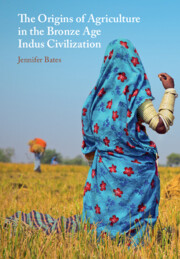
The Indus civilization in South Asia (c. 320 – 1500BC) was one of the most important Old World Bronze Age cultures. Located at the cross-roads of Asia, in modern Pakistan and India, it encompassed ca. one million square kilometers, making it one the largest and most ecologically, culturally, socially, and economically complex among contemporary civilisations. In this study, Jennifer Bates offers new insights into the Indus civilisation through an archaeobotanical reconstruction of its environment. Exploring the relationship between people and plants, agricultural systems, and the foods that people consumed, she demonstrates how the choices made by the ancient inhabitants were intertwined with several aspects of society, as were their responses to social and climate changes. Bates' book synthesizes the available data on genetics, archaeobotany, and archaeology. It shows how the ancient Indus serves as a case study of a civilization navigating sustainability, resilience and collapse in the face of changing circumstances by adapting its agricultural practices.
Violence, both physical and nonphysical, is central to any society, but it is a version of the problem that it claims to solve. This Element examines how states in ancient East Asia, from the late Shang through the end of the Han dynasty, wielded violence to create and display authority, and also how their licit violence was entangled in the 'savage' or 'criminal' violence whose suppression justified their power. The East Asian cases are supplemented through citing comparable Western ones. The themes examined include the emergence of the warrior as a human type, the overlap of hunts and combat (and the overlap between treatments of alien species and alien peoples), sacrifice of both alien captives and 'death attendants' from one's own groups, the impact of military specialization and the increased scale of armies, the emergent ideal of self-sacrifice, and the diverse aspects of violence in the regime of law.
Recommend this
Email your librarian or administrator to recommend adding this to your organisation's collection.