To save content items to your account,
please confirm that you agree to abide by our usage policies.
If this is the first time you use this feature, you will be asked to authorise Cambridge Core to connect with your account.
Find out more about saving content to .
To save content items to your Kindle, first ensure no-reply@cambridge.org
is added to your Approved Personal Document E-mail List under your Personal Document Settings
on the Manage Your Content and Devices page of your Amazon account. Then enter the ‘name’ part
of your Kindle email address below.
Find out more about saving to your Kindle.
Note you can select to save to either the @free.kindle.com or @kindle.com variations.
‘@free.kindle.com’ emails are free but can only be saved to your device when it is connected to wi-fi.
‘@kindle.com’ emails can be delivered even when you are not connected to wi-fi, but note that service fees apply.
The chapter opens with comments on autobiographical writings by Petrarch, Augustine, Uriel da Costa, Franciscus Junius, Ludvig Freiherr von Holberg, Jan Amos Komenský, and Leibniz. There are seen as attempts to make sense of one’s own life circumstances, while aware that absolute knowledge of one’s own life is not possible. This is particularly salient when it comes to understanding one’s sufferings. Following this, there is a discussion of the concepts of public and fatherland, comparing contemporary times to olden times, primarily Greek and Roman antiquity. The public is understood as a kind of collective moral and legal arbiter, and language plays an important role in its existence. This is seen to be particularly important for what is called a public of the Hebrews. The contemporary public is that of Christianity, but also of commerce, schools, and universities. A fatherland is explained in terms of familial bond to a community and a link in the chain of humanity. This is followed by a discussion of Machiavelli, Hugo Grotius, and Leibniz.
Classical reception scholarship on Michael Field has primarily focused on the duo’s engagement with ancient Greek poetry, yet the author’s oeuvre contains eight closet dramas and innumerable poems focused on Ancient Rome. This chapter takes a closer look at Michael Field’s Roman Trilogy, comprised of The Race of Leaves (1898), The World at Auction (1901), and Julia Domna (1903), the dramas in which Michael Field grapple most closely with the entanglement between imperial and literary decadence. Through the depiction of queer artists using collaborative art as a form of resistance, the Decadent Trilogy sheds light on Michael Field’s understanding of the resemblance between ancient and modern imperial decadence.
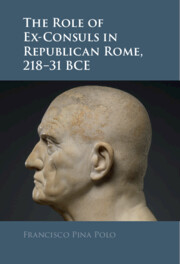
The consulship was the highest office in the Roman Republic. At the end of their term ex-consuls automatically attained the status of consulares, remained members of the Senate for life, gained prestige and influence in Rome and were therefore expected to play a prominent role in Roman politics and society. Holding the consulship by no means marked the end of a consular's political activities. But what did ex-consuls do from the time they completed their consulship until their death? What was their political career? What was their political role in the Senate? What kinds of public tasks and duties did they perform for the res publica? What function did consulares play in Roman society, and how strong was their leadership capacity? This is the first book in any language on the political role of ex-consuls, who formed the top level of the aristocracy during the Roman Republic.
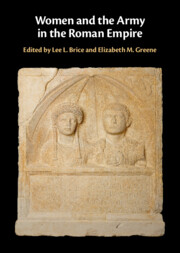
The presence of women in Roman military contexts has been established beyond doubt by scholars in recent decades. Nevertheless, very little sustained attention has been paid to who these women were, how they fit into the fabric of settlements, and what their contributions were to these communities. This volume offers new insights into the associations, activities, and social roles of women in the context of the Roman army, emphasizing the tangible evidence for the lived realities of women and families at different social levels. The various chapters adopt dynamic perspectives and shed new light on archaeological and historical evidence to provide novel conclusions about women's lives in antiquity. Histories of the Roman army can no longer ignore the women who lived and worked in its midst and histories of Roman women must acknowledge their important military role.
This chapter explains that the reasonable person was not the first anthropomorphised legal standard. The idea of model characters can be traced back to the oldest documents of humanity. The chapter introduces three of these ancient ancestors of the reasonable person: the silent person of Egypt (geru maa), the earnest person of Greece (ho spoudaios), and the male head of a family in ancient Rome (paterfamilias). There are many other ancestors of the reasonable person, and at least implicit anthropomorphised standards of behaviour could probably be found in any society at any time. The three concepts here are presented only as examples, and because they form part of one Mediterranean context in which the ancient Egyptians probably influenced the ancient Greeks, who in turn influenced the Romans, whose influence on contemporary European law and on the systems derived from it can still be felt. Each of the three figures introduced in this chapter deserves its own biography and the analysis offered here remains fragmented. Nonetheless, the selected aspects of the lives of the geru maa, of the spoudaios, and of paterfamilias foreshadow many of the questions, tensions, and challenges with which the common law’s reasonable person still struggles today.
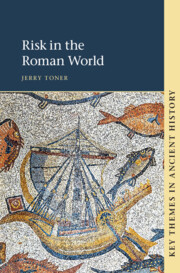
The chapter begins by looking at Beck’s theory of a Risk Society and how this has denied that risk is a term that can be applied to the ancient world. There is a survey of relevant work that has been carried out on uncertainty in antiquity, before the chapter examines how the term risk emerged and the various ways of defining the term. The chapter argues for a broader, cultural approach that sees risk as more than a modern numerical concept and the development of ideas concerning risk as a historical process.
Modern risk studies have viewed the inhabitants of the ancient world as being both dominated by fate and exposed to fewer risks, but this very readable and groundbreaking new book challenges these views. It shows that the Romans inhabited a world full of danger and also that they not only understood uncertainty but employed a variety of ways to help to affect future outcomes. The first section focuses on the range of cultural attitudes and traditional practices that served to help control risk, particularly among the non-elite population. The book also examines the increasingly sophisticated areas of expertise, such as the law, logistics and maritime loans, which served to limit uncertainty in a systematic manner. Religious expertise in the form of dream interpretation and oracles also developed new ways of dealing with the future and the implicit biases of these sources can reveal much about ancient attitudes to risk.
Recent scholarly interest in the figure of the interpreter has resulted in a wealth of studies of individual interpreting careers and interpretation practices in specific historical contexts. But, while it is common for present-day knowledge and personal experience of interpreting to inform historical case studies, or for historical examples to receive passing mention in accounts of the contemporary situation, a truly critically informed diachronic perspective is so far lacking. This chapter takes a comparative diachronic approach to the study of interpreting by comparing and contrasting the lives of military interpreters in diverse historic contexts. Rather than offering separate biographies, my aim is to show how structural factors affect the position and practices of interpreters across time and space. I will also show how experience in working with fragmentary evidence from one period (e.g., documents from the ancient Mediterranean world) can be used to inform research on interpreting in other historic contexts (e.g., British Army records from the First World War).
This chapter introduces the subject of prostheses, prosthesis use, and prosthesis users in classical antiquity. It compares contemporary, historical, and ancient historical prostheses and indentifies certain types of continuity across millennia. It undertakes a literature review of the current state of scholarship on impairment and disability in classical antiquity, highlighting how little attention has been paid to assistive technology by scholars to date. It explains the methodology that will be used in this monograph. It provides an overview of the different types of evidence that will be used (i.e. literary, documentary, archaeological, bioarchaeological). It outlines the contents of the monograph, chapter by chapter.
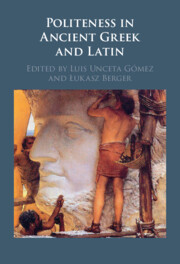
Politeness serves to manage social relations or is wielded as an instrument of power. Through good manners, people demonstrate their educational background and social rank. This is the first book to bring together the most recent scholarship on politeness and impoliteness in Ancient Greek and Latin, signalling both its universal and its culture-specific traits. Leading scholars analyse texts by canonical classical authors (including Plato, Cicero, Euripides, and Plautus), as well as non-literary sources, to provide glimpses into the courtesy and rudeness of Greek and Latin speakers. A wide range of interdisciplinary approaches is adopted, namely pragmatics, conversation analysis, and computational linguistics. With its extensive introduction, the volume introduces readers to one of the most dynamic fields of Linguistics, while demonstrating that it can serve as an innovative tool in philological readings of classical texts.
The ancient city of Gabii—an Italian polity of the first millennium BC and a peer to early Rome—has often been presented as an example of urban decline, a counterpoint to Rome's rise from a collection of hilltop huts to a Mediterranean hegemon. Here the authors draw on the results from recent excavations at Gabii that challenge such simplistic models of urban history. Diachronic evidence documenting activity at the site over the course of 1400 years highlights shifting values and rhythms materialised in the maintenance, transformation and abandonment of different urban components. This complex picture of adaptation and resilience provides a model of ancient urbanism that calls into question outdated narratives of urban success and failure.
Throughout history, reform has provoked rebellion - not just by the losers from reform, but also among its intended beneficiaries. Finkel and Gehlbach emphasize that, especially in weak states, reform often must be implemented by local actors with a stake in the status quo. In this setting, the promise of reform represents an implicit contract against which subsequent implementation is measured: when implementation falls short of this promise, citizens are aggrieved and more likely to rebel. Finkel and Gehlbach explore this argument in the context of Russia's emancipation of the serfs in 1861 - a fundamental reform of Russian state and society that paradoxically encouraged unrest among the peasants who were its prime beneficiaries. They further examine the empirical reach of their theory through narrative analyses of the Tanzimat reforms of the nineteenth-century Ottoman Empire, land reform in ancient Rome, the abolition of feudalism during the French Revolution, and land reform in contemporary Latin America.
It has traditionally been assumed that biblical writers considered Nero to be the Antichrist.. This book refutes that view. Beginning by challenging the assumption that literary representations of Nero as tyrant would have been easily recognisable to those in the eastern Roman empire, where most Christian populations were located, Shushma Malik then deconstructs the associations often identified by scholars between Nero and the Antichrist in the New Testament. Instead, she demonstrates that the Nero-Antichrist paradigm was a product of late antiquity. Using now firmly established traits and themes from classical historiography, late-antique Christians used Nero as a means with which to explore and communicate the nature of the Antichrist. This proved successful, and the paradigm was revived in the nineteenth century in the works of philosophers, theologians, and novelists to inform debates about the era's fin-de-siècle anxieties and religious controversies.
When contemporary dispossessed urban classes are figured as a “proletariat,” a potent historical analogy is activated in which the well-documented experience of the burgeoning industrial working classes of nineteenth-century Europe provides an implicit template for interpreting events and processes far removed in time and space. Yet Karl Marx's own deployment of the figure of the proletariat, which often provides the inspiration and model for such analogic moves, was itself in its own time already a complex historical analogy, invoking the social hierarchies of ancient Rome. Rethinking this doubly analogical intellectual history provides an occasion both for considering the uses and abuses of historical analogy, and for using a reflection on the original (Roman) proletarians as a conceptual lever for prying apart some outdated assumptions about the contemporary politics of certain propertyless urban populations, in southern Africa and beyond.
Recommend this
Email your librarian or administrator to recommend adding this to your organisation's collection.