To save content items to your account,
please confirm that you agree to abide by our usage policies.
If this is the first time you use this feature, you will be asked to authorise Cambridge Core to connect with your account.
Find out more about saving content to .
To save content items to your Kindle, first ensure no-reply@cambridge.org
is added to your Approved Personal Document E-mail List under your Personal Document Settings
on the Manage Your Content and Devices page of your Amazon account. Then enter the ‘name’ part
of your Kindle email address below.
Find out more about saving to your Kindle.
Note you can select to save to either the @free.kindle.com or @kindle.com variations.
‘@free.kindle.com’ emails are free but can only be saved to your device when it is connected to wi-fi.
‘@kindle.com’ emails can be delivered even when you are not connected to wi-fi, but note that service fees apply.
This chapter focuses on written systems. It introduces logographic, semiographic and phonographic scripts, including alphabets, abjads, abugidas, and syllabaries, and provides a short account of the origin of writing. This chapter also exemplifies noteworthy conscripts and discusses the connection between writing, the fictional world, and the phonological and morphological structure of a language. In addition, it provides conlanging practice, provides you with a blueprint that will facilitate the design of an original conscript for a conlang, and introduces the writing system of the Salt language.
You have used IPA to document your language’s words and their features, but this chapter introduces other options for writing your conlang, beginning with a brief overview of different types of writing systems. The second section introduces romanization strategies, which utilize standard keyboard characters to represent sounds in a language. The third section discusses how you can adapt an existing orthography to your conlang, provided it makes sense for your speakers to have access to that existing orthography. Finally, the fourth section discusses the process of creating a unique orthography if that is the direction you want to take for your language. By the end of this chapter, you will decide how you might romanize your language and whether you will use an orthography to represent the written form of your language.
Chapter 3 explores the “The Metaphors We Read With.” Here we find books rhetorically manufacturing a new kind of consciousness, as the affordances of text technologies provide a way to describe human experience. This chapter shows that, whether it is poets claiming love “is printed on my heart,” or physicians claiming a man’s sickness is his “comma” and not his “period,” or a botanist saying an animal is a plant “bound up in one volume,” the symbols of the book reshaped the intellectual and linguistic makeup of English culture. Books have affordances, which in turn provide figurative resources for writers.
In this first full chapter readers will find a general survey of those aspects of Balkan geopolitical, cultural, and linguistic history that are most relevant for the present study, including the Balkans in relation to the Ottoman Empire. We locate the Balkans geographically, describing its physical characteristics and discussing the controversy over where its northern limits are to be located. Various other extralinguistic factors are discussed that are relevant for the linguistic situation. Most importantly, the languages of the Balkans are introduced as to their genealogical affiliation, their historical attestation, their documentation, their pertinent representation in scholarly literature, their dialectology, their social setting, and related matters, including associated writing systems. For the sake of completeness, all languages found in the Balkans, from ancient to early modern, are given some attention, creating a comprehensive account of the geographically determined languages of the Balkans; ultimately, though, the focus is narrowed to the Balkan languages, i.e. those languages in the region that significantly (or in any attested fashion) display the morphosyntactic and other convergence phenomena that are central to the concept of a contact area, i.e. to a sprachbund.
Most Slavic orthographies are relatively shallow, relying on phonemic and morphological principles; other orthographic principles play minor roles. However, some orthographies with a rather unbroken tradition give the historical principle a certain role (like Polish or Czech); others rely heavily on the morphological principle (like Russian or to some extent Bulgarian). In some minor details (like comma rules or quotation marks) one can see different external influences, especially French and German. In the ways writing systems were adapted, the major split is between languages written in Cyrillic and those written in Latin. In the Latin alphabet, the main devices used are diacritics (nowadays especially those introduced by the Hussites) and digraphs, whereas Cyrillic hardly has diacritics or digraphs at all but uses special letters created from ligatures or with diacritic elements or borrowed from a different script. Spelling reforms over the course of history have generally strengthened the phonemic principle, unified orthography for a language, or increased or decreased differences vis-à-vis other languages in line with the political situation.
This chapter shows that the Slavic scripts roughly align with the cultural division between Slavia Orthodoxa and Slavia Latina. Although the Cyrillo-Methodian tradition of the Glagolitic script connected to the Old Church Slavonic language was originally not confined to either of the two areas and the Glagolitic script was used longest in Catholic Croatia, it is nowadays continued in the form of the Cyrillic script, whereas the Latin alphabet in Slavia Latina is based on a completely different, ‘Western’ tradition. However, mutual influences abound and can be seen in script changes and various instances of biscriptality as well as in the introduction of roman type in the West in the sixteenth century, the adoption of its design principles in the ‘civil type’ in the East in the eighteenth century, and the gradual replacement of both blackletter and Old Cyrillic, which was (almost) completed only in the twentieth century.
It is generally accepted by scholars that the songs of Homer were first written in ~ 700 BCE; the text seems to spring fully formed into a still illiterate world, demonstrating in a sophisticated vocabulary the first example of the use of a new alphabet. The language used is a never-spoken construct; its construction represents the first use of an alphabet enabling words to be written. This paper aims to open a discussion on the means by which spelling emerged, either democratically or as the work of one man.
After a survey of the characteristic features of the genre of origin stories in biblical, Greek, and Phoenician sources, this chapter attempts to trace the history of the genre and the circumstances that led to its appearance in the Hebrew Bible and Ancient Mediterranean literature, from its sources of inspiration in the Near East until its establishment in the eastern Mediterranean in the second quarter of the first millennium bce.
Some Greek texts contain words in Latin script and/or with Latin endings. Latin script occurs mainly in Roman law texts; these are investigated with particular attention to Theophilus Antecessor and the Scholia Sinaitica. Evidence for script mixture within individual words is considered. Words in Latin script and/or with Latin endings are more likely to be codeswitches than loanwords, but some loanwords appear with one or both these features. Multi-word phrases retain their original script and inflections much more often than individual words; these are mostly codeswitches, but some phrases may be loanwords.
It is true that most teachers have limited knowledge of how words work in English. Linguistics hasn’t been a feature of their own schooling or their teacher education, and you can’t teach what you don’t know. The good news is that it isn’t hard to build the knowledge – in fact, it’s fun. In this chapter we look more closely at the linguistic threads that contribute to the rich tapestry of each word: etymology, orthography, phonology and morphology.
Chapter 3 outlined four key principles for teaching spelling: start with meaning; teach spelling explicitly; teach a repertoire of spelling knowledge; and integrate spelling instruction into all subject areas. This chapter introduces a 10-step process for planning and implementing a spelling program that is grounded in those four principles. Interspersed among the steps in the planning process are some of the questions teachers and parents frequently ask as they embark on the implementation process. What would your answers be? My responses are posted at the end of the chapter.
This chapter is focused on getting spelling assessment right, and expands upon steps 9 and 10 in the program planning process, introduced in chapter 4: assessing spelling in use, and keeping records of teaching and learning.
Chapter 2 described how words work in English, and provided guidance on what to teach in spelling. Just as important as knowing what to teach is knowing how to teach, and that is the focus of this chapter. Many teachers simply teach spelling the way they were taught – through a list of words to be learned for an end-of-week assessment. However, research shows that this is an ineffective way to learn to spell. This chapter outlines four key principles for teaching spelling, each based on what the research tells us about how we learn to spell. 1 Start with meaning. 2 Teach spelling explicitly. 3 Teach a repertoire of spelling knowledge. 4 Integrate spelling instruction across all subject areas.
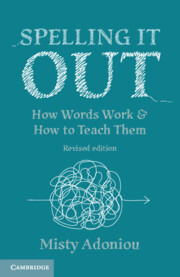
Spelling can be a source of anxiety for school children and working professionals alike. Yet the spelling of words in English is not as random or chaotic as it is often perceived to be; rather, it is a system based on both meaning and a fascinating linguistic history. Misty Adoniou's public articles on the processes of teaching and learning spelling have garnered an overwhelming response from concerned parents and teachers looking for effective solutions to the problems they face in teaching English spelling to children. Spelling It Out, Revised edition aims to ease anxiety and crush the myth that good spelling comes naturally. Good spelling comes from good teaching. Based on Misty Adoniou's extensive research into spelling learning and instruction, this book encourages children and adults to nurture a curiosity about words, discover their history and, in so doing, understand the logic behind the way they are spelled.
The final chapter notes that Alphabet’s megacorporate existence could, further to the ideological reasons detailed in Chapter 8, potentially be brought to an end by two sets of considerations that are readily apparent right now. The first set of considerations relates to discord amongst the megacorporation’s employees, and the second to anti-monopoly sentiment. Taken together, these considerations suggest that, in the short term, Alphabet’s capacity to remain a megacorporation will likely turn on its capacity to account for disruptive elements from within; and its capacity to avoid being undermined by anti-trust threats from without. The chapter’s summary then brings the book to a close by emphasizing that, even if Alphabet’s existence comes to an end sooner rather than later, the megacorporate concept it is an example of, the identification of the infinite times ideology that informs it and the philosophical perspective that I have used to discuss it, remain of value: for they all help reveal that corporate influence over society is more profound than is commonly recognized.
As a megacorporation, Alphabet is, by definition, an organizational agent of the highest degree. Nevertheless, it is neither entirely self-defined nor self-created. In particular, it has been shaped by the Silicon Valley context from within which it emerged. Accordingly, the chapter’s first section provides an overview of the key actors and sectors that have helped define, and mythologize, Silicon Valley. Following this, Google’s emergence, success and transformation are described and explained. Then, and in accord with the characteristics detailed in Chapter 2, Alphabet is shown to be a megacorporation. As Alphabet’s global scale and broad scope, monopolistic tendencies, corporate social responsibility concerns and political-economic hybridity are relatively simple to describe, the chapter’s summary notes that it is the megacorporation’s existential impacts – on the extent, and our experience of, the past and the future – that is focused on throughout the book’s second part.
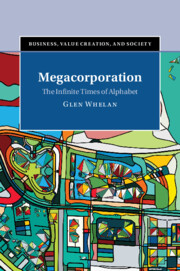
When the scale and scope of influence that a corporation wields is so great that it eclipses that of nearly all other corporations combined, it attains megacorporate status. Whelan proposes that, amongst the current big tech cohort, it is only Alphabet, the parent company of Google, that can be categorized as such. In advancing a novel philosophical perspective, and aspiring to an amoral ideal of analysis, Whelan reveals Alphabet's activities to be informed by the ideology of infinite times, consequently transforming how we experience the past, present and the future at personal and social levels. By shining a light on such corporate existential impacts, Megacorporation: The Infinite Times of Alphabet opens up a new field of research that makes the philosophical analysis of business and society an everyday concern. This novel study on corporate social influence will appeal to readers interested in big tech, business and society, political economy and organization studies.
Chapter 11 focuses on one of the most important events of the last 5,000 years: the development of writing. Writing is defined as a system of more or less permanent marks used to represent an utterance in such a way that it can be recovered more or less the same way without intervention. Writing is distinguished from ideograms that represent things or concepts directly. Readers are introduced to alphabets in which, though imperfectly, each letter represents one sound, syllabaries which represent the syllable, abjads, in which, typically, only consonants are written, and abujidas, in which each consonant is represented with a basic vowel. The chapter includes examples for each type of writing from many different languages. The history of writing is summarized, from its beginnings in Mesopotamia, China, and Mesoamerica, to modern day writing in different parts of the world. Each new concept introduced is amply illustrated with images from different types of writing systems, and readers are encouraged to try to understand how reading should proceed in each case.
This paper explores the history of the alphabet revolutions in the Ottoman Empire and the Russian Empire, beginning in the 1860s and culminating with the new Turkish alphabet and the Soviet latinization movement in the 1920s. Unlike earlier works that have treated these movements separately, this article traces the origins of the alphabet revolutions to the 19th-century communications revolution, when the telegraph and movable metal type challenged the existing modes of knowledge production and imposed new epistemologies of writing on the Muslims in the Russo-Ottoman space. This article examines the media technologies of the era and the cross-imperial debates surrounding various alphabet proposals that predated latinization and suggests that the history of language reform in the Russo-Ottoman world be reevaluated as a product of a modernizing information age that eventually changed the entire linguistic landscape of Eurasia.
places emoji within the context of the evolution of language and communications technology. Since language first evolved some one hundred thousand years ago, allowing people to communicate complex ideas to each other, each new technology has extended its reach. The last few decades have seen the speed of technological change increase rapidly, with the computer, the internet and mobile devices making communication across distances ever easier and cheaper. But these inventions have also presented challenges for how we communicate, especially around the important issue of empathy and emotional distance. Various innovations, from punctuation marks to emoticons, have been used in an attempt to provide solutions for these challenges. In explaining the trajectory of this evolution, the chapter looks at how emoji relate to and differ from earlier forms of written language, such as hieroglyphics, and why they’ve emerged to become so popular at this particular juncture in history.