To save content items to your account,
please confirm that you agree to abide by our usage policies.
If this is the first time you use this feature, you will be asked to authorise Cambridge Core to connect with your account.
Find out more about saving content to .
To save content items to your Kindle, first ensure no-reply@cambridge.org
is added to your Approved Personal Document E-mail List under your Personal Document Settings
on the Manage Your Content and Devices page of your Amazon account. Then enter the ‘name’ part
of your Kindle email address below.
Find out more about saving to your Kindle.
Note you can select to save to either the @free.kindle.com or @kindle.com variations.
‘@free.kindle.com’ emails are free but can only be saved to your device when it is connected to wi-fi.
‘@kindle.com’ emails can be delivered even when you are not connected to wi-fi, but note that service fees apply.
The first Linear B tablets were found by Evans in Knossos, many more by Blegen in Pylos in 1939 and progressively in all Mycenaean centres. Crete had three writing types Hieroglyphic, Linear A being more widespread, still undeciphered, and Linear B which descends from Linear A and appeared in mainland Greece around 1400 BC. After many endeavours, it has been deciphered in 1952 revealing a syllabic script for an early stage of Greek language. The debate of concordance between the Knossos and the Pylos tablets followed and is still alive. The inscribed clay tablets, simply dried, were baked by the fires that destroyed the palaces and thus preserved. They are administrative documents mostly inventory or tax statements teaching us a lot about Mycenaean life, palatial system, social hierarchy but no literature or history.
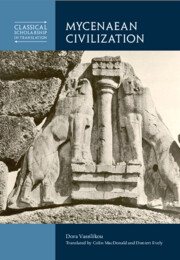
The Bronze Age of Greece was unknown until the end of the 19th century, when Heinrich Schliemann's excavations stunned the world by bringing to light the glamour of Mycenaean elite society. This book, by one of Greece's most distinguished archaeologists, provides a complete introduction to Mycenaean life and archaeology. Through both chronological and thematic chapters, it examines the main Mycenaean centres, the palaces and kingship, the social structure, writing, religion and its political implications, and the contacts and relations of the Mycenaeans with neighbouring countries, especially Asia Minor, Egypt, the coast of Syria-Palestine and Italy. Attention is paid to the distinctive Mycenaean art, including monumental architecture, gold and silver metalwork and jewellery, and the book is supported by over 300 illustrations. Dora Vassilikou concludes by examining the simultaneous catastrophes that brought the Bronze Age of the Eastern Aegean to its end and opened up a new era.
Recommend this
Email your librarian or administrator to recommend adding this to your organisation's collection.