To save content items to your account,
please confirm that you agree to abide by our usage policies.
If this is the first time you use this feature, you will be asked to authorise Cambridge Core to connect with your account.
Find out more about saving content to .
To save content items to your Kindle, first ensure no-reply@cambridge.org
is added to your Approved Personal Document E-mail List under your Personal Document Settings
on the Manage Your Content and Devices page of your Amazon account. Then enter the ‘name’ part
of your Kindle email address below.
Find out more about saving to your Kindle.
Note you can select to save to either the @free.kindle.com or @kindle.com variations.
‘@free.kindle.com’ emails are free but can only be saved to your device when it is connected to wi-fi.
‘@kindle.com’ emails can be delivered even when you are not connected to wi-fi, but note that service fees apply.
This section draws on previous chapters to compare Zimbabwe to other resource-wealthy states in Southern Africa, particularly Botswana, Namibia, South Africa, and Zambia. In all these states, resource sector policy has been essential to these states’ historical and institutional development. However, this chapter looks at how, even given many advantages and a level of development that was once ahead of these states regarding state capacity and democratization, Zimbabwe has fallen distinctly behind these other states. An overview of the resource sector shows that timing matters as other resource sectors are far more institutionalized than Zimbabwe and, while often leaving much to be desired, have not led to the same level of institutional and political decline. While these other states have had many of the same challenges and have had extreme difficulties, Zimbabwe has nonetheless been at the far end of the bell curve when it comes to resource curse dynamics.
This chapter introduces the central puzzle of this study: why, in contrast to other states in Southern Africa, have Zimbabwean democratic institutions stagnated or even declined since independence in 1980? To begin to answer this question, an overview of the resource sector in Zimbabwe, particularly the large diamond found in 2006, and the development of institutions since Zimbabwe became independent in 1980, is given. Furthermore, an institutional analysis, a brief overview of past studies, and a research design are outlined. In terms of case selection, Zimbabwe is placed in the overall population of cases when it comes to resource curse dynamics, and the concept of the “opaque” state is defined. Furthermore, Zimbabwe is defined in terms of democratization and state capacity, concepts that will be used throughout the study.
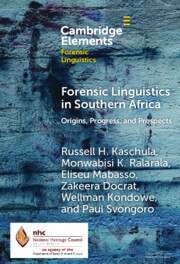
This Element introduces the study of forensic linguistics, particularly in southern Africa, but also in Africa more generally. In the past six decades, there has been clear evidence that the discipline of forensic linguistics is, or was, unknown to general linguists, legal linguists, and applied linguists on the African continent. Now, however, the situation is rapidly changing, with forensic linguistics studies gaining momentum in various parts of Africa. In this Element the authors introduce the topic, define the discipline, address the language of record issue in southern Africa, as well as critically debate the state of court interpreting and translation of documentation into African languages, address police interviewing techniques, while also looking at possible future developments in the discipline of forensic linguistics. This title is also available as Open Access on Cambridge Core.
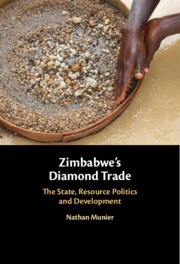
What happens when states experience a rapid increase in resource wealth? This book examines the significant diamond find in eastern Zimbabwe in 2006, possibly the largest in over 100 years, and its influence on the institutional trajectory of the country. Nathan Munier examines how this rapid increase in resource production shaped the policies available to political actors, providing a fresh understanding of the perpetuation of ZANU-PF rule and the variation in the trajectory of institutions in Zimbabwe compared to other Southern African states. This study places Zimbabwe amongst the overall population of resource-wealthy countries such as such as Angola, Botswana, Namibia and South Africa, especially those that experience a significant increase in production. In doing so, Munier contributes to the understanding of resource politics, political economy, and comparative African politics.
Resilient Zulu moral economy compelled Natal’s sugar planters and white settler state to introduce Indian indentured workers since 1860. As concerns over productivity in a weak colonial economy informed this decision, meticulous management of labor time crucially shaped the treatment of migrant Indian indentees. Moreover, systemic violence in capital’s life processes formed the culture of work-discipline in the plantations and in other industrial sectors. Subsequently, as contract expired Indian indentees acquired relative economic mobility compared to Africans, they appeared in Zulu critiques of Natal’s settler colonial order. Ironically, dispossessed Zulus reproduced colonial logic of time management while discussing the comparative economic success of Indian “newcomers.” Zulu critiques of colonial labor management also complemented the racial exclusivity of migrant Indians. Analyzing the complex workings of capital, labor, and race in nineteenth-century Natal, this article explains how capital’s life processes shaped violent conflicts in the intimate domestic space of working-class lifeworld.
This article explores the systems of policing that emerged in the early Cape Colony (1652–1830). Contrary to previous historical scholarship that understood the institution to be largely nonexistent or of marginal importance to the colony’s political economic development, this article argues that the Cape colony’s systems of policing, which doubled as ad hoc military organizations, were not so much weak as privatized. It shows how this persistent tendency was motivated by the Dutch East India Company’s desire to maximize profits—though it manifested differently in different parts of the colony. Moreover, this article demonstrates that the mercantile economy that the company installed at the Cape ensured that private policing would become a vehicle of indigenous dispossession. In doing so, it seeks to contribute to the field of African carceral studies and understandings of processes of racialization in the early Cape.
This article offers the first gendered history of African radio audiences. It uses a comparative approach to demonstrate that colonial development projects in Ghana and Zambia successfully created mass African audiences for radio between the 1930s and 1950s, at a time when most radio sets on the continent were owned by white settlers. However the gendered impact of the projects was uneven. In Zambia the promotion of battery-operated wirelesses inadvertently created a male-dominated audience, while the construction of a wired rediffusion system in Ghana attracted equal numbers of male and female listeners. Ghana’s radio project offers new perspectives on the history of colonial development as a very rare example of a scheme that benefitted women as much as men. Differences in the voice of Ghanaian and Zambian radio also reveal that these early radio schemes had a lasting influence on broadcast content and listening culture in both countries beyond the 1950s.
This piece explores the parallel development of two fisheries management regimes in mid-twentieth-century Lake Malawi: one imposed by the British colonial government over the lake and the other by Senior Chief Makanjira focused on Mbenji Island. The parallel development of these regimes provides opportunity for close analysis of how fisheries management centred on different knowledge and practices led to distinctive legacies of governance legitimacy and efficacy. Given the increasing recognition that Indigenous knowledge is crucial to the future sustainability of fisheries globally, we contend that it is imperative to recognise the ways in which colonial pasts have embedded knowledge hierarchies and exclusionary decision-making processes within national fisheries governance regimes that continue to obstruct capacities to bring different knowledges, practices, and management approaches together effectively and appropriately.
This chapter focusses on ubiquitous plant presences in some of the literatures of southern Africa, essentially of South Africa and Zimbabwe. Both Indigenous societies and incursive colonial regimes depended fundamentally on plant life for shelter, food, materials, and aesthetics of belonging. Colonials imported numerous alien species, both deliberately cultivated and inadvertently ‘released’, with incalculable impacts on the subcontinent’s variegated local environments. The governing divide between ‘indigenous’ and ‘alien’, however, is complicated by sundry blurrings and ironic cross-overs. These dynamics, affecting commercial, societal, and emotional dimensions alike, are explored through some selected nodes, particularly the iconography of Eden or Arcadia; the complex aesthetic ecology of the suburban garden; and the treatment of trees, especially the native yellowwood and the alien jacaranda.
In this article, we demystify the South African Defence Force’s 32 Battalion and de-exceptionalize the apartheid military by connecting it to other colonial military communities, and apartheid governance more broadly. Drawing on oral history, autoethnography, and archival documents, we demonstrate the highly unequal, yet mutual, reliance of white authorities and elite Black women in the haphazard and improvised nature of apartheid military rule. Most women arrived at the unit's base, Buffalo, as Angolan refugees, where white military authorities fixated on their domestic and family lives. We examine the practical workings of military rule by considering three nodes of social surveillance and control. Elite Black women, known as “block leaders,” served as intermediaries, actively participating in the mechanics of military rule while also using their position to advocate for their community. Finally, we consider the ingrained violent patriarchal nature of life in the community by highlighting the nature of women's precariousness and labor.
Focusing on the first decades of the twentieth century but acknowledging longer-term patterns of circulation, this paper discusses how cattle, historically occupying important meanings and roles in the lives of African agropastoralists, was commodified and marketed in southern Mozambique just as Lourenço Marques became the new capital of Mozambique. Highlighting the relations that consolidated between the capital and surrounding cattle-rich areas in a period marked by cattle disease but also the First World War and the Great Depression, the paper looks at the role of different agents and bodies involved in the emerging beef market. Ultimately, the paper shows how African agropastoralists, the main cattle producers in the region, resisted these conditions and tried to engage with markets on their own terms, even in the face of their dwindling control over the different factors that influenced the size and quality of their herds.
Transfrontier conservation landscapes, such as the Kavango–Zambezi Transfrontier Conservation Area (KAZA TCA) in southern Africa, play a crucial role in preserving global biodiversity and promoting the sustainable development of local communities. However, resources to facilitate management could become scarce across large areas, leading to difficulties in obtaining baseline ecological information. Consequently, in the absence of sustainable management vast landscapes may experience loss of wildlife species, which could destabilize ecosystems. This effect is particularly significant if the loss involves top predators. Hence, understanding carnivore distributions is critical to informing management. We conducted a mammal survey in the Ondjou Conservancy in Namibia, an 8,729 km2 understudied area in the south-west of the KAZA TCA. We analysed camera-trapping data from a 2,304 km2 grid and identified high carnivore richness (18 species) despite widespread human activity and prey depletion. Using a multi-species occupancy framework we found that carnivore occurrence increased with increasing distance from the main village and with closer proximity to the Nyae Nyae Conservancy neighbouring the KAZA TCA, which has large and diverse carnivore populations. Carnivore occurrence was higher when local prey richness was high. The Ondjou Conservancy could function as an important buffer for the larger conservation network, yet rural communities in this area require support for fostering human–wildlife coexistence. Additionally, restoring the natural prey base will be critical to ensuring the long-term viability of carnivore populations in this and other human-impacted landscapes. With many remote areas of transfrontier conservation landscapes being understudied, our findings illustrate the conservation potential of such areas within large-scale conservation networks.
In the late 1970s and early 1980s, the terrain of the diplomatic and security landscape of Southern Africa shifted dramatically. South Africa declared various Bantustans “independent,” but they were not recognized by other countries. Small regional states like Lesotho increasingly took more combative diplomatic stances, aided by Cold War connections and, in this case, a local border dispute. This article examines a proposed ski resort that South Africa wanted to build in the QwaQwa Bantustan on Lesotho's border starting in 1975. Because of Lesotho's diplomatic and military escalation, the Khoptjoane resort was never built, but the lengthy dispute contributed to the sidelining of the apartheid regime's diplomats in favor of its securocrats. Thus, we argue the failed ski resort contributed to the atmosphere in which Pretoria greenlit the Maseru Massacre of 1982, presaging the apartheid regime's increased 1980s willingness to use its military superiority against township residents and Southern African neighbors alike.
During its decade-long war (1964–74) against Portuguese colonialism, Frelimo developed a language to express the style in which it imagined the nation. On taking power in 1975, Frelimo used this language — its watchwords — to signal the shared identity it aimed to instill within Mozambique. Frelimo asked Mozambicans to live in the future tense: to turn away from familiar idioms of belonging and embrace a sense of self and other untethered to past or present. The misalignment between this vision and its reception is most evident at local levels of administrative action, where people at lower rungs of the state received Frelimo's watchwords and creatively applied them, transforming ideas into practices. Many Mozambicans were unable or unwilling to accept Frelimo's vision, and as civil war engulfed more of the country in the early 1980s, Frelimo abandoned this nationalism, exchanging it for an idea of national community people could more easily imagine.
This chapter begins by highlighting southern African archaeology’s importance at a global level, stressing the enormous time-depth over which hominins have been present in the region, the diversity of its archaeological record, and the contributions that this has made and continues to make to broader debates within archaeology and anthropology. Next, it indicates key changes made here relative to the first edition of this book in 2002 and then identifies the main sources of evidence available for reconstructing southern Africa’s past. These include archaeology, palaeoclimatic and palaeoenvironmental science, ethnographic data, historical linguistics, genetics, and oral and written histories. The chapter then introduces the overall structure of the book, ending with a discussion and justification of some key matters of nomenclature regarding how southern Africa’s varied inhabitants have been/should be called. Guidance is also given on matters of orthography relative to sounds not used in English.