To save content items to your account,
please confirm that you agree to abide by our usage policies.
If this is the first time you use this feature, you will be asked to authorise Cambridge Core to connect with your account.
Find out more about saving content to .
To save content items to your Kindle, first ensure no-reply@cambridge.org
is added to your Approved Personal Document E-mail List under your Personal Document Settings
on the Manage Your Content and Devices page of your Amazon account. Then enter the ‘name’ part
of your Kindle email address below.
Find out more about saving to your Kindle.
Note you can select to save to either the @free.kindle.com or @kindle.com variations.
‘@free.kindle.com’ emails are free but can only be saved to your device when it is connected to wi-fi.
‘@kindle.com’ emails can be delivered even when you are not connected to wi-fi, but note that service fees apply.
The third chapter of this guide to improving your BSL focuses predominantly on use of the signing space around the body, and pays particular attention to improving your use of pointing, perspective and collocation. Section 3.1 provides detailed explanation of the way that interlocutors make reference to many different things during a conversation and explains that this act of referencing (or pointing) in this way is called ‘deixis’. Several types of deixis are illustrated, along with following discussion of how correct use of perspective and collocation are important. The following section, 3.2, provides examples of common errors made in relation to pronominal and temporal deixis and how to correct them. This includes explanation of the typical perspective and collocation errors that are made when learners overuse the signing space. Sections 3.3 and 3.4 provide exercises that a BSL learner can do to improve use of pointing and to enhance awareness of the perspectives that are evoked when the signing space is used correctly.
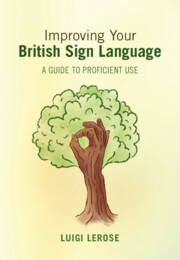
This practical, illustrated guide is designed for students who want to improve their use of British Sign Language (BSL), helping them to manage some of the more challenging aspects of BSL learning in an accessible way. Written by a highly experienced sign language speaker, it contains around 750 photos of signs, including examples of common mistakes alongside the corresponding correct signs. Each chapter is accompanied by video demonstrations of all the signs it exemplifies, showing BSL in action. The book is based on the latest research on BSL within theoretical linguistics, since understanding the latest advances in this fast-moving field is known to help improve the skills of non-native speakers. It is intended primarily for self-study, allowing students to work at their own pace on articulation accuracy, recognise the kinds of errors they are likely to make, and gain a better understanding of the visual nature of BSL.
Recommend this
Email your librarian or administrator to recommend adding this to your organisation's collection.