To save content items to your account,
please confirm that you agree to abide by our usage policies.
If this is the first time you use this feature, you will be asked to authorise Cambridge Core to connect with your account.
Find out more about saving content to .
To save content items to your Kindle, first ensure no-reply@cambridge.org
is added to your Approved Personal Document E-mail List under your Personal Document Settings
on the Manage Your Content and Devices page of your Amazon account. Then enter the ‘name’ part
of your Kindle email address below.
Find out more about saving to your Kindle.
Note you can select to save to either the @free.kindle.com or @kindle.com variations.
‘@free.kindle.com’ emails are free but can only be saved to your device when it is connected to wi-fi.
‘@kindle.com’ emails can be delivered even when you are not connected to wi-fi, but note that service fees apply.
This chapter examines the ways in which Judith Wright shaped Australian literary culture, not only through her poetry but also through her work as an editor, anthologist and critic. It contextualises the development of Wright’s poetry in light of her childhood, education and the impact of World War II, arguing that misreadings of her pastoral lyric during Wright’s lifetime failed to appreciate how it undercut settler mythmaking. The chapter discusses Wright’s exploration of a psychic interior during the 1950s and how she became increasingly focused on the settler-colonial mind during the 1960s. It outlines Wright’s engagement with Aboriginal land rights and her leadership in the burgeoning environmental movement. The chapter ascribes much of this change to the influence of Oodgeroo Noonuccal and discusses their poetic correspondence and friendship in the 1970s. The chapter also considers her turn from poetic voice towards practices of observation and listening, arguing that Wright’s attention to ‘the human pattern’ evident in her last volume, Phantom Dwelling, suggests less a silence in her later years than a realignment of her focus and energy.
Metropolitan liberal thinkers idealized settler colonialism as the positive face of nineteenth-century imperialism. The developmental logic of stadial thought played an enduring role in asserting settlement’s racially demarcated conception of civilization and sociability. A variety of forms of settler narrative from Australia and New Zealand circulated widely in Britain and their portrayals of character engaged directly with those civilizing claims. The chapter first considers two contrasting accounts of cultural contact: Arthur Phillip’s The Voyage of Governor Phillip to Botany Bay (1789), and Frederick Maning’s Old New Zealand, a Tale of the Good Old Times (1863). It then addresses the thematizing of settler criminality in Australian novels: Marcus Clarke’s His Natural Life (1870–72), Rolf Boldrewood’s Robbery under Arms (1882–83), and Fergus Hume’s The Mystery of a Hansom Cab (1886). It lastly assesses the delineation of gender roles in short story collections set in frontier environments: Barbara Baynton’s Bush Studies (1902), and G. B. Lancaster’s Sons o’ Men (1905). While representations of settler character interrogated liberalism’s justification of colonization as a means of civilizational progress and improvement, settlement’s racialized foundations of possessive individualism also remained visible but were largely unchallenged.
For more than 150 years, politicians, the federal government, and missionary churches misled Canadians about deaths, abuse, and the genocidal intent in residential schools for Indigenous children. More recently, the identification of suspected unmarked graves at former school sites has triggered a renewed spread of misinformation denying the harmful legacy of residential schools. To what extent does the Canadian public endorse residential school denialism? Can education counter this misinformation? In this study, we develop and test a scale for measuring residential school denialism. We find that nearly one in five non-Indigenous Canadians agree with denialist claims, while an equal share feel they do not know enough to offer an opinion. Denialist beliefs are more common among men, conservatives, those with anti-Indigenous attitudes, and white Canadians who strongly identify with their racial in-group. In an experiment, we also show that educational information reduces non-opinions and increases the likelihood of rejecting denialist arguments.
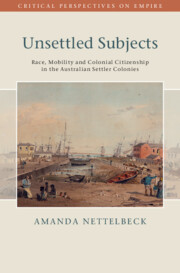
At the end of the nineteenth century, settler states gained implicit imperial sanction to practice racialised border-policing on disingenuous grounds of language proficiency. As is well known, this outcome was the result of settler dominion efforts through the late nineteenth century to consolidate ‘whiteness’ as the structuring principle of future settler nationhood. But the pathway to this outcome was neither smooth nor inexorable: it emerged from an interconnected colonial world that was inherently multiracial and unsettled. Although the nineteenth-century experiment of settler colonisation was dominated by British migrants motivated by land ownership, the settler colonies were also occupied by a diverse mix of non-European people on the move. Their contributions formed an essential underpinning of settler colonial growth in ways that highlighted Australia’s dependency on broader patterns of colonial trade and migration around and beyond the empire. Of the ethnically diverse peoples who migrated to colonial Australia, some were already British subjects; others were not. But a great many became permanent settlers who asserted their own understandings of citizenship in empire.
This article reconceptualizes the “rural problematique” in Canada through the contemporary “problem” of the rural migrant. Utilizing critical historical institutional theory, we argue that the challenges newcomers face in rural spaces not only reveal the stagnation of settlement policies but also demonstrate the long-lasting, integrative and harmful impacts of policy inertia. While newcomers experience the implications of inadequate and exclusionary social policies particularly acutely, the obstacles they face cannot be solved through changes to migration policy alone. Rather, we show how these barriers are the result of the historical, specific role that rural Canada plays within the political economy of the country, which relies upon the delineation between rural and urban, and the persistence of the rural as problematic. Thus, an analysis of the contemporary “problem” of the rural migrant demonstrates how the context can change, but the outcomes, which are consistent with the broader rural dynamic, remain the same.
Lying between the Indian and Pacific Oceans, Australia served as a crossroads for trade and migration across the British Empire. Australia's settler colonies were not only subject to British immigration but were also the destination of emigration from Asia and 'Asia Minor' on terms of both permanent settlement and fixed indenture. Amanda Nettelbeck argues that these unique patterns shaped nineteenth-century debates about the relationship of the settler colonies to a porous empire. She explores how intersecting concerns around race and mobility – two of the most enduring concerns of nineteenth-century governance – changed the terms of British subjecthood and informed the possibilities of imagined colonial citizenship. European mobility may have fuelled the invasive spread of settler colonialism and its notion of transposed 'Britishness', but non-European forms of mobility also influenced the terms on which new colonial identities could be made.
Chapter 3 examines the origins of modern territoriality in settler colonies, centring on the English colonies of North America. A range of existing accounts view property as important in the history of sovereignty. This chapter engages with them, offering an account of how property surveying drove the emergence of modern territoriality in North America. A host of settler colonial conditions, ranging from cultural understandings of property to non-recognition of Native American boundaries, resulted in the use of geometric surveying techniques in the creation of private property becoming central to colonial life. Territorial disputes between colonies were then addressed using boundary-making techniques of delimitation and demarcation already familiar from the resolution of property disputes. After US independence, these techniques were used to create interimperial boundaries. Comparisons between different types of settler colonialisms globally are used to add weight to this explanation and to justify the focus on English North American colonies.
The goal of this chapter is to introduce the crisis of missing and murdered Indigenous women and girls, settler colonialism, and patriarchy. It begins with the story of Abigail Echo-Hawk, the director of the Urban Indian Health Institute, and an enrolled citizen of the Pawnee Nation of Oklahoma. Abigail has advocated for decolonizing data to stop the crisis of missing and murdered Indigenous women and girls in the US. Informed by tribal critical race theory (TribalCrit), this chapter defines and examines popular myths of settler colonialism and patriarchy, two intersecting systems at the root of this crisis and the genocide of Indigenous peoples in the US. Settler colonialism by White Europeans involves seizing land, eradicating Indigenous peoples and culture, and creating a permanent settler society on that territory. Patriarchy is a system of gendered domination that invests men with exclusive rights, authority, and privilege over women. The chapter includes a Food for Thought section on the climate crisis and the Land Back movement. It ends with a discussion of Abigail Echo-Hawk and the importance of stories.
This essay examines the overlooked 1979 strike by Palestinian workers at the Jerusalem District Electricity Company (JEDC) as a pivotal moment of anti-colonial resistance. It argues that the strike, which fused demands for better wages with a political struggle against Israel’s erosion of the company’s concession and autonomy, demonstrates the inextricable link between class and national liberation. By mobilizing broad popular solidarity to defend a critical national infrastructure, the JEDC workers’ union articulated a mode of resistance in which labor solidarity became a primary vehicle for asserting sovereignty and contesting the political economy of settler colonial occupation. Their actions foreground the central role of an organized urban working class in the broader Palestinian struggle for development and liberation.
What is happening in Gaza now is a total displacement of any form of normality. This displacement of the normal has been effected by a population-wide project of social reproduction. Every Gazan, including children, is solicited to reproduce life, to survive. At the same time, social reproduction in Palestine has always also entailed insurgent possibilities, where this form of labour has indeed sustained and reproduced Palestinian revolutionary action. From collective kitchens to local initiatives of care for children, to using drones as musical instruments to distract children from the deafening violence of its soundscape, social reproduction is iterated as both survival and insurgency. This short intervention tries to think through the question of how to make sense of social reproduction as capitalist oppression through the unwaged housework, and as colonial violence through the mass extermination of a population, without leaving behind its potential for insurgency?
Te Papa Tongarewa, the Museum of New Zealand, is a cultural institution located in Aotearoa New Zealand. The museum’s foundational principle of biculturalism appears increasingly inadequate for addressing the fundamental injustices associated with settler/invader colonialism and can be seen as a barrier to achieving a “collective future.” This article argues that Te Papa must discard biculturalism insofar as it does not provide for tino rangatiratanga (self-determination) or mana motuhake (Indigenous sovereignty). Currently, Te Papa promotes Indigenous cultural inclusion and the celebration of Te Ao Māori (The Māori World) within a settler/invader-defined national identity and cultural memory. In the future, a decolonial and tikanga-based (Māori legal and customary practices and system) approach should be implemented at Te Papa.
Kansas’ tumultuous, violent early years drove the development of a distinctively intrusive, inexpert model of reform. The KCIR was a clear elaboration upon this historical pattern. Constitutional restraints left the state persistently underfinanced. The conflicts of the Bleeding Kansas period catalyzed political and mob violence that persisted until the 1890s. Progressive Republicans, the dominant political force in Kansas from the 1890s through the 1920s, thus developed an aggressive program of regulation of economic and personal conduct, a program not reliant on rational administration, for which there was no fiscal capacity or expertise, but upon an expansive legal conception of regulatory (or flatly coercive) interventions justifiable by appeal to the public interest. These reforms were often ineffective or too bold to withstand scrutiny in the US Supreme Court. The state’s leaders, like Governor Allen, had considerable first-hand experience with the difficulties, and in many cases the violence, of settlement: Their commitment to the state’s forceful variant of progressivism rose from deep and genuine fear of social disorder.
Australia, Canada and the United States are settler-colonial federations comprising two types of federal units. The first are states/provinces: full, permanent federal partners, securely settler controlled. The second are territories. Historically, territories were “partners in waiting,” slated for federal incorporation once settlers achieved control of the jurisdiction, outnumbering and disempowering Indigenous peoples. The “rights revolution” made achieving control by force less acceptable. Meanwhile, in Australia, Canada and the US, there remain several territories where Indigenous peoples hold significant power. I find today’s remaining territories experience a new way settlers target Indigenous power, not through force but through rights-challenges. Further, I show these rights-challenges provoke “constitutive contests,” the outcome of which are consequential, potentially “re-constituting” territories in a manner fostering settler control. Finally, I explore why territories might be especially vulnerable to re-constitution through settler-rights challenges.
This chapter provides an overview of the emergence of a body of literature that emplots Indigenous material realities and forms of knowledge into Latinx literature’s representational horizon. These texts mark a significant transition, moving away from an understanding of Latinx identity rooted in a mythological Indian past, and focusing instead on a diverse array of issues grounded in Indigenous identities, experiences, and epistemologies. These include explorations of the liberatory potential in transnational feminist solidarities, the thematization of contemporary manifestations of settler colonialism, the foregrounding of land-based knowledge, and the celebration of the creative power and insurgent force of the erotic. Focusing on works by Graciela Limón, Kali Fajardo-Anstine, Natalie Diaz, and Alan Pelaez Lopez, the chapter argues that these writings collectively depict Latinx Indigeneity at the intersections of race, gender, sexuality, and colonialism, raising complex issues with respect to overlapping and ongoing histories of colonization and fostering an opportunity for centering Indigenous experiences while interrogating the multiracial character of Latinidad.
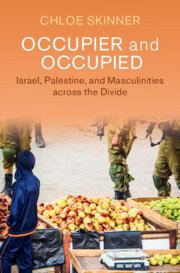
This introductory chapter discusses the focus of this monograph, and places it in its theoretical, contextual and methodological context. Working from the premise that while gender shapes violence, violence also shapes gender, I introduce the central line of enquiry of this book: the gendered politics of settler colonialism, with a specific focus on masculinities across the sharply hierarchical divide of Israeli militarism and occupied Palestine.
The empirical research is placed within its historical context, serving to contextualise the settler colonial present – the application of which is explicated within this section. My own positionality, research methodology and the structure of the book is discussed after articulation of the conceptual framework of the book. The latter explores theory and literature surrounding gender, masculinities, violence, and their intersections – affirming Demetriou’s (2001, 342–48) argument that “when the conditions for the reproduction of patriarchy change”, “exemplary masculinities […] adapt accordingly.”
The concluding chapter highlights the fluidity and interconnected nature of masculinities within specific interactional settings across Israel and Palestine, indicating that what is hailed as ‘the ideal’ is ever subject to change amid complex webs of power, patriarchy, and militarised colonisation. Each telling components of much broader and complex stories, I summarise each chapter as indicative of the contingency and mutual adaptability of gendered dynamics across manufactured, militarised, and sharply hierarchical colonial divides. I argue that gendered identities in this context are connected by that which simultaneously separates them – the militarised violence of the colonial regime. In so doing, the intertwined nature of identities across and enmeshed within complex webs of power, violence and resistance are explored, revealing a plurality of scripts and codes that variously constitute the complex gendered politics of settler colonialism.
Chapter I explores traditionally ‘non-hegemonic’ attributes as inherent to militarised masculinities in contemporary Israel, examining embodied compliance and submission to a higher order as a normalised means of ascending the ‘hierarchy of bodies’ that bolsters and undergirds the Zionist project from its outset. Exploring basic training, punishments, military hierarchy, friendship, camaraderie and death, I argue that the conscious performance of embodied submission (with enthusiastic consent) is as much valued within conscripted military masculinities as militarised domination in this context. Indeed, I suggest that the conscripted combat soldier – the archetypal national and masculine hero – must be both visibly dominant over the indigenous Palestinian ‘Other’, while simultaneously malleable and submissive to the goals of the Israeli state. As such, I explore both polarities of domination and submission as demanded within the parameters of idealised military masculinity – illustrating the gendered tensions that punctuate normative binaries in this militarised setting.
Working from the premise that gender and violence are cyclically related, masculinities' connection to power and violence are frequently simplistically assumed. Yet, amid ongoing colonisation and military occupation, there are other more complex dynamics simultaneously at play across Israel and Palestine. In this book, Chloe Skinner explores these dynamics, untangling the gendered politics of settler colonialism to shed specific light on the ways in which masculinities shift and morph in this context of colonial violence. Oscillating between analysis of Israeli militarism, colonisation, and military occupation in Palestine, each chapter examines the constitutive performance and negotiation of masculinised ideals across these colonial hierarchies. Masculinities are thus analysed across these settings in connection, rather than in isolation, as gendered hierarchies, performances, and identities intertwine and intersect with the racialised violence of settler colonialism.
This chapter takes plantation as a rubric under which theorizations of race and space in Marxism and Black and Indigenous critical theory might be usefully coordinated for the sake not only of intersectional practicality but intellectual purchase for literary scholars in particular. Historically associated with the racializing regimes of both settler colonialism and enslavement that made what historian James Belich has called “the Anglo-world,” plantation comes into view as a key means through which capitalist social relations originating in late medieval southeastern England have been planted across the planet to the massive detriment of human and nonhuman life. Understood as sites at which the compulsion to expand set in motion by capital in the metropole confronts noncapital in its most resistant difference, white settler colonies in North America and Oceania are treated as experimental spaces for the satisfaction of that compulsion – that is, as not only spatial but phenomenological frontiers of real subsumption. This chapter focuses on one such experiment: the settler/master’s assumption of the role of the God of Genesis, specifically the power to bring worlds out of and into being through acts of signification, the whole-cloth fiction of race foremost among them.
Contemporary racial theorization about American society assumes the universality of White dominance as its point of departure. We argue here that Hawai‘i is an exception, where White supremacy has given way to a multiracial mainstream, shared by the Chinese, Japanese, and Whites. This was a surprising development in a state founded in settler colonialism and racial capitalism, which was moreover a racially hierarchical plantation society until the middle of the twentieth century. The pivot, in Hawai‘i as on the mainland, occurred during the post-World War II period, when the economy underwent a transformation requiring a more educated workforce. On the mainland, this socioeconomic shift opened up the mainstream to the so-called White ethnics. But these were few in number in Hawai‘i, and so the Chinese and Japanese ascended socioeconomically and socially instead. The ethnoracial hierarchy created in this period is still in evidence, as shown by pronounced inequalities among Hawaiian groups. However, the end of White supremacy has been associated with very widespread ethnoracial mixing in families. We discuss some ways in which Hawai‘i may offer a preview of twenty-first-century changes in the U.S. as a whole.