To save content items to your account,
please confirm that you agree to abide by our usage policies.
If this is the first time you use this feature, you will be asked to authorise Cambridge Core to connect with your account.
Find out more about saving content to .
To save content items to your Kindle, first ensure no-reply@cambridge.org
is added to your Approved Personal Document E-mail List under your Personal Document Settings
on the Manage Your Content and Devices page of your Amazon account. Then enter the ‘name’ part
of your Kindle email address below.
Find out more about saving to your Kindle.
Note you can select to save to either the @free.kindle.com or @kindle.com variations.
‘@free.kindle.com’ emails are free but can only be saved to your device when it is connected to wi-fi.
‘@kindle.com’ emails can be delivered even when you are not connected to wi-fi, but note that service fees apply.
Melissa Merritt aims to locate one of the limits of Kant’s Aristotelianism. While it is widely supposed that Aristotle is the most relevant ancient reference point for Kant’s conception of virtue as “moral strength of will” (6:405), Merritt argues that Kant draws primarily on Stoic ethics. Much of what may seem Aristotelian in Kant’s remarks about virtue — such as his likening it to “the state of health proper to a human being” (6:384) — should be read as nods to a pervasive tendency of ancient Greek thought, which views ethics as a dimension of natural teleology. Ethics, so conceived, is centrally concerned with how the human being develops naturally towards the telos of virtue, conceived as the completion of our essentially rational nature. While this is a feature common to Aristotelian and Stoic ethics, Merritt argues that Kant favors a specifically Stoic approach, one that has a notion of “appropriate” or completion-promoting action — officium — at its heart.
Carla Bagnoli takes up a worry about Kant’s version of constitutivism about moral norms, which says that the norms of rationality are too abstract to account for the exercise of rational agency and fail to do justice to the significance that the consequences of action have for moral assessment. Bagnoli argues that: (i) the constitutive norms of practical reason are not meant to provide normative reasons for action by themselves. So, the incompleteness of constitutivism about practical reason is not a bug, but an essential feature of the constitutivist agenda; (ii) the full story about determining rational action includes reference to the consequences, which are importantly comprised in the Kantian account of the agent’s description of the action under assessment; (iii) to explain how this works, it is best to deploy a strategy that deserves to be called Aristotelian – that of placing action in its circumstances.
Alexandra Newton discusses the relation between virtue and habit in Kant’s moral philosophy. While commentators frequently claim that Kant rejects Aristotle’s definition of virtue as a type of habit, Newton argues that this overlooks the fact that Kant distinguishes different kinds of habit. While he rejects the idea that virtue is a habit of action or desire, like Aristotle he allows virtue to be a habit of choice (hexis prohairetike), understood as an exercise of practical reason. Carefully distinguishing the different notions of habit Kant delineates thus allows us to see that his conception of virtue is more Aristotelian than commonly assumed. At the same time, Newton notes, there remain important points on which Kant’s conception diverges from Aristotle’s, having to do specifically with the temporal character of virtue
This chapter fully develops the concept of moral imagination through a discussion of Bayer CropScience. A historic review of the concept of moral imagination is explored and with particular reference to Adam Smith, Immanuel Kant, and John Dewey, leading to the more recent work of Martha Nussbaum. A technology of how to apply moral imagination is developed drawing extensively on Adam Smith’s figure of an “impartial spectator” and Immanuel Kant’s approach to practical reasoning as evident in the recent work of Mark Johnson. We consider the scope and applicability of moral imagination in practice through the work of Amartya Sen.
This chapter provides a short overview of the secondary literature concerning this problem, in particular both “reversal” and “deflationary” readings of Kant’s project. It introduces the basic strategy of the argument of the book, namely that Kant’s analysis in the first part of Groundwork III does not move from the conditions of thinking to freedom of the will, but rather from the conditions of willing to the conditions of thinking: The “I will” implies the “I think” and as such all of the conditions of thinking. Several possible objections are refuted at the outset in order to provide a clear context for the chapters that follow, and the content of each of the following chapters is summarized.
Kant is often cited by contemporary expressivists as an early proponent of expressivism. But that association remains controversial. In this chapter, I consider whether Kant is best read as an expressivist, focusing on his account of practical thought and language. In doing so, I present a variety of reasons for thinking that Kant’s views are similar in central respects to contemporary forms of expressivism. But I also argue that there are good reasons for the Kantian to resist any such assimilation – reasons for them to think that Kant’s view is not a form of expressivism, but something better than it.
The recognition of the particular in law is crucial, and any good lawyer or judge should be able to correctly establish the potential instantiation of the abstract into the particular. This is the arduous task of the so-called ‘determination’. In his influential new book, Reciprocal Freedom, Ernest Weinrib elucidates the dynamic relationship of transforming the abstract into a determination. As is usual in his writings, Weinrib shows a perceptive, nuanced, and insightful position on the nature of private law. Nevertheless, I maintain that determination can only occur through the application of practical reason—a deliberative process that aligns with the valuable and the good, rather than solely focussing on the right and the dutiful. In grappling with Weinrib’s masterful work, I thus argue that the fundamental premise of his view is ‘the separation of rights and values’, and I aim to debunk this presupposition.
Kant and the Stoics both rely on a momentous argument, set out in Plato’s dialogues, for the conclusion that nothing is unconditionally good but wisdom, yet they differ on how to interpret it. The Stoics identify this wisdom with the perfection of technical or productive knowledge of nature, and they regard it as the sole good. Kant identifies this wisdom with the perfection of practical knowledge of the good, and, analyzing this knowledge along the hylomorphic lines implicitly suggested in Plato’s argument, he locates wisdom’s unconditional goodness – its morality, or moral goodness – in its agreement not with the object it produces but with its form, morality’s principle. Two contrasting accounts of morality’s relation to perfection thus emerge. The Stoics see perfection in the knowledge of nature as entailing moral goodness, whereas Kant argues that moral goodness is the condition of all other goodness, including that of perfection.
This short epilogue concludes the book, with a brief reflection on MacCormick’s final book, Practical Reason in Law and Morality (2008), where MacCormick confronted his own impending death from cancer, and where he once again articulated a relational approach to ethics, politics, and law.
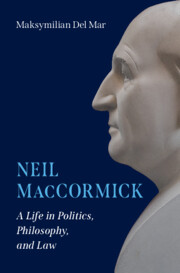
This chapter examines the intellectual, especially philosophical, context of MacCormick’s education as a philosopher, including his relationships with his teachers and their ideas. MacCormick’s own education is placed in a broader historical context, mainly by reference to the influential history published on it while MacCormick was studying: George Davie’s The Democratic Intellect (1961). While at the University of Glasgow, MacCormick was taught by a number of philosophers who had a considerable impact on his interests and orientations, including Robin Downie, David Raphael, and WD Lamont. This chapter discusses the work of these philosophers and considers how MacCormick related to them. There is a particular emphasis on Lamont and his concept of authority, as well as how he related law and morality.
This final chapter turns to the other basic question that MacCormick asked himself, again exploring it for over four decades: is reason practical, and if so how? MacCormick engaged in this question in the form of a life-long dialogue with his Enlightenment predecessors, and especially Stair, Hume, Smith, and Kant. This chapter tracks this dialogue, while also keeping in mind the contemporary interlocutors of MacCormick’s theory of practical reason, which included not only the dominant voices in Anglo–American jurisprudence, such as Hart and Dworkin, but also philosophers in the European Continent, such as Perelman and Alexy. The first part of the chapter focuses on what may be called MacCormick’s meta-ethics, showing how MacCormick adopted perspectivalism about value. The second shows how, particularly in his theory of legal reasoning, MacCormick discusses the importance of constructing an inter-subjective space (via universalisation) and how he explores the complexity of deliberation as well as the defeasibility of decision within that space. Throughout, the chapter reads MacCormick’s account of the limited practicality of reason as a matter of character.
Neil MacCormick (1941–2009) was one of the twentieth century's most important legal philosophers and one of Scotland's most influential public intellectuals. This book tells the story of his political and philosophical life, from his intensely political childhood as the son of 'King John', one of the founders of the Scottish National Party, through to his involvement in Scottish politics – especially as the author of SNP's constitutional policy – and his role as a Member of the European Parliament, helping to draft the European Constitution. With special attention to MacCormick's character, this book offers a reading of his entire oeuvre, covering his contributions to theories of legal and moral reasoning, institutional legal theory, nationalism, post-sovereignty, subsidiarity, and constitutional pluralism in Europe. This book reads MacCormick as a highly creative thinker who excelled in the art of constructing inclusive middles and thereby developed his own distinctive approach to politics and philosophy.
A rights-based theory of property relies heavily on practical reason. “Practical reason” is the domain in which people apply fundamental principles of moral reasoning to practice. This chapter contrasts practical reason with theoretical reason. It introduces specification (reasoning from broad moral rights to specific entitlements between right- and duty-holders), determination (the implementation of moral directives in law and other social conventions), and reasoning with core cases. This chapter’s argument dispels the “copy view” of morality, in which theories of morality must recommend in practice rules and institutions that follow closely from what they recommend in principle. This chapter also shows how practical reason considers the consequences of different proposed rights and policies, without becoming consequentialist or prioritizing social welfare over individual rights. This chapter shows how practical reason applies with speed limits and customary rights in snow-covered parking spaces.
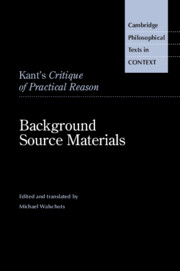
Kant did not initially intend to write the Critique of Practical Reason, let alone three Critiques. It was primarily the reactions to the Critique of Pure Reason and the Groundwork of the Metaphysics of Morals that encouraged Kant to develop his moral philosophy in the second Critique. This volume presents both new and first-time English translations of texts written by Kant's predecessors and contemporaries that he read and responded to in the Critique of Practical Reason. It also includes several subsequent reactions to the second Critique. Together, the translations in this volume present the Critique of Practical Reason in its full historical context, offering scholars and students new insight into Kant's moral philosophy. The detailed editorial material appended to each of the eleven chapters helps introduce readers to the life and works of the authors, outlines the texts translated, and points to relevant passages across Kant's works.
The Cambridge Platonists’ philosophy of religion might be summed up as a tension between their commitment to the fixed nature of reason and goodness on the one hand and a commitment to freedom and distaste for all forms of tyranny and imposition on the other. This last chapter contends that the Cambridge Platonists not only acknowledge this tension, but embrace it, revelling in the paradoxical way that absolute fixedness and absolute freedom come together at the highest levels of being. This is made possible by what Stephen Darwall (writing specifically of Cudworth) has identified as an early theory of ‘practical reason’. This Platonic theory of practical reason draws together all the elements of the Cambridge Platonists’ outlook considered in earlier chapters – moral realism, divine communicative intent, and participatory epistemology, illustrating the extent to which this Platonic outlook binds together not only the thought of Whichcote, More, Cudworth and Smith but also runs through each of their views on different philosophical topics such as obligation, freedom and pedagogy.
Kant did not initially intend to write the Critique of Practical Reason, let alone three Critiques. It was primarily the reactions to the Critique of Pure Reason and the Groundwork of the Metaphysics of Morals that encouraged Kant to develop his moral philosophy in the second Critique. In this brief introduction I outline some of the major events that took place in Kant’s development between the first and second Critiques. I illustrate that the story of the Critique of Practical Reason’s origin reveals that it is especially suited to being accompanied by certain background source materials that help illuminate its aims and contents.
August Wilhelm Rehberg (1757–1836) was a civil servant in Hanover, but he also made several important contributions to the philosophical debates of his time. This chapter contains the first English translation of Rehberg’s review of the second Critique, which was highly influential and read by figures such as Reinhold and possibly Fichte as well. In the review, Rehberg doubts that pure reason can be practical. One of the most important statements of the review is Rehberg’s claim that the feeling of respect must be something sensible and, as such, must contain an element of pleasure, despite what Kant says. Kant was aware of the review and is thought to have responded to it in later works such as the third Critique.
Johann Georg Heinrich Feder (1740–1821) was a well-respected and well-known professor of philosophy at the University of Göttingen, especially during the 1770s and early 1780s. A turning point took place in Feder’s life and career, however, when he edited the infamous Göttingen review of the first Critique, which was originally written by Christian Garve and to which Kant responds in the Prolegomena. This chapter contains a complete translation of Feder’s review of the second Critique, which therefore captures the opinion of one of Kant’s most well-known and infamous critics. Feder discusses a number of topics in the review, including: whether pure reason can be practical without the assistance of feeling and inclination, the nature of good and evil and their relationship to pleasure and displeasure, and the idea that respect for the moral law is respect for ourselves as legislators.
Andrea Bianchi, Graduate Institute of International and Development Studies, Geneva,Fuad Zarbiyev, Graduate Institute of International and Development Studies, Geneva
Building on Derrida’s celebrated analysis of the term ‘supplement’, this chapter investigates the fundamental ambivalence of supplementary means of treaty interpretation. While the general philosophy of the Vienna Convention interpretive regime rests on the assumption of a hierarchy between the primary means set forth in Article 31 of the Vienna Convention and the supplementary means of Article 32, qualifying certain means as supplementary presumes that the primary interpretive means are somewhat lacking and in need of a complement. The chapter also focuses on the ‘danger’ of such supplement that has been highlighted in practice, namely, that supplementary means themselves need to be interpreted before they can be used in an interpretive inquiry, reinforcing the larger point made in the book that it is impossible to get an unmediated access to any signified. The chapter argues that since supplementary means are not comprehensively listed in the treaty interpretation regime, a virtually endless number of materials can be made relevant in treaty interpretation discourse through the channel of supplementary means.
Andrea Bianchi, Graduate Institute of International and Development Studies, Geneva,Fuad Zarbiyev, Graduate Institute of International and Development Studies, Geneva
How does one ascertain the object and purpose of a treaty? Can a treaty have more than one object and purpose? What does giving effect to the object and purpose of a treaty mean in practice? Despite such fundamental uncertainties surrounding them, the ‘object and purpose’ are widely resorted to in the practice of treaty interpretation. This chapter argues that the object and purpose doctrine is coextensive with a large amount of interpretive discretion. The identification of the object and purpose of a treaty a largely indeterminate process, and the assumption that the treaty makers necessarily want the object and purpose of their treaty to be implemented under all circumstances leaves the treaty interpreter with considerable normative power that can hardly be resisted given the very terms of the assumption. The chapter argues that consideration of the finality of a treaty cannot be an exercise in abstract logic, but meet the requirements of practical reason.