To save content items to your account,
please confirm that you agree to abide by our usage policies.
If this is the first time you use this feature, you will be asked to authorise Cambridge Core to connect with your account.
Find out more about saving content to .
To save content items to your Kindle, first ensure no-reply@cambridge.org
is added to your Approved Personal Document E-mail List under your Personal Document Settings
on the Manage Your Content and Devices page of your Amazon account. Then enter the ‘name’ part
of your Kindle email address below.
Find out more about saving to your Kindle.
Note you can select to save to either the @free.kindle.com or @kindle.com variations.
‘@free.kindle.com’ emails are free but can only be saved to your device when it is connected to wi-fi.
‘@kindle.com’ emails can be delivered even when you are not connected to wi-fi, but note that service fees apply.
This study draws an economic model of the growth of nonprofit organizations by analyzing the behaviors of three major actors—nonprofit organizations, private donors, and governments—in making decisions on the allocation of limited resources for nonprofit services. Since decisions made by each actor affect resource allocation, it is important to understand what drives these decisions. The model was tested using an unbalanced, 463 panel dataset collected from 28 OECD countries over a 23-year period. The results indicated that macro- and micro-economic trends and government policies framed the decision premises of the three major actors, which led them to leverage the supply and demand for goods and services and, in turn, determined how they allocated limited resources for nonprofit services. This result implies that understanding the interdependencies of all sectors of the economy is critical to comprehending the size and development of the nonprofit sector. Effective management of micro-economic policies and macro-economic stability is necessary. More important, however, is understanding how a decision in one part of the economy will have intended and unintended effects on the nonprofit sector.
This research note presents the RepResent Belgian Panel (RBP). The RBP is a voter panel survey consisting of four waves fielded to a sample of voters in Belgium around the May 2019 federal, regional, and European elections in Belgium. It provides unique data on about 250 variables for a quota sample of the same respondents, pre-2019 elections (N = 7351), post-2019 elections (N = 3909), one year after the elections (N = 1996), and 2 years after the elections (N = 1119). The RBP panel dataset was designed to analyse voters’ political attitudes and behaviours, notably on different dimensions of democratic representation, and with a specific focus on democratic resentment (e.g. citizens’ attitudes towards democracy such as distrust and alienation, but also behaviours such as abstention, protest, or voting for anti-establishment parties). Its longitudinal structure allows to explore the political dynamics at play in Belgium throughout the lengthy government formation process. Finally, the last two waves of the RBP were fielded during the Covid-19 pandemic, allowing to explore public opinion before and during this global crisis. The RBP should be of interest to scholars of public opinion and electoral studies.
Previous studies of nonprofit growth have lamented the lack of cross-national longitudinal data measuring the size of the nonprofit sector across countries, which has made it difficult to assess the current state of knowledge about the nonprofit sector beyond national boundaries. Recent progress in measuring nonprofit growth using panel studies or cross-national data has compensated for the limitations of the existing research, but even the recent data are either country specific or cross sectional in nature. This study takes on the challenge of supplementing the current research by measuring nonprofit growth using internationally comparable longitudinal data. Specifically, this study focuses on whether certain key indicators of the overall state of the economy can be used to predict and explain the size of nonprofit sectors cross-nationally. The overall state of the economy has considerable relevance for nonprofit growth, as it influences the levels of government funding and private philanthropy that benefit the nonprofit sector. The results indicate that the existing theories about the nonprofit sector account for variations in nonprofit growth but are limited in their explanations of the underlying dynamics of such variations beyond national boundaries. Social origins theory is a useful addition that helps to explain cross-national variations in nonprofit growth. Importantly, the interplay among the government, private philanthropy, and the nonprofit sector is dynamic, and its effect on economic indicators varies across nonprofit regime types when sociodemographic variables are controlled.
This article explores intraspeaker malleability in the realisation of the first-person possessive in the North-East of England ([maɪ], versus [mi] and [ma]). The analysis relies on a combination of a trend sample and a novel dynamic panel corpus that covers the entire adult lifespan. While [mi] has been around at least since the 1970s on Tyneside, [ma] appears to have made its way into the system during the 1980s and 1990s. The panel data add intraspeaker information to this ongoing change, revealing a turnover in the proportional usage of possessive variants between two recordings that are on average ten years apart. Regression modelling provides differentiated information about intraspeaker changes across the lifespan, suggesting that, with only a few exceptions, intraspeaker grammars are stable across the lifespan. The analysis supports recent panel research that has argued for the importance of considering the socio-demographic trajectory of the individual: while speakers who are part of the ‘marché scolaire’ (Bourdieu & Boltanski 1975: 7) orient towards the standard, speakers working as professional carers (e.g. nurses) tend to retain high rates of the reduced variants across their lifespans to do local identity work and establish better interpersonal relations with their clients.
While laboratory and field experiments are the major items in the toolbox of behavioral economists, household panel studies can complement them and expand their research potential. We introduce the German Socio-Economic Panel’s Innovation Sample (SOEP-IS), which offers researchers detailed panel data and the possibility to collect personalized experimental and survey data for free. We discuss what SOEP-IS can offer to behavioral economists and illustrate a set of design ideas with examples. Although we build our discussion on SOEP-IS, our purpose is to provide a guide that can be generalized to other household panel studies as well.
In this chapter, we consider trajectories of change in vernacular African American Language (AAL) based on a set of seven temporal data points, from 48 months of age to post-secondary (19-21 years of age), using a Dialect Density Measure (DDM). Although different trajectories are uncovered, the predominant pattern is the “roller-coaster effect,” in which children’s vernacular index entering school recedes over the first four grades, accelerates during sixth to eighth grade, then recedes again as they proceed through secondary and post-secondary school. Comparison of token-based and type-based inventories show a high correlation in the results, and most individual variables also follow this pattern. However, some variables that are acquired during the later acquisition phase, such as ‘habitual be’ and copula/auxiliary absence, may show divergent patterns over the early lifespan.
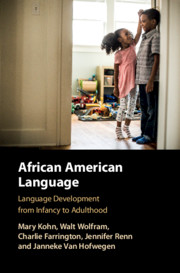
From birth to early adulthood, all aspects of a child's life undergo enormous development and change, and language is no exception. This book documents the results of a pioneering longitudinal linguistic survey, which followed a cohort of sixty-seven African American children over the first twenty years of life, to examine language development through childhood. It offers the first opportunity to hear what it sounds like to grow up linguistically for a cohort of African American speakers, and provides fascinating insights into key linguistics issues, such as how physical growth influences pronunciation, how social factors influence language change, and the extent to which individuals modify their language use over time. By providing a lens into some of the most foundational questions about coming of age in African American Language, this study has implications for a wide range of disciplines, from speech pathology and education, to research on language acquisition and sociolinguistics.
This research examines the characteristics of the age demographic of a top management team (TMT) as drivers of a firm's environmental management (EM) strategy comprising compliance-only and beyond-compliance initiatives. Using a matched sample of publicly listed firms in Kinder, Lydenberg, and Domini and Bloomberg, panel data regression techniques on a unique dataset of 3,251 firm-year observations suggest that a link does exist. Driven by a desire for legacy and a preference for risk-averse decisions, aging TMTs will support beyond-compliance initiatives. On the other hand, age diversity is expected to enhance the innovative potential of a TMT for solving pressing compliance-related environmental issues. The study finds that aging TMTs support beyond-compliance as compared to compliance-only EM strategies. TMT age diversity, though helpful in developing compliance-only initiatives, is not instrumental in driving beyond-compliance initiatives. The study highlights the challenges in developing a comprehensive EM strategy suggesting paths for future research.
Disasters are typically unforeseen, causing most social and behavioral studies about disasters to be reactive. Occasionally, predisaster data are available, for example, when disasters happen while a study is already in progress or where data collected for other purposes already exist, but planned pre-post designs are all but nonexistent. This gap fundamentally limits the quantification of disasters’ human toll. Anticipating, responding to, and managing public reactions require a means of tracking and understanding those reactions, collected using rigorous scientific methods. Oftentimes, self-reports from the public are the best or only source of information, such as perceived risk, behavioral intentions, and social learning. Significant advancement in disaster research, to best inform practice and policy, requires well-designed surveys with large probability-based samples and longitudinal assessment of individuals across the life-cycle of a disaster and across multiple disasters.
This paper examines the stability of egocentric networks as reported over time using a novel touchscreen-based participant-aided sociogram. Past work has noted the instability of nominated network alters, with a large proportion leaving and reappearing between interview observations. To explain this instability of networks over time, researchers often look to structural embeddedness, namely the notion that alters are connected to other alters within egocentric networks. Recent research has also asked whether the interview situation itself may play a role in conditioning respondents to what might be the appropriate size and shape of a social network, and thereby which alters ought to be nominated or not. We report on change in these networks across three waves and assess whether this change appears to be the result of natural churn in the network or whether changes might be the result of factors in the interview itself, particularly anchoring and motivated underreporting. Our results indicate little change in average network size across waves, particularly for indirect tie nominations. Slight, significant changes were noted between waves one and two particularly among those with the largest networks. Almost no significant differences were observed between waves two and three, either in terms of network size, composition, or density. Data come from three waves of a Chicago-based panel study of young men who have sex with men.
Approximately seven million people in the UK are engaged in informal caregiving. Informal caregivers are at risk of poorer mental and physical health. However, less is known about how the relationship between the informal caregiving and psychological distress changes over time. The aim of this study was to investigate longitudinal associations between the informal caregiving and psychological distress amongst UK men and women aged 16+.
Methods
Data were analysed from the UK Household Longitudinal Study (UKHLS, n = 9368), a nationally representative study of UK households. Longitudinal linear mixed modelling was used to estimate associations between the longitudinal patterns of informal caregiving (non-caregiver/one episode of 1–2 years/intermittent caregiving/3+ years caregiving) and trajectories of psychological distress across seven waves of UKHLS data.
Results
Informal caregiving was not associated with psychological distress for men. Women engaged in long-term (⩾3 years) or intermittent caregiving had higher levels of psychological distress at the point of initiation, compared with women who were not caregivers throughout the study period (3+ years caregiver: regression coefficient 0.48, 95% confidence interval (CI) 0.07–0.89; intermittent caregiver: regression coefficient 0.47, 95% CI 0.02–0.92). Trajectories of psychological distress changed little over time, suggesting a plateau effect for these caregiving women.
Conclusions
Women engaged in long-term or repeated shorter episodes of informal caregiving reported more symptoms of psychological distress than non-caregiving women. Given the increased risk of reporting psychological distress and the increasing importance of the informal care sector, the risk of poorer mental health of informal caregivers should be a priority for public health.
This panel study, conducted in a large Venezuelan organization, took advantage of a serendipitous opportunity to examine the organizational commitment profiles of employees before and after a series of dramatic, and unexpected, political events directed specifically at the organization. Two waves of organizational commitment data were collected, 6 months apart, from a sample of 152 employees. No evidence was found that employees’ continuance commitment to the organization was altered by the events described here. Interestingly, however, both affective and normative commitment increased significantly during the period of the study. Further, employee’s commitment profiles at Wave 2 were more differentiated than they were at Wave 1.
In this article we present the results of a panel survey in which 242 men aged 40 to 55 were followed for approximately seven years after they became involuntarily unemployed. The study focused on reintegration probabilities of the older workers and on the question of their reaction to a situation of prolonged unemployment. The study shows that if policy is not changed, the probability of the reintegration of older, long-term unemployed persons into the labour force will remain extremely low. Re-entry via a ‘normally’ functioning labour market (formal application procedures and official job intermediaries) takes place almost exclusively during the first year after dismissal. If a new job is not found, a resigned feeling occurs among almost all of this older unemployed group. Most of the older people adjust to the new circumstances sooner or later. If one wishes to protect older persons from the trap of long-term unemployment (and in many cases total exclusion), more rapid interventions must be made, and reorientation and retraining efforts must be started sooner, before it is ‘too late’. From the employer’s point of view, there is not much interest in those who are still unemployed after one year.
In a wide variety of multi-wave panel studies in economics and sociology, comparisons between the observed transition matrices and predictions of them based on time-homogeneous Markov chains have revealed a special kind of discrepancy: the trace of the observed matrices tends to be larger than the trace of the predicted matrices. A common explanation for this discrepancy has been via mixtures of Markov chains.
Specializing to mixtures of Markov semi-groups of the form

we exhibit classes of stochastic matrices M, probability measures µ and time intervals Δ such thatfor k = 2, 3 and 4. These examples contradict the substantial literature which suggests — implicitly — that the above inequality should be reversed for general mixtures of Markov semi-groups.
Recommend this
Email your librarian or administrator to recommend adding this to your organisation's collection.