To save content items to your account,
please confirm that you agree to abide by our usage policies.
If this is the first time you use this feature, you will be asked to authorise Cambridge Core to connect with your account.
Find out more about saving content to .
To save content items to your Kindle, first ensure no-reply@cambridge.org
is added to your Approved Personal Document E-mail List under your Personal Document Settings
on the Manage Your Content and Devices page of your Amazon account. Then enter the ‘name’ part
of your Kindle email address below.
Find out more about saving to your Kindle.
Note you can select to save to either the @free.kindle.com or @kindle.com variations.
‘@free.kindle.com’ emails are free but can only be saved to your device when it is connected to wi-fi.
‘@kindle.com’ emails can be delivered even when you are not connected to wi-fi, but note that service fees apply.
Germaine Tailleferre (1892–1983) is now remembered largely because she was a member of Les Six, a group of French composers active in the late 1910s and early 1920s. Tailleferre encountered many obstacles, most notably a difficult personal life including two brief marriages to men who were unsupportive of her musical career; it is also true that critics tended to focus on her gender rather than her musical style. This Element tells the fascinating story of Tailleferre's life and long career and, most significantly, explores the development of her musical style and her role in the development of neoclassicism in France. In recent years, international performers have rediscovered her appealing, lively music and have at last started to bring Tailleferre to wider audiences. This Element will contribute to the rediscovery of Tailleferre and will reveal her to be a significant force in twentieth-century French music.
Edited by
Martin Nedbal, University of Kansas,Kelly St. Pierre, Wichita State University and Institute for Theoretical Studies, Prague,,Hana Vlhová-Wörner, University of Basel and Masaryk Institute, Prague
This chapter discusses the search for a modernist musical culture in Czechoslovakia after 1918 and the ideological underpinnings of this search. The chapter also focuses on three specific modernist tendencies: neoclassicism, neofolklorism, and a set of musical trends termed civilism, which runs parallel to the German New Objectivity movement. Although based on different techniques and viewpoints, the three tendencies are marked by internal similarities. All three approaches to modern composition aim at abandoning Romantic sensibilities and avoiding romanticism through different means: neoclassicism by a recourse to pre-Romantic music; neofolklorism in an exploration of musical traditions of the common people from different ethnic groups; and civilism in a reliance on jazz.
While a three-dimensional statue may be photographed from any angle, some views are more pervasive than others, and a published photograph of an Attic grave relief not in a frontal view can hardly be found at all. Relief sculpture seems to ask for a frontal view, while sculpture in the round presents itself to the viewer wherever s/he stands. Since the late nineteenth century, however, there have also been attempts to limit the range of “possible” views onto freestanding sculpture by defining for each statue a principal view, or Hauptansicht. Such attempts thereby turn sculpture into relief. The conceptualization of sculpture as relief can be traced back both to sculptor Adolf Hildebrand’s Das Problem der Form in der bildenden Kunst (1893) and to the rise of photography in the academic study of sculpture. The practice of subjecting sculpture to a particular view, however, stretches even further back, at least to neoclassicism. Indeed, the privileging of one view is a compositional strategy in ancient sculpture itself. Yet in contrast to the photographic experience of a statue strictly limited to its “correct” view, the “bad” views, or nonprincipal views, still played a crucial role in the ancient aesthetic experience of sculpture.
This chapter studies relations between Schoenberg, Stravinsky and their respective camps, from the early twentieth century through the composers’ later years in California. Beginning with an early moment in which their relations were characterized by curiosity and mutual respect, it sketches the emergence in the 1920s of an opposition between Schoenberg’s expressionism and Stravinsky’s neoclassicism. It then examines how this opposition was reinterpreted and codified (if not ossified) in T. W. Adorno’s influential Philosophy of New Music, and in his subsequent writings on both composers. Adorno described Schoenberg’s music as a seismograph that registers tremors of feeling; this chapter reworks Adorno’s metaphor in order to propose that the Schoenberg–Stravinsky–Adorno triad might register tectonic movements of a much larger modernity. Engaging with recent literature on all three figures, it suggests some ways their work might relate to modern regimes of racial difference.
This chapter frames Thomas Mann’s engagement with physiognomic culture in his 1912 novella. The aesthetics of the face staged by Mann’s novella conjure a physiognomic hierarchy. At the top of this hierarchy, one finds the character of Tadzio portrayed as a neoclassical Greek sculpture. The mechanism for this projection is ekphrasis. At the bottom of the hierarchy, Mann’s novella constructs a series of racialized minor characters identified as facial types. The text nonetheless destabilizes this hierarchy through the figure of the barber, who gives Aschenbach a consequential makeover – a version of Loy’s “auto-facial-construction,” in this case relying on makeup. The chapter places the discussion of Tadzio’s “perfect face” in relation to the recent reassessment of Luchino Visconti’s cinematic adaptation of Mann’s novella in Kristina Lindström and Kristian Petri’s documentary, The Most Beautiful Boy in the World (2021). The conclusion: the veneration of youthful face comes at a cost.
In the Autumn of 1952, both Stravinsky and Boulez were invited to dine at Virgil Thompson’s New York apartment. Boulez had already written ‘Stravinsky Remains’ which analysed the rhythmic invention in The Rite. However, Boulez did not hide his disdain for Stravinsky’s neoclassicism in this chapter. Similarly, although Stravinsky praised Le Marteau, Boulez’s music remained foreign to him. For some years, the two friends entered into an unspoken pact that Boulez would stop speaking disrespectfully regarding Stravinsky’s neoclassicism and Stravinsky would speak eloquently about Boulez, as well as pointing to Webern as the way forward in serialism and not to Schoenberg. In spite of Stravinsky’s turn to serialism, he could seemingly do nothing to be accepted by the European avant-garde. His friendship with Boulez ultimately ended due primarily to problems over the 1957 performance of Threni and Souvtchinsky’s machinations, even though Stravinsky liked Boulez the man and respected the musician.
“Militant Neoclassicism” argues that W. E. B. Du Bois marshaled post-Kantian aesthetics against the anthropological categories posited by Enlightenment theorists. The chapter departs from the traditional interpretation of Du Bois as a champion of integration, which relies heavily on The Souls of Black Folk at the expense of Du Bois’s later Marxism. This interpretation downplays his controversial advocacy for the self-segregation of African-American communities, which sought to capitalize on intra-group solidarity in order to rectify class conflict. The chapter argues that these collectives, spheres of free action carved out from predominately white social structures, evince the aesthetic autonomy theorized by Friedrich Schiller, whom Du Bois admired and quotes in Souls. Attending to aesthetic autonomy also reveals new connections between Du Bois and cultural anthropology, especially the work of Ruth Benedict, who advanced aesthetic arguments about anthropological communities that distinguished themselves from a dominant social milieu.
Chapter 15 details Goethe’s commitment to Greek and Roman art, demonstrating that it pervades all his activity, including his literary work. His interest was primed by his years as a student in Leipzig, but his Italian journey of 1786–8 was the turning point, for it enabled him to connect the theory which he had learned with his own creative practice. Moreover, Italy gave him access to both Roman and Greek heritage. The chapter also examines neoclassical tenets in Goethe’s writing on art and closes with an analysis of his characterisation of Winckelmann.
Bernstein’s fame, reputation, and personality have for the most part been seen as excessive and problematic. This perception militated from the start against his position in time, place, and tradition as a serious composer being influential or even accepted. Yet from the golden moment of opportunity for American composers in which he grew to adulthood to his barely noticed final works, he was following a diligent route of creative output that may yet bear fruit at greater distance from the man himself, though it would be difficult to claim that, taken as a whole, it has yet done so.
The section’s closing chapter discusses the polemic between Classics and Romantics, which, despite local differences and its lack of traction in Britain, helped crystallise Romanticism in many countries both as a national and as a pan-European cultural phenomenon. Beginning with contradictory statements by Stendhal and Goethe, it argues that the Classic-Romantic nexus not only contributed to the meaning of ‘romantic’ but also of ‘classic’. The first did not replace the other, but instead complexified it by re-appropriating texts from antiquity. The chapter first shows how eighteenth-century philology informed discussions of modern culture in critical texts by F. Schlegel and Schiller, and in A.W. Schlegel’s lectures. These in turn informed Staël’s influential statements in De l’Allemagne and in her letter on translation, which fired up Romanticism in Italy, as well as Stendhal’s ‘Racine et Shakespeare’, which did the same in France. The author touches on the ideological role of translation, but also of Romantic philology and of philhellenism, showing how the Romantics in Germany, France, Britain, Spain, Poland, and Russia re-appropriated the classics. The chapter concludes with a more detailed discussion of Hölderlin’s Hyperion to show Romanticism’s reluctance to differentiate the classic from the modern.
This chapter focuses on the life and writings of Pietro Napoli Signorelli (1731–1815) and provides one way through which to map out the shifts and transformation of the cosmopolitan ideal in an age of growing patriotism. Napoli Signorelli wrote and lived between the intellectual and political worlds of two connected peripheries of Europe, Italy and Spain, and one of its intellectual centres, France. The Bourbon courts in Madrid and Naples provided the political thread for these debates and the Neoclassical tradition the background for them. The querelle between the ancients and moderns remained central, as writers searched within and outside of the Neoclassical tradition to stake their claims. Knowledge of the shared ground of the Neoclassical canon bound enlightenment writers together but also provided the fodder to drive them apart. Napoli Signorelli’s work and life illuminates a crisis or reconfiguration of cosmopolitanism, specifically at the end of the eighteenth century, when the Neoclassical underpinnings of cosmopolitanism were unsettled by emerging patriotic identities within Europe.
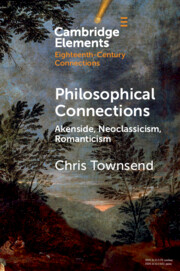
Neoclassical and Romantic verse cultures are often assumed to sit in an oppositional relationship to one another, with the latter amounting to a hostile reaction against the former. But there are in fact a good deal of continuities between the two movements, ones that strike at the heart of the evolution of verse forms in the period. This Element proposes that the mid-eighteenth-century poet Mark Akenside, and his hugely influential Pleasures of Imagination, represent a case study in the deep connections between Neoclassicism and Romanticism. Akenside's poem offers a vital illustration of how verse was a rival to philosophy in the period, offering a new perspective on philosophic problems of appearance, or how the world 'seems to be'. What results from this is a poetic form of knowing: one that foregrounds feeling over fact, that connects Neoclassicism and Romanticism, and that Akenside called the imagination's 'pleasures'.
This chapter is an examination of Britten’s engagement with progressive musical and aesthetic thought. As a successful and popular composer, Britten is rarely identified as an ‘avant-garde’ artist, yet his career took note of progressive developments from 1930s neoclassicism to 1970s minimalism. For mid-century critics, Britten was a cosmpolitan figure; more recently, his commitment to tonality argues a ‘reactive modernism’, in dialogue with tradition. Britten’s relations to avant-garde thought involve successive historical contexts. In the 1930s, he sought to study with Berg, wrote experimental film soundtracks, and explored neoclassical parody, without abandoning key tonality. In the 1940s, Britten’s music developed greater metric complexity. Britten’s 1950s catalogue increasingly explores a personal twelve-tone thematic idiom, along with non-European percussion sonorities inspired by renewed encounters with Balinese gamelan. Criticising avant-garde ‘complication’ in the 1960s, Britten tempered public scepticism with personal support for British avant-gardists.
A summary of the book’s conclusions regarding Elliott Carter’s late music, on his fusing of technical and expressive concerns, the patterns of harmonic, rhythmic, and textural change in his music, and his engagement with modernist poetry and eighteenth- and nineteenth-century music, as well as the comic elements in his late compositions.
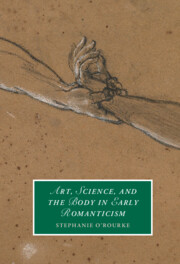
The Introduction delineates a shared set of concerns animating both artistic practices and scientific discourses at the turn of the nineteenth century, which were deeply invested in the human body’s ability to secure the relationship between reality and illusion, and between seeing and knowing. It first reevaluates historical accounts of the decline of neoclassicism and rise of Romanticism, and particularly the waning pictorial supremacy of the idealized nude body. It then lays out the importance of “popular science” and “Enlightenment empiricism” for the cultural landscape of eighteenth-century Britain and Continental Europe, revealing how the scientific authority of the human body was undergoing intense scrutiny. Recognizing such developments as interlocking rather than parallel enables us to think more critically about how artworks interrogated some of the visual and structural features of popular scientific discourses and, ultimately, the empirical framework that undergirded them.
Can we really trust the things our bodies tell us about the world? This work reveals how deeply intertwined cultural practices of art and science questioned the authority of the human body in the late eighteenth and early nineteenth centuries. Focusing on Henry Fuseli, Anne-Louis Girodet and Philippe de Loutherbourg, it argues that romantic artworks participated in a widespread crisis concerning the body as a source of reliable scientific knowledge. Rarely discussed sources and new archival material illuminate how artists drew upon contemporary sciences and inverted them, undermining their founding empiricist principles. The result is an alternative history of romantic visual culture that is deeply embroiled in controversies around electricity, mesmerism, physiognomy and other popular sciences. This volume reorients conventional accounts of romanticism and some of its most important artworks, while also putting forward a new model for the kinds of questions that we can ask about them.
Chapter 6 turns to the disintegration of the political unity of the Iberian World, and addresses the role of the classical rhetorical tradition in spreading new and even revolutionary ideas in both the Atlantic and the Pacific (c. 1750–1850). It begins by showing that new Enlightenment wine was frequently put in post-humanist bottles, focusing on the orations delivered in the Patriotic Economic Societies (sociedades de amigos del país) in Spain and the Philippines. It then shows that a similar pattern can be seen in the oratory of the Age of Revolutions in Mexico. While the public ceremonial oratory of the early Mexican Republic is often portrayed as having arisen spontaneously to fulfill the needs of the new nation, this chapter argues that this was merely the last in a long line of applications in the Iberian World of a tool of social ordering inherited from Mediterranean antiquity.
“The slaveholders,” Frederick Douglass said in 1849, “are sleeping on slumbering volcanoes.” American readers in the 1850s were captivated by such apocalyptic imagery. As the crisis over slavery developed—from the Fugitive Slave Act (1850) to the Kansas–Nebraska Act (1854) to the Dred Scott decision (1857)—many became increasingly convinced that their world would, like Pompeii in the first century, come to a fiery, apocalyptic end. But debates arose about how and why the United States might come to an end and whether this end could be prevented. While abolitionist writers often described slavery as a sin, others thought of slavery as a national pathology that might be cured or, at the very least, managed. This chapter explores the apocalyptic dimensions of the period that has long been called the American Renaissance.
In a way, Igor Stravinsky’s turn to Greek antiquity as a source of inspiration came about as a gift to the man who arguably played the most important role in the composer’s artistic development: Sergei Diaghilev (1872–1929). Indeed, Stravinsky’s very first work on a Greek theme, the opera-oratorio Oedipus rex (1926–7; rev. 1948), materialised as an anniversary present to the Russian impresario for the twentieth season of the Ballets Russes, in 1927.1 The fact that Diaghilev disliked what he described as ‘un cadeau très macabre’ (a very macabre present), says very little about the significance of this work – or, in fact, of Stravinsky’s subsequent works on ancient Greek topics – in the composer’s artistic evolution.
More than any other twentieth-century composer, Stravinsky stands out within ballet modernism. He wrote more scores for dance or for theatre events with a significant dance element (eighteen in total) than any other major composer of his time. It was dance too, primarily Diaghilev’s Ballets Russes, which gave Stravinsky the key platform from which to launch his career, including the opportunity to work with the modernist choreographer George Balanchine (1904–83). Together, Stravinsky and Balanchine formed the most celebrated composer–choreographer collaboration of the century.