To save content items to your account,
please confirm that you agree to abide by our usage policies.
If this is the first time you use this feature, you will be asked to authorise Cambridge Core to connect with your account.
Find out more about saving content to .
To save content items to your Kindle, first ensure no-reply@cambridge.org
is added to your Approved Personal Document E-mail List under your Personal Document Settings
on the Manage Your Content and Devices page of your Amazon account. Then enter the ‘name’ part
of your Kindle email address below.
Find out more about saving to your Kindle.
Note you can select to save to either the @free.kindle.com or @kindle.com variations.
‘@free.kindle.com’ emails are free but can only be saved to your device when it is connected to wi-fi.
‘@kindle.com’ emails can be delivered even when you are not connected to wi-fi, but note that service fees apply.
Wetlands have deep geological histories, stories of bedrock, sediment, and sea rise. But the direction and speed of flow has been shaped just as surely by human interests and intervention. This chapter asks how wetland commons were used, managed, and disputed in the centuries and decades prior to improvement projects. Moving from the action of ice sheets and mosses to national legislation and daily work, it examines how environmental and political scales intersected. By the late sixteenth century, communities in the northern fens faced amplified flood risks and conflict over shared commons. But these challenges did not necessarily strengthen intervention by state-sanctioned institutions capable of coordinating at a larger scale. A less linear and more fragmented picture emerges in the northern fens, where environmental politics pivoted on rights and responsibilities defined by local custom. Fen custom was reproduced by communal decision-making and participatory acts of walking, remembering, and working. It formed a flexible fabric, adapted in response to dynamic waterways and porous boundaries and negotiated through confrontations on riverbanks as well as courtrooms.
The introduction presents the aims, scope and structure of the book and discusses major historiographical issues: the role of empires in global history; that of slavery in the Atlantic world and that of serfdom in Eurasia; the great divergence debate; the historical meanings and practices of emancipation in a global perspective. The introduction then discusses the question of scales; the role of gender and law; the definitions of institutions, empires and capitalism as well as the qualification of coercion, resistance and agency.
In a global landscape increasingly shaped by technology, artificial intelligence (AI) is emerging as a disruptive force, redefining not only our daily lives but also the very essence of governance. This Element delves deeply into the intricate relationship between AI and the policy process, unraveling how this technology is reshaping the formulation, implementation, and advice of public policies, as well as influencing the structures and actors involved. Policy science was based on practice knowledge that guided the actions of policymakers. However, the rise of AI introduces an unprecedented sociotechnical reengineering, changing the way knowledge is produced and used in government. Artificial intelligence in public policy is not about transferring policy to machines but about a fundamental change in the construction of knowledge, driven by a hybrid intelligence that arises from the interaction between humans and machines.
Parliamentary oversight, which is an activity that occurs in both congressional and parliamentary settings, faces many challenges. This is especially the case in parliamentary systems. Institutionally, actors in parliament must oversee the government’s use of power, but complex incentive challenges leave only limited room for oversight to occur, or only when it serves partisan purposes. These two behavioural logics, institutional and partisan, are most apparent in parliamentary oversight committees. This article argues that more controlled/stronger institutional settings strengthen the institutional logic relative to the partisan one in parliamentary oversight procedures. The article tests this argument by investigating the outcomes of oversight cases and the degree of unity across governing and opposition party lines while varying the institutional setting. The research design utilizes variations in oversight-related committee systems for the Danish, Swedish and Norwegian parliaments, which are known for their influential political parties. The results show generally high degrees of unity in oversight cases, but that the degree varies depending on the institutional setting: higher in more controlled/stronger institutional settings, and lower in less controlled/weaker ones.
This chapter introduces the central puzzle of this study: why, in contrast to other states in Southern Africa, have Zimbabwean democratic institutions stagnated or even declined since independence in 1980? To begin to answer this question, an overview of the resource sector in Zimbabwe, particularly the large diamond found in 2006, and the development of institutions since Zimbabwe became independent in 1980, is given. Furthermore, an institutional analysis, a brief overview of past studies, and a research design are outlined. In terms of case selection, Zimbabwe is placed in the overall population of cases when it comes to resource curse dynamics, and the concept of the “opaque” state is defined. Furthermore, Zimbabwe is defined in terms of democratization and state capacity, concepts that will be used throughout the study.
The final chapter generalizes the theoretical development from other chapters of this book to states in different regions. Venezuela, similar to Zimbabwe, has also experienced many similar dynamics: hyperinflation, decline of the formal sector, and while at one time having a similar if not better level of development to other countries in its region, has now fallen distinctly behind. However, similar to ZANU-PF and the large diamond production after 2006, the PSUV in Venezuela also had a source of funding to perpetuate its rule after 2012: alluvial gold. Eritrea also has some similarities to Venezuela and Zimbabwe, as they have produced and continued to discover a large amount of resource wealth in a single-party dominant political system. Nonetheless, Eritrea may have avoided some of the extreme pitfalls of Venezuela and Zimbabwe. The rapid increase in Zimbabwean diamond wealth and the resulting “opaque” institutions provide lessons for states with a large amount of resource wealth. This study illustrates that different types of resources offer some commonalities but also distinctly different challenges for the institutional trajectory of states and overall capacity.
Capitalism is in trouble, or so we have been told. I argue that Adam Smith has a lot to teach us about the future of capitalism. I first examine recent discussions about the current challenges and criticisms against capitalism such as the productivity slowdown, waning competition, the role of globalization, rising inequality, and climate change. I emphasize that there are some global trends, but there are also important national and regional differences reflecting differences in institutions and policy. Not only natural-scientific technology, but also social-scientific technology—that is, governance, policy, and institutions—matter. Then, I explain what Smith can teach us. First, Adam Smith conceives a truly inclusive capitalism: he takes income distribution into account when he argues for the desirability of economic development. Second, inclusive capitalism requires broad formation and sharing of knowledge among people. Third, the expansion of exchange and trade has beneficial effects, but we should be aware of its distributional consequences. Fourth, institutions matter. Fifth, proper law and institutions—the “system of natural liberty”—are essential to a well-functioning market economy. However, the “system of natural liberty” is not automatically achieved. Policy and institutions are history-dependent; therefore, history matters.
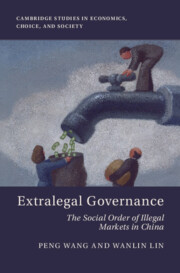
Drawing on insights from sociology and new institutional economics, Extralegal Governance provides the first comprehensive account of China's illegal markets by applying a socio-economic approach. It considers social legitimacy and state repression in examining the nature of illegal markets. It examines how power dynamics and varying levels of punishment shape exchange relationships between buyers and sellers. It identifies context-specific risks and explains how private individuals and organizations address these risks by developing extralegal governance institutions to facilitate social cooperation across various illegal markets. Adopting a multiple-case study design to sample China's illegal markets, this book utilizes four cases - street vending, small-property-rights housing, corrupt exchanges, and online loan sharks - to examine how market participants foster cooperation and social order in illegal markets.
United Nations peacekeeping is drifting from its post–Cold War liberal model toward a more sovereignty-focused approach. This essay posits that the change is not formal or doctrinal, but instead emerges through institutional drift and norm reinterpretation, driven by accelerated US retrenchment, China and Russia’s growing influence, host-state assertiveness, and internal United Nations adaptation. Drawing on theories of norm dynamics, bureaucratic culture, and empirical studies of peacekeeping mission practice, the analysis shows how liberal principles, such as democratization and human rights, are increasingly sidelined in favor of conflict containment and host-state support. The essay concludes by outlining four potential futures for peacekeeping: gradual drift into stabilization, normative fragmentation and regionalization, niche reaffirmation of liberalism, and formal norm redefinition. Together, these scenarios suggest peacekeeping is entering a postliberal era, marked not by collapse, but by contested adaptation within a shifting world order.
This chapter explores the varied facets through which conceptions of materialism manifest across the larger ecologies of literary production bundled under the rubric “African literature.” It deliberately treats both of these terms – materialism and literature – in their broadest senses. The chapter begins with a brief consideration of the various manifestations of materialism which have emerged in studies of African literature, reading materialism variously as critique (in its Marxist/socialist guise), aesthetic (what Zimblar and Etherington call the “materials” of world literature), and context (material worlds and worldings). The chapter then expands on these ideas through a set of literary-focused readings which draw on anglophone, francophone, and other African literatures, largely emphasizing the global circulations of the novel form from 1960 to the present day. This chapter finally concludes by looking at materialism through the twinned concepts of circulation and mediation, exploring the ways in which the material structures which allow a literature to “emerge,” in market terms, simultaneously impact the constitution of the African literary text and its publics.
This study sheds light on the diffusion of knowledge production as an institutional norm among central, development, and investment banks. It builds on an original database of 24,435 peer-reviewed scientific items published by a pool of 237 central banks, development banks, and investment banks from 1966 to 2023. The focus is on their interactive dynamics, analysed through a two-fold approach: Granger-Causality analysis for linear relationships and a multivariate Markov chain approach for non-linear interactions. Central banks emerge as leaders in scientific production, influencing development and investment banks. Results lead to further questions about inter-institutional agenda-setting, such as how central banks shape research priorities, the extent to which their intellectual leadership impacts others’ priorities, and the mechanisms through which institutional norms are diffused and reinforced within the global financial and policymaking landscape.
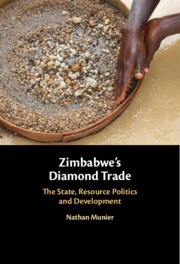
What happens when states experience a rapid increase in resource wealth? This book examines the significant diamond find in eastern Zimbabwe in 2006, possibly the largest in over 100 years, and its influence on the institutional trajectory of the country. Nathan Munier examines how this rapid increase in resource production shaped the policies available to political actors, providing a fresh understanding of the perpetuation of ZANU-PF rule and the variation in the trajectory of institutions in Zimbabwe compared to other Southern African states. This study places Zimbabwe amongst the overall population of resource-wealthy countries such as such as Angola, Botswana, Namibia and South Africa, especially those that experience a significant increase in production. In doing so, Munier contributes to the understanding of resource politics, political economy, and comparative African politics.
The introduction reviews the current debate concerning the origins of the industrial revolution in England, especially the institutionalist argument, its emphasis on property rights, and critical responses to it. In brief, the classic institutionalist argument is that the Glorious Revolution marked a significant improvement in the security of property rights, leading in turn to the Industrial Revolution a century later. The most common counter-argument is that property rights had been secure in England since the medieval period. Herein lies part of the significance of wardship for larger debates concerning the origins of the industrial revolution. If, as the book contends, wardship meant that property rights were much less secure than is now commonly supposed, this would go a long way to resuscitating classic institutionalist accounts of English/British institutional change in the seventeenth century and consequent economic development.
This chapter examines the policy influence of churches under autocratic and democratic regimes. The main analysis focuses on Zambia and Ghana, both of which have undergone numerous periods of democratization and autocratization. The chapter shows how liberal democratic institutions improve the ability of churches to accomplish their educational policy goals in these two countries and, suggestively, across sub-Saharan Africa more generally by giving churches greater influence over policymaking and protecting their agreements with the state.
The first half of this chapter surveys some of the tangible economic consequences of wardship – it increased the incidence of waste (that is asset-stripping of wards’ estate), increased the barriers to agricultural improvement and obstructed land transactions. The difficulty lies in presenting systematic evidence concerning this – ideally it would be possible to identify and attribute differences in agricultural productivity according to freehold tenure – some of which did entail wardship for underage heirs, namely ‘knight service’ and some of which did not, namely ‘socage’. But beyond a massive data collection exercise it is unclear how this could be achieved. Instead, as a proxy for productivity, the second half of this chapter presents evidence concerning land values. As one would expect, land held by socage sold at a 10% premium compared with land held by knight service.
Institutions of organization are designed to lower transaction costs. Transaction costs tend to be prohibitively high when large numbers of people would be required to engage in a transaction, so those transactions will not occur. Classic cases of externalities, such as when large numbers of people in an area suffer from air pollution from nearby industries, are good examples. Large numbers prevent those suffering from pollution from negotiating with those who are causing it. One way that market institutions deal with the problem of large numbers is to reduce those large number cases down to bilateral exchanges. With two parties engaged in transactions, transaction costs are lower, which facilitates mutually advantageous exchange. That works well for institutions of organization, but is difficult to apply to institutions of governance because one set of rules is designed for the entire population. Transaction costs are necessarily high, which means that only an elite few will be able to negotiate in the design of those institutions of authority and governance.
The conclusion returns to the book’s central argument – that wardship, the arbitrary burdens it imposed on those unfortunates ensnared, the wider economic costs ensuing, all while producing so little benefit to the Crown, was representative of the wider Stuart state. It is easy to envisage how a nascent industrial revolution might have been smothered by the Stuart fiscal state, perhaps via monopolies being awarded to undeserving favourites, or contracts and property rights being re-drawn to suit the perceived interests of the Crown. Ultimately, the conclusion will make the case that the industrial revolution could not have started in England during the eighteenth century, were it not for the constitutional changes of the seventeenth century.
Exchange within the political marketplace, just like the marketplace for goods and services, takes place within an institutional structure that lowers transaction costs to facilitate political exchange. One difference is that whereas institutional constraints in markets for goods and services typically are enforced by a third party – government – institutional constraints in the political marketplace are enforced by those who are constrained by them. This chapter discusses a variety of political institutions, and explains why those institutions, in general, are designed to enable the political elite to maintain their power against potential challengers. Recognizing the way that political institutions are designed to protect the power of the incumbent elite, the chapter concludes that the most important dimension of political competition is the competition between elites and challengers, not competition among parties.
The Desolate Boedelskamer was an innovative institution. It introduced a new approach to insolvency. Rather than punishing the insolvent debtor, the Desolate Boedelskamer sought to raise him up. Even though it remained firmly embedded in the early modern mental world and its communal culture of governance, the Amsterdam Desolate Boedelskamer is a clear example of how professionalization and good governance were able to provide systemic trust in a world of growing complexity. This new institution was part of the moral economy of seventeenth-century Amsterdam and relied upon it to function, but it also helped to shape that moral economy. Through a careful balancing act of trust and power, this institution was able to support the proliferation of credit, granting numerous insolvents in seventeenth-century Amsterdam a true stay of execution. In this analytical conclusion, the impact and wider implications of the book's argument will be discussed in a broader context.
This paper explores diversifying legislatures within a context of ethnonationalism, populism, and democratic erosion. Although diversity and inclusion are often viewed as symbols of democratization, research increasingly challenges this. In fact, diversity and inclusion can occur in tandem with democratic erosion—how so? How do minorities navigate hostile environments? To answer this question, I analyze how women politicians with intersecting identities strategically use their gendered and racialized identities. I conduct a qualitative study of four different women politicians in the Israeli Knesset—Miri Regev of Jewish Mizrahi [Moroccan] descent, Pnina Tamano-Shata of Jewish Ethiopian descent, Merav Michaeli of Jewish Ashkenazi [European] descent, and Aida Touma-Suleiman, a Palestinian-Israeli. I find that women will highlight the aspects of their identities that they believe will benefit them the most, resulting in their promotion of ethnonational divisions and reducing opportunities for solidarity among minority populations.