To save content items to your account,
please confirm that you agree to abide by our usage policies.
If this is the first time you use this feature, you will be asked to authorise Cambridge Core to connect with your account.
Find out more about saving content to .
To save content items to your Kindle, first ensure no-reply@cambridge.org
is added to your Approved Personal Document E-mail List under your Personal Document Settings
on the Manage Your Content and Devices page of your Amazon account. Then enter the ‘name’ part
of your Kindle email address below.
Find out more about saving to your Kindle.
Note you can select to save to either the @free.kindle.com or @kindle.com variations.
‘@free.kindle.com’ emails are free but can only be saved to your device when it is connected to wi-fi.
‘@kindle.com’ emails can be delivered even when you are not connected to wi-fi, but note that service fees apply.
The twelfth century witnessed an unprecedented scholarly effort to access and assimilate new corpora of knowledge by translating Greek as well as Arabic sources into Latin. This chapter surveys the various translations, discusses the role of those who mediated them to the Latin tradition, and finally focuses on the reception of the texts at the University of Paris during the first decades of the thirteenth century.
This article investigates the syntactic properties of deponents in finite and nonfinite contexts in several Indo-European languages (Vedic Sanskrit, Ancient Greek, Latin, Hittite, Modern Greek) and proposes a novel definition of deponency: deponents are morphologically nonactive verbs with noncanonical agent arguments that are merged below VoiceP. Since VoiceP is spelled out with nonactive morphology in those languages if it does not introduce an external argument itself, the result is a surface mismatch between morphological form and syntactic function. This proposal predicts that only certain nonfinite forms of deponents will surface with the syntax/morphology mismatch, namely, those that include VoiceP. Nominalizations without VoiceP will appear to suspend the voice mismatch. These predictions are shown to be correct with respect to the behavior of deponent participles in the languages under study.
An indisputable fact of life and of nature is that humans and human institutions necessarily both exist in and live through time. The importance of this fact and the conscious recognition of it is reflected in the concern for the passage of time and for humans' place vis-à-vis time observable in various sorts of artistic expression, from the visual arts such as sculpture and painting to various reflections in literary and even musical sources. Taking the arts as my point of departure, I first outline here and then contrast different views of time from within different domains and disciplines and from different vantage points, discussing in turn the artist's, the physicist's, the linguist's, and, ultimately, the ordinary speaker's view of time. I then contrast continuity across time with change across time, and illustrate continuity amidst change through an extended case study of the past-tense marker in Indo-European languages known as the ‘augment’, examining its stability and change throughout all of attested Greek, from Mycenaean Greek of the second millennium BC up through Modern Greek of the present day, with particular focus on its realization in certain regional dialects of the modern language. The augment thus provides an important object lesson in linguistic continuity and change, as it proves to be a remarkably durable but at the same time intriguingly elastic morpheme, at least as far as Greek is concerned. Since the view of time that I ultimately dwell on leads me to a consideration of time and history, I end with some observations on both the history of the field and my own personal history.
Veiling meant many things to the ancients. On women, veils could signify virtue, beauty, piety, self-control, and status. On men, covering the head could signify piety or an emotion such as grief. Late Roman mosaics show people covering their hands with veils when receiving or giving something precious. They covered their altars, doorways, shrines, and temples; and many covered their heads when sacrificing to their gods. Early Christian intellectuals such as Origen and Gregory of Nyssa used these everyday practices of veiling to interpret sacred texts. These writers understood the divine as veiled, and the notion of a veiled spiritual truth informed their interpretation of the bible. Veiling in the Late Antique World provides the first assessment of textual and material evidence for veiling in the late antique Mediterranean world. Susannah Drake here explores the relation between the social history of the veil and the intellectual history of the concept of truth as veiled/revealed.
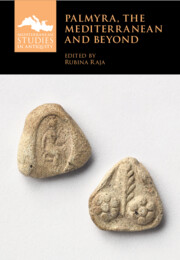
Palmyra is one of the most famous sites of the ancient world and played a major role in the overland trade between the Mediterranean and the East. This volume explores fascinating aspects of Palmyrene archaeology and history that underline the site's dynamic relations with the Roman world, whilst simultaneously acknowledging its extremely local nature. The chapters explore Palmyra as a site, but also Palmyrene society both at home and abroad – as travellers in the then known world and contractors and businesspeople as well as innovative political and military leaders of their time. They illuminate Palmyra's and Palmyrene society's negotiations, struggles, benefits and disadvantages from being part of the Roman Empire, situated on the fringes between the East and the West, and their use of this location to recreate themselves as a central power player – at least for a time – within a rapidly changing world.
The chapter is focused on the Palmyrene Tariff (CIS II.3913), a lengthy bilingual text in Aramaic and Greek promulgated in the city in AD 137 to regularize local taxation, i.e. taxes on goods entering and leaving the city which originate within its immediate vicinity, and on trades being plied within the city, not taxes on long-distance trade. Attention is given to the book on the Tariff by Ilia Sholeimovich Shifman, published in Russian in 1980 and republished in English in 2014, and to the publications of Michał Gawlikowski (2012, 2014) on the original location of the Tariff stone opposite a shrine devoted to Rab-Asīrē and close to the Agora. The respective roles of Greek and Aramaic are explored, including the question of which had priority in the drawing up of the Tariff. The sources and composition of the text are analysed with reference to the role played by earlier Roman authorities. A final section considers the position of tax collectors in Palmyrene society and the light which the Tariff can throw on life in Roman Syria.
Chapter 4 is in part an examination of a Mycenaean divine Potnia, one affiliated with the “labyrinth,” the Potnia of the dabúrinthos (δαβύρινθος). The labyrinthine space with which she is associated is an Asian cult notion introduced from Anatolia to Balkan Hellas. This chapter also examines the Rājasūya, a Vedic rite of consecration by which a warrior is made a king and a likely cult counterpart to the Mycenaean initiation of the wanaks.
Chapter 2 examines the Vedic sacrificial post called the yūpa and its role in ritual performances. A Mycenaean Greek cognate term and comparable ritual implement lies behind the Linear B form spelled u-po – that is, hûpos (ὗπος). Among other topics treated in this chapter are the Mycenaean deity called the po-ti-ni-ja, a-si-wi-ja, the Asian Potnia, and the u-po-jo po-ti-ni-ja, the Potnia of the u-po (that is, húpoio Pótnia [ὕποιο Πότνια]), a term matched exactly by Sanskrit patnī-yūpá-.
Chapter 6 examines Iranian cult and myth as evidenced in the Nart sagas of Transcaucasia, but also among Scythians as well as in Zoroastrian tradition, including the psychotropic cult substances Haoma (Iranian) and Soma (Indic). The Greek polis of Dioscurias in the Caucasus is explored as a place where Hellenic and Indo-Iranian divine-twin myth and cult affiliation meet, as indeed they do in the Pontic polis of Sinope. Aeolian connections are conspicuous at both locales.
While borrowing from most languages does not affect the structure of English word-formation, the number of Greek and Latin loans and new words based on them is so overwhelming that new types of word-formation are created. Because loans and English (or other European) uses of the patterns do not always provide the same outputs, and because classical elements can be added to English elements, the neoclassical formations are difficult to describe.
Chapter 7 examines the sheep’s fleece filter used in the preparation of Soma. A cult ideology in which such an implement played an important role was preserved for some time in Iranian tradition in the Caucuses, ultimately giving expression to Greek ideas about the presence of fleecy filters impinged with gold in the vicinity of Dioscurias – rationalizing accounts of the Golden Fleece of Aeolian Argonautic tradition. Particular elements of the Golden Fleece myth find parallels in Indic poetic accounts of the performance of Soma cult. The common Hellenic and Indic elements constitute a shared nexus of ideas that earliest took shape in Bronze-Age communities of admixed Mycenaean and Luvian populations into which Mitanni Soma ideas had spread via Kizzuwatna. The Golden Fleece mythic tradition, with its geographic localization in Transcaucasia, is a Mycenaean Asianism that took shape in Asia Minor under Indic and Iranian influences and that continued to evolve among the Iron-Age Asian Greeks.
Chapter 5 considers the Indic divine twins, the Aśvins (Aśvínā), or Nāsatyas (Nā́satyā), their association with the Indic Dawn goddess Uṣas, and their place in the Indic Soma cult. Discussion then shifts to the kingdom of Mitanni in Syro-Mesopotamia, a place into which Indic culture was introduced as Indo-Iranian peoples migrated southward through Asia, as also at Nuzi. There is good lexical evidence for the presence of a Soma cult in Mitanni, and Soma-cult ideas appear to have spread out of Mitanni, through Kizzuwatna, into the Luvian milieu of western Asia Minor, where such ideas would almost certainly have been encountered by resident Mycenaean Greeks, intermingled biologically, socially, culturally, and linguistically with Luvian populations. With that spread certain elements of Soma-cult ideology were mapped onto Anatolian cult structures.
Chapter 3 examines the Mycenaean wanaks and lāwāgetās, figures responsible for leading Mycenaean society in specific ways and who correspond notionally to figures implicit in Indic and Iranian social structures – figures who descend from still more ancient Indo-European antecedents charged with the task of leading society through the spaces of the Eurasian Steppes and in migrations southward out of the Steppes.
This book shows that the development of Greek chronicle writing from the fourth to the seventh century was not linear. Whilst the impact of the chronicle of Eusebius of Caesarea was great, subsequent writers corrected his errors and incorporated the third-century chronographies by Hippolytus and Julius Africanus into the framework shaped by Eusebius. As a consequence, chronographies and not chronicles dominate in Greek literature. One innovation of the fourth century was to link computus (the calculation of the Easter date) and chronography, first visible in the work of Andreas, brother of Magnus (352), and later in that of Annianus (412). The direct impact of Annianus has been overestimated: unique in some of its core ideas, his work resurfaced only in the 560s, in the context of Justinian’s attempt to impose the Christmas date of 25 December on the church of Jerusalem. This controversy caused a flurry of works of chronography and computus to be written in the early seventh century. Besides this tradition, the book also uncovers a tradition of chronicles with a local focus, which shaped the chronicle of John Malalas. We argue that the source indications of Malalas deserve more credit than they are usually granted.
This article argues that there are two different types of ‘past potential’ relevant to the Classical Greek tense and mood system. First, the past-tense indicative with ἄν can signal that a designated past event was once possible but not realized (retrospective root potential: ἐποίει ἄν ‘could have done’). Second, the optative with ἄν can express uncertainty about whether a designated past event actually occurred (retrospective epistemic potential: ποιοȋ ἄν ‘may have done’). While such usages are recognized in the traditional grammars, they have been dismissed in modern discussions. The article presents a detailed theoretical argument, backed up by both close readings of individual passages and broader discussions of corpus data, in favour of establishing these past potential usages as an integral part of Classical Greek grammar.
This study investigates cross-linguistic influence in bilingual children, examining whether activation of a bilingual’s other language or a structure from that language leads to differences in the magnitude of cross-linguistic influence. We triangulate evidence from both across-language and within-language priming experiments conducted with 36 Italian–Greek bilingual children aged 7 to 11. We designed the priming experiments to prime the verb-subject-object (VSO) word-order – an inappropriate structure in Italian but grammatical in Greek – following a VSO in Italian or in Greek. We observed a gradual increase in VSO production in Italian throughout the tasks, particularly in the across-language priming experiment. The results are discussed in terms of implicit learning mechanisms underlying priming and the connectedness of syntactic representations in bilingual grammar, supporting a model of cross-linguistic influence in which both structure and language activation play a role. Effects of age and dominance in Greek varied between the two priming conditions.
Shelley’s translation of Plato’s Symposium as The Banquet, composed with great speed over ten days in July 1818, radically transformed the poet’s thoughts on love, translation, originality, and ancient philosophy. Shelley became Shelley through Plato. Rather than an arbiter of forms and banisher of poets from his ideal republic, Shelley’s Plato is himself a poet, as he claims in ‘A Defence of Poetry’. Through his reading and translation of the ancients – and particularly Plato – philosophy and poetry become concomitant for Shelley. Ultimately, Shelley is indebted to the philosopher’s use of literary forms over any straightforward adoption of his philosophy of forms. This chapter looks before and after Shelley’s translation of Plato’s Symposium to trace the poet’s reading of the ancients from 1812 until his accidental death in 1822, revealing the lasting, shifting influence of ancient philosophy on Shelley’s poetry.
Teaching ancient literature in translation is increasingly common across schools and universities; however, there has been limited discussion of pedagogical approaches towards, specifically, translated literature. I discuss the findings of a study conducted on first-year undergraduates at Oxford University, who analysed translations of the Iliad as part of a taught course. The publication of Wilson (2023) offers an opportunity to see how students respond to very recent translations. I explore the pitfalls students encounter when analysing poetry in translation and the ways educators, whether in high schools or universities, can help students negotiate these pitfalls and develop a more sophisticated understanding of literary translation. In particular, I discuss how a student’s level of familiarity with the Greek language affects the ways they analyse translations, and how educators can encourage students with little or no Greek to engage with translations successfully.
This chapter reviews the ancient Greek, Roman and Jewish evidence to discern the marriage practices the early Christians would have known. It lays the foundation for tracing the antiquity of customs attested in the later Byzantine sources. In addition to ancient texts, this chapter examines Roman artistic depiction of marriage in frescoes and funerary art.
All his life, Hopkins was either student or teacher of the Classics. School, university, teaching posts, and finally a professorship in Dublin meant that he was engaged professionally with Latin and Greek almost without intermission. There are subjects, topics, or words in his writings which obviously derive directly from those studies, and there are approaches which were plainly learned from his experience. Specific examples of influence are betrayed by words and ideas, but the influence is perhaps more general; in word order, for example, or in the idea of poetry as speech, which connects with his discovery and use of Sprung Rhythm. His understanding of rhythm is the most important thing which his classical studies nurtured. In his university training and in his own teaching rhythm was a central concern. The Classics gave him models to follow, but they also freed him from some conventions of English poetry, which allowed him to write in an original style.