To save content items to your account,
please confirm that you agree to abide by our usage policies.
If this is the first time you use this feature, you will be asked to authorise Cambridge Core to connect with your account.
Find out more about saving content to .
To save content items to your Kindle, first ensure no-reply@cambridge.org
is added to your Approved Personal Document E-mail List under your Personal Document Settings
on the Manage Your Content and Devices page of your Amazon account. Then enter the ‘name’ part
of your Kindle email address below.
Find out more about saving to your Kindle.
Note you can select to save to either the @free.kindle.com or @kindle.com variations.
‘@free.kindle.com’ emails are free but can only be saved to your device when it is connected to wi-fi.
‘@kindle.com’ emails can be delivered even when you are not connected to wi-fi, but note that service fees apply.
The Boer armies turned to guerrilla warfare in the second half of 1900 because they could not hold ground in the face of British military power, but were unwilling to give up their fight for independence. An emerging generation of Boer leaders – prominent among them Christiaan De Wet, Kroos de la Rey and Jan Smuts – recognised the tactical strengths of their commandos and the potential they had for continuing resistance. Using their superior mobility, knowledge of the countryside, and intelligence networks, commandos could identify when and where to strike before rapidly evading the British response. De Wet’s operations in mid-1900 demonstrated that such operations could rise above being mere irritations and seriously disrupt British operations. Gradually, a new path to victory emerged in Boer minds: by continuing to resist within the now annexed Republics and spreading the war to the Cape and Natal, the commandos could exhaust British willingness to continue and give the Republics an upper hand during any peace negotiations.
Charles Frederick Cox returned home from South Africa on 3 October 1902. That this was months after his own regiment, 3NSWMR was because Cox had been sent to London to participate in Coronation duties for King Edward VII. While there he was both permanently promoted to Lieutenant Colonel and made a Companion of the Order of the Bath. Just as he had done upon arrival in South Africa, on his return to Sydney Cox delivered some remarks to reporters waiting dockside. ‘Lieutenant Colonel Cox does not think there will be any more trouble in the Transvaal or Cape Colony’, the Sydney Morning Herald reported, ‘but if more fighting takes place he is ready for more either there or elsewhere.’
At the heart of the bushman-soldier myth was combat. The skills of the bush – riding, shooting, living off the land, the innate intelligence of ‘the colonial’ – were valuable because they could deliver success on the battlefield. The bushmen would ‘be able to meet stratagem by stratagem’, as civilian advocate H. S. Stockdale crowed, and be ‘just as likely to stalk “the Boer” as the Boers to stalk them.’ Like many civilian enthusiasts Stockdale conceived of the Australians as auxiliaries to a British regular force, serving as scouts and skirmishers on the fringes of the battle. Military men were under no such illusions: the Australian contingents would do everything mounted rifles were expected to, from ersatz cavalry work to seizing and holding ground. Both groups, however, shared a confidence in their ideas. ‘As Australians have shown themselves in the fields of sport,’ Stockdale declared, ‘so I feel will they prove themselves on the field of battle.’
The war that began in October 1899 was not the first time Britain and the Boer Republics had clashed. The Free State and the Transvaal Republic were the fruit of the great trek (Voortrek), the mass exodus of Boers from southern Africa’s coastal regions in the 1830s that was prompted by British conquest of the region 20 years earlier. In 1877 the British annexed the two states; in 1880 the burghers rebelled. Their victory in 1881 led to a negotiated treaty that restored Boer independence while giving Britain a degree of control over their external affairs. What followed was what Bill Nasson has characterised as a ‘nervous stability’, as both sides regarded each other with suspicion but worked to avoid a renewal of hostilities while balancing their own interests.
When Australians woke on the morning of 13 October 1899 to headlines announcing war had broken out in South Africa, it must have come as little surprise. Since the collapse of talks between the Transvaal and Britain in June, war had seemed increasingly likely. The failure of these talks had prompted discussion, both in London and Australia, of the possibility of Australian contingents being raised and sent to South Africa in the event of war. A meeting between the six colonial commandants in late September to mastermind the raising of a united Australian contingent force collapsed in intercolonial bickering, but this proved only a minor speed bump. By the time the Boer ultimatum that made war inevitable was delivered on October 9 four of the six colonies had already received requests from London for troops, and the proposition was being openly debated in colonial parliaments. While there was vocal opposition from a minority, all six colonies ultimately agreed to send contingents to South Africa. It would be a small commitment for what was expected to be a short war.
On the evening of 12 June 1901, Private C.A. Salmon of the 5th Victorian Mounted Rifles was making himself comfortable at the end of a long day’s trek. The left wing of 5VMR, part of a detachment under the command of Major Morris, had camped near a farm called Wilmansrust in the eastern Transvaal. Mail had arrived from home, fuel was readily available, and the rum ration had been dispensed. Spirits within the bivouac of the column were high. Yet, as Salmon lay down to read the newspapers sent from home, a shot rang out, followed closely by a series of volleys. Around 100 men from the Middelburg Commando had succeeded in moving past the camp’s outlying pickets undetected and were attacking. Salmon emerged into the darkness and was immediately wounded in the face; when he recovered he found himself face-to-face with one of the attackers, who called him a British cow and demanded he put his hands up. Salmon complied; so too did the survivors. Fourteen Victorians had been killed and 46 wounded, of whom a further four would eventually succumb. The entire engagement had lasted around 15 minutes.
Over 15,000 individual Australians served in contingents in South Africa and at least 600 died. While it was quickly overshadowed by the First World War, it was nonetheless an important part of Australia’s military history. Australian soldiers were sent in the belief that they possessed certain qualities that would make them valuable on the battlefield. It was an idea that, in various forms, would continue to surface throughout the first half of the twentieth century. What follows is an analysis that not just dispels this myth but shows what it can tell us about war more generally.
In early December 1900, the New South Wales Imperial Bushmen finished a day of marching in the western Transvaal and made camp. A storm was brewing, and just before midnight it broke. Troopers woke to a downpour that quickly soaked through their blankets, their uniforms and their food. The ground turned to mud and horses began to break their lines and escape. Exhausted from trekking and now unable to sleep, the New South Welshmen began to try and restore order in the camp. Amidst the confusion and misery, one helpful soldier began a sarcastic rendition of the song “Soldiers of the Queen.”’
Trying to destroy the commandos in the field was one half of Kitchener’s strategy. The other was the destruction of farms and the removal of civilian populations from rural areas to camps close to the British-controlled central railroad. This was designed to deny the commandos access to food and intelligence, but also to act as a threat: continued resistance meant denial of access to family and destruction of virtually everything a burgher owned.
It was not a radical departure from British practice but an evolution and consolidation of what had occurred over the previous 12 months. From the outset of the invasion of the two Republics, the British had considered forms of collective punishment valid for what they saw as illegitimate military actions. This policy had always been chaotically implemented, clashing as it did with a recognition that the conquered populations would have to be governed and so needed to be courted. Perhaps more importantly the shambolic state of British logistics meant during the invasion units lived off the land and rarely fulfilled their obligations to pay for what they took. By the end of 1900, the precedent for large-scale destruction as a tool of war had been well and truly set.
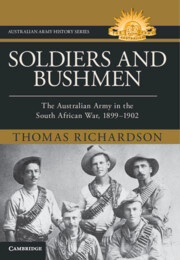
Soldiers and Bushmen: The Australian Army in South Africa, 1899–1902 examines the commitment to what was expected to be a short war. It presents a thematic, analytical history of the birth of the Australian Army in South Africa, while exploring the Army's evolution from colonial units into a consolidated federal force. Soldiers and Bushmen investigates the establishment of the 'bushmen experiment' – the belief that the unique qualities of rural Australians would solve tactical problems on the veldt. This, in turn, influenced ideals around leadership, loyalty and traditional combat that fed the mythology of the Australians as natural soldiers. The book also examines the conduct of the war itself: how the Army adapted to the challenges of a battlefield transformed by technology, and the moral questions posed by the transition to fighting a counterinsurgency campaign.
Bushmen’ or ‘San’ are not one ethnic group. They are several, speaking a diversity of languages, having many different settlement patterns and kinship systems, and even possessing a variety of economic practices. Yet we think of them as a unity. This is not as strange as it may seem, for all such groups share a common origin as an original hunting-and-gathering population (or populations) of southern Africa. Diversity includes biological difference, linguistic affiliation and so on. Even what we call them reflects a kind of diversity. Many experts, especially in archaeology, call them ‘San’, a term derived from the word saan or sān (common gender plural) in Khoekhoe dialects. It occurs in no Bushman or San language, whereas other experts prefer to use Bushmen or Basarwa, and a few have used Kua or even N/uakhoe (literally, ‘red people’). Kua is the preferred generic term in a few languages, and Red People is a fairly common self-description in some. Etymologically though, each of these terms is problematic. This introductory chapter will explore these issues and look forward to general themes in the book.
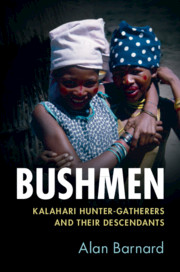
The hunter-gatherers of southern Africa known as 'Bushmen' or 'San' are not one single ethnic group, but several. They speak a diverse variety of languages, and have many different settlement patterns, kinship systems and economic practices. The fact that we think of them as a unity is not as strange as it may seem, for they share a common origin: they are an original hunter-gatherer population of southern Africa with a history of many thousands of years on the subcontinent. Drawing on his four decades of field research in Botswana, Namibia and South Africa, Alan Barnard provides a detailed account of Bushmen or San, covering ethnography, archaeology, folklore, religious studies and rock-art studies as well as several other fields. Its wide coverage includes social development and politics, both historically and in the present day, helping us to reconstruct both human prehistory and a better understanding of ourselves.
Recommend this
Email your librarian or administrator to recommend adding this to your organisation's collection.